Peanl industry weathers the storm
pp. 46-47 · Read in the full issue
Business
By Florence Syme-Buchanan
THE Cook Islands’ flour
ishing pearl industry took
a vicious beating from Cyclone Martin in November - broken, but not out, a comeback of greater proportions is planned.
The Cook Islands is one relieved nation - 90 per cent of pearl farms lying up to 30 feet underwater in Manihiki lagoon were untouched by the gale. Expected harvests from Manihiki, the country’s main pearl supplier could reap between $8 million to $9 million in the next two years, estimates Marine Resources Secretary Raymond Newnham. It’s money that the Cook
Islands desperately needs. Each oyster spat will contribute towards bringing the bat tered Cook Islands economy back on track as the pearl industry is second only to tourism as a major player in rebuilding the country.
Initial fears that the 46-square mile lagoon would be contaminated by house hold debris and vegetation tossed into it by Cyclone Martin may be unfounded.
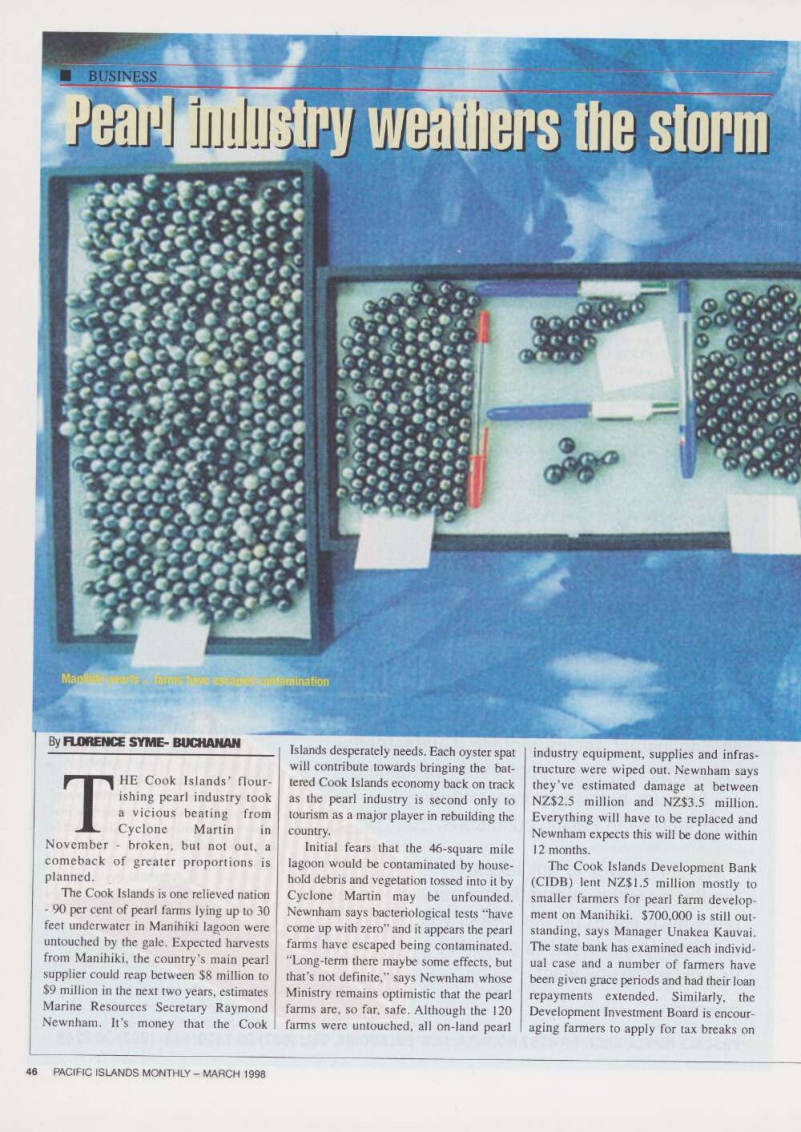
Newnham says bacteriological tests “have come up with zero” and it appears the pearl farms have escaped being contaminated.
“Long-term there maybe some effects, but that’s not definite,” says Newnham whose Ministry remains optimistic that the pearl farms are, so far, safe. Although the 120 farms were untouched, all on-land pearl
industry equipment, supplies and infras tructure were wiped out. Newnham says they’ve estimated damage at between NZ$2.5 million and NZ$3.5 million.
Everything will have to be replaced and Newnham expects this will be done within 12 months.
The Cook Islands Development Bank (CIDB) lent NZ$l.5 million mostly to smaller farmers for pearl farm develop ment on Manihiki. $700,000 is still out standing, says Manager Unakea Kauvai.
The state bank has examined each individ ual case and a number of farmers have been given grace periods and had their loan repayments extended. Similarly, the Development Investment Board is encour aging farmers to apply for tax breaks on
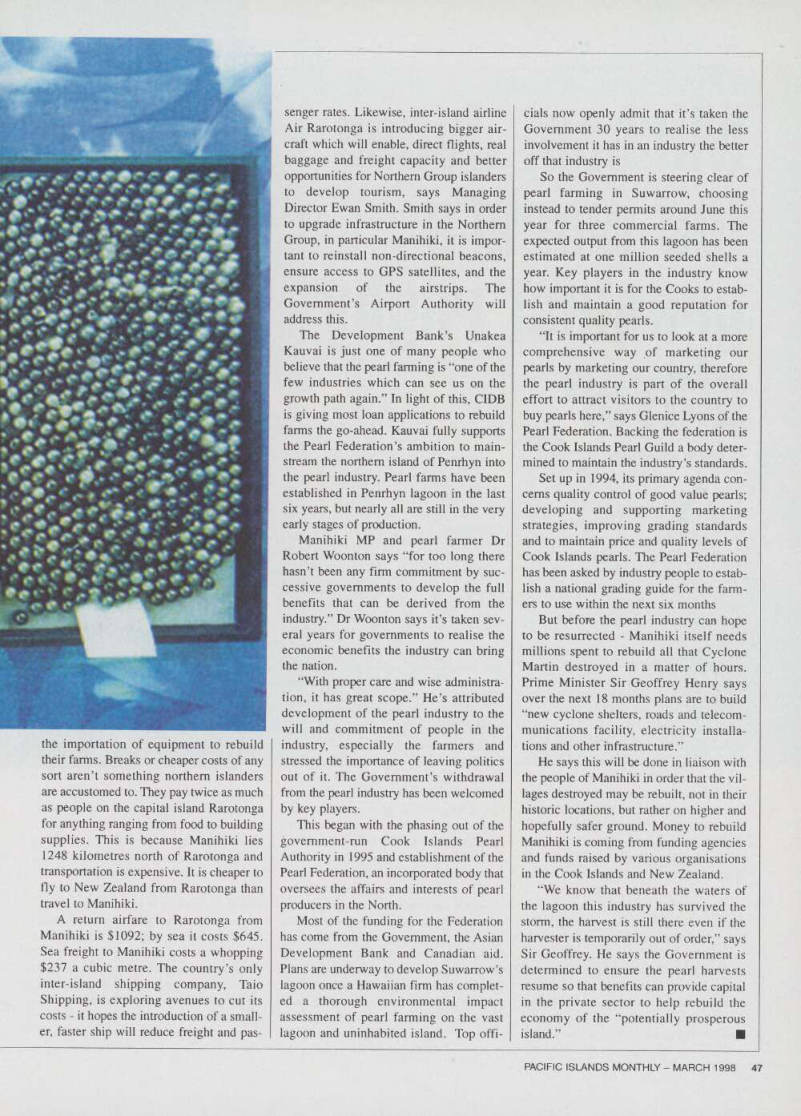
Manhiki pearls... farms have escaped contamination
the importation of equipment to rebuild their farms. Breaks or cheaper costs of any sort aren’t something northern islanders are accustomed to. They pay twice as much as people on the capital island Rarotonga for anything ranging from food to building supplies. This is because Manihiki lies 1248 kilometres north of Rarotonga and transportation is expensive. It is cheaper to fly to New Zealand from Rarotonga than travel to Manihiki.
A return airfare to Rarotonga from Manihiki is $1092; by sea it costs $645.
Sea freight to Manihiki costs a whopping $237 a cubic metre. The country’s only inter-island shipping company, Taio Shipping, is exploring avenues to cut its costs - it hopes the introduction of a small er, faster ship will reduce freight and pas
senger rates. Likewise, inter-island airline
Air Rarotonga is introducing bigger air
craft which will enable, direct flights, real
baggage and freight capacity and better
opportunities for Northern Group islanders to develop tourism, says Managing Director Ewan Smith. Smith says in order to upgrade infrastructure in the Northern Group, in particular Manihiki, it is impor tant to reinstall non-directional beacons, ensure access to GPS satellites, and the expansion of the airstrips. The Government’s Airport Authority will address this.
The Development Bank’s Unakea Kauvai is just one of many people who believe that the pearl farming is “one of the few industries which can see us on the growth path again.” In light of this, CIDB is giving most loan applications to rebuild farms the go-ahead. Kauvai fully supports the Pearl Federation’s ambition to main stream the northern island of Penrhyn into the pearl industry. Pearl farms have been established in Penrhyn lagoon in the last six years, but nearly all are still in the very early stages of production.
Manihiki MP and pearl farmer Dr Robert Woonton says “for too long there hasn’t been any firm commitment by suc cessive governments to develop the full benefits that can be derived from the industry.” Dr Woonton says it’s taken sev eral years for governments to realise the economic benefits the industry can bring the nation.
“With proper care and wise administra tion, it has great scope.” He’s attributed development of the pearl industry to the will and commitment of people in the industry, especially the farmers and stressed the importance of leaving politics out of it. The Government’s withdrawal from the pearl industry has been welcomed by key players.
This began with the phasing out of the govemment-run Cook Islands Pearl Authority in 1995 and establishment of the Pearl Federation, an incorporated body that oversees the affairs and interests of pearl producers in the North.
Most of the funding for the Federation has come from the Government, the Asian Development Bank and Canadian aid.
Plans are underway to develop Suwarrow’s lagoon once a Hawaiian firm has complet ed a thorough environmental impact assessment of pearl farming on the vast lagoon and uninhabited island. Top offi
cials now openly admit that it’s taken the Government 30 years to realise the less involvement it has in an industry the better off that industry is So the Government is steering clear of
pearl farming in Suwarrow, choosing
instead to tender permits around June this year for three commercial farms. The expected output from this lagoon has been estimated at one million seeded shells a year. Key players in the industry know how important it is for the Cooks to estab lish and maintain a good reputation for consistent quality pearls.
“It is important for us to look at a more comprehensive way of marketing our pearls by marketing our country, therefore the pearl industry is part of the overall effort to attract visitors to the country to buy pearls here,” says Glenice Lyons of the Pearl Federation. Backing the federation is the Cook Islands Pearl Guild a body deter mined to maintain the industry’s standards.
Set up in 1994, its primary agenda con cerns quality control of good value pearls; developing and supporting marketing
strategies, improving grading standards
and to maintain price and quality levels of Cook Islands pearls. The Pearl Federation has been asked by industry people to estab lish a national grading guide for the farm ers to use within the next six months But before the pearl industry can hope to be resurrected - Manihiki itself needs millions spent to rebuild all that Cyclone Martin destroyed in a matter of hours.
Prime Minister Sir Geoffrey Henry says over the next 18 months plans are to build “new cyclone shelters, roads and telecom
munications facility, electricity installa
tions and other infrastructure.”
He says this will be done in liaison with the people of Manihiki in order that the vil lages destroyed may be rebuilt, not in their historic locations, but rather on higher and hopefully safer ground. Money to rebuild Manihiki is coming from funding agencies and funds raised by various organisations in the Cook Islands and New Zealand.
“We know that beneath the waters of the lagoon this industry has survived the storm, the harvest is still there even if the harvester is temporarily out of order,” says Sir Geoffrey. He says the Government is determined to ensure the pearl harvests resume so that benefits can provide capital in the private sector to help rebuild the economy of the “potentially prosperous island.” ■