Sweatshops or model factories?
pp. 43-45 · Read in the full issue

Labour
Marianas labour laws under the microscope
By Susan Prokop
Tourist arrivals dip 17 per cent”, read the headline in the December 4, 1997 Marianas Variety. “They Came. They Saw. They Golfed” read another headline in the January 20, 1998 New York Times about U.S.
Congressional visits to the Marianas.
Were Members of Congress trying to bolster an important part of the territory’s economy? Not exactly. A spate of Congressional visitors to CNMI through out 1997 was just part of the well-funded campaign by the government of CNMI to stop legislation to extend U.S. immigration and minimum wage laws to the Marianas.
Over the past year, U.S. critics of CNMI immigration and labour policies stepped up their attempts to toughen territory stan dards in these areas [see PIM July 1997], Fighting back, the CNMI government brought to the islands at its own expense seven members of Congress, their fami lies, and over 75 staff members. The total tab for these trips has been put at well over $500,000.
This is in addition to the $l.l million a year the CNMI government spent to retain legal and lobbying representation in the nation’s capital.
Most of those making the trip to CNMI have been Republican representatives and staffers. This reflected astute political cal culations by CNMI’s leaders since Republicans hold the majority in Congress.
Thus, they have the power to advance or stop legislation of interest to the territo ry. The most notable of these GOP visitors was Congressman Tom DeLay of Texas, who is third in seniority among the leader ship in the House of Representatives.
On a visit to CNMI over the December Congressional holiday recess, DeLay was feted by outgoing Governor Froilan Tenorio, who was defeated for re-election by Pedro Tenorio.
Froilan Tenorio had been an outspoken opponent of U.S. efforts to change immi gration and labour policy in CNMI. DeLay also attended a dinner sponsored by Hong Kong magnate, Willie Tan, whose garment factories have been fined millions of dol lars by the U.S. Labor Department for numerous violations of worker health and
safety standards.
Among the staffers making the trek to CNMI in 1997 was Colin Chapman, an aide to GOP Congressman Don Young of Alaska, the chairman of the House Natural Resources Committee, which has jurisdic tion over the Marianas. Chapman’s group met with representatives from the CNMI Department of Labor and Immigration, the governor’s office and the legislature.
According to Chapman, they toured factories with “good records and not-so good records.” One facility, whose name he could not recall, had been fined by DoLI but was in the process of imolementing an
improvement plan.
Chapman said, “this showed to us a
willingness to make improvements and get up to standards.” He reported that the Congressional staffers and Marianas offi cials talked about the islands’ economy and its dependence on Asian tourism and the
garment industry.
Chapman cautioned against any changes that could adversely affect the strong CNMI economy and which might ultimately affect U.S. taxpayers.
“If that’s taken a\yay, [i.e. the income CNMI derives from foreign factories that use guest worker labour] it will have to be replaced by Uncle Sam”, implying that the federal treasury is actually saving money by allowing CNMI to operate as it always has.
The funds expended by CNMI have apparently been money well spent. DeLay assured his generous hosts that efforts to impose U.S. minimum wage laws and immigration controls would go nowhere as long as he was in the Congressional lead ership. Impressed by his tour of Willie Tan’s factories, DeLay was quoted in Pacific Daily News complimenting the conditions of one facility which, “although by U.S. mainland standards could be criti cised, are very clean.”
Referring to descriptions of Marianas factories as debilitating sweatshops, DeLay added, “and the air conditioning surprised me. I didn’t see anybody sweat ing.”
Although Marianas and Congressional
spokesmen insisted that the delegations received thorough briefings on labour con ditions in CNMI, one staffer said to an
Illinois paper, the National News Reporter, “I’m sure I only saw the things they thought it wise to show me.”
According to a report in the Congressional newspaper, Roll Call, Senate staffers on one trip had asked to meet with human rights advocates critical of the Marianas government but “were informed by CNMI officials that the activists did not return their phone calls
seeking an appointment.”
Yet, the glowing picture painted by DeLay and some GOP staffers contrasts from the experiences of other lawmakers and continuing press reports of labour problems in the Marianas.
Recent reports in The Marianas Variety and other local papers recount tales of worker mistreatment and exploitation. In December, five Chinese women filed charges in Saipan’s federal court claiming
they were forced into prostitution by man agers of a nightclub where they worked as hostesses.
Late last year, the U.S. Labor Department filed suit on behalf of several non-resident employees who were denied promised overtime compensation by the Marianas Star Corporation.
According to a National Journal editori al, China, Sri Lanka and other Asian and Pacific nations have continued to lodge complaints with the Clinton administration over the poor treatment of their immigrant workers by CNMI employers.
These stories were reinforced by the U.S. Commission on Immigration Reform which issued a report in January criticising immigration procedures and policies in the Marianas.
Noting that 90 per cent of private sector workers in CNMI are foreign contract
labourers, with “few rights” and “subject to serious labour and human rights abus es”, the Commission said “only a few countries, and no democratic society, have immigration policies” like the Marianas.
The closest equivalent is Kuwait.”
In his interview with PIM, Colin Chapman was reminded about the percent age of private sector jobs held by foreign ers and the fact that CNMI citizens are clustered largely in government jobs because wages in the private sector are so low.
U.S. Republican party dogma insists that private sector employment is prefer able to public sector work and government employment should be reduced whenever possible.
Didn’t it seem ironic for Republican officials to be supporting CNMI policies that drive its citizens into government
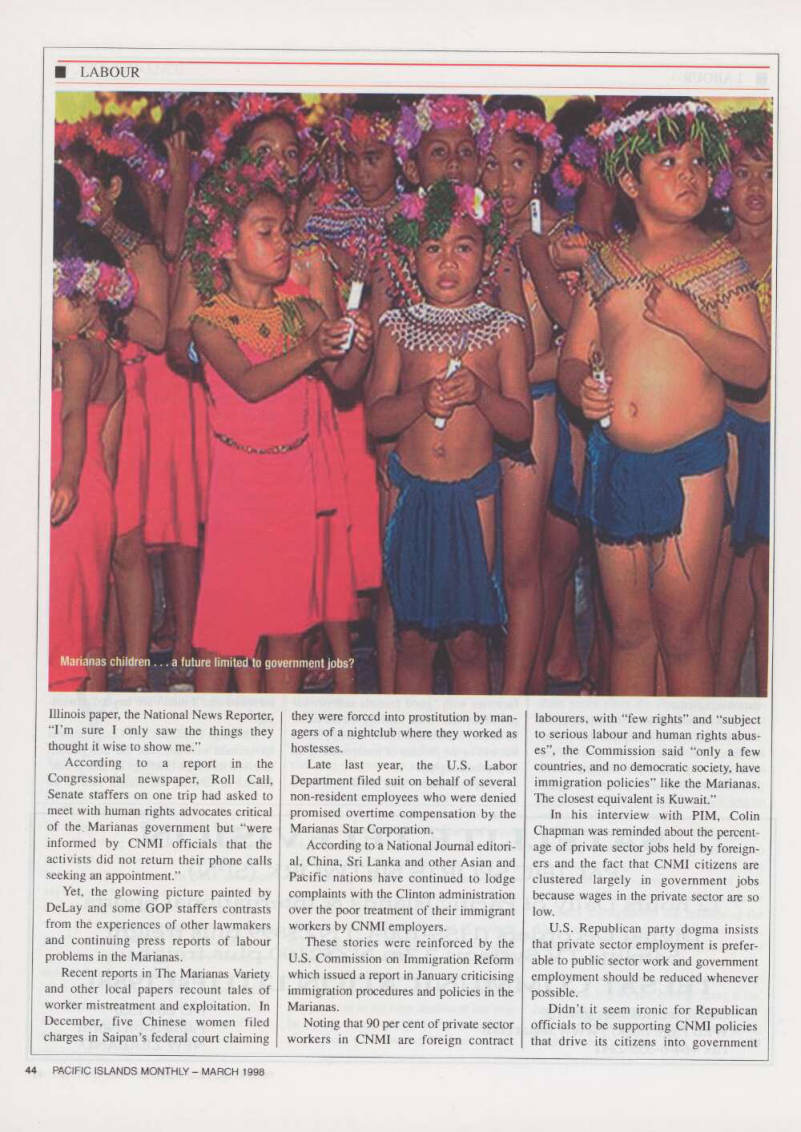
Marianas children ... a future limited to government jobs?
jobs? Chapman replied that such a ques tion was “getting a little complicated twisting things around.
“The interest of the people in CNMI is in growing their economy and lessening their dependence on federal support. It’s a different culture down there than what we have in the U.S. You may be comparing apples and oranges.”
After a January trip to CNMI for the inauguration of Pedro Tenorio,
Congressman George Miller, [D-
Califomia] author in the House of Representatives of the Marianas Reform Bill, came away with a somewhat different perspective than his GOP counterparts.
Travelling at U.S., not CNMI expense, the California Democrat and two staffers spent five days in the Commonwealth meeting with members of the legislature, the new Governor, representatives of the business community, and federal labour and law enforcement officials.
In talks with the new government about worker rights, immigration and law enforcement, Miller said officials “impressed me with their understanding of the extent of the problems and their com
mitment to decisive action.”
Nevertheless, Miller remained “deeply troubled about the ability of the Commonwealth-run immigration system to protect foreign workers from exploita tion, abandonment and fraud.”
His scepticism stemmed from several meetings with church leaders and human rights advocates and guest workers fearful to come forward publicly with their charges.
In scenes reminiscent of a spy novel.
Miller’s group found notes slipped under their hotel doorways inviting them to clan destine night-time meetings where they heard of continued abuse of vulnerable immigrants.
These rendezvous introduced the U.S. visitors to Bangladeshis defrauded of their savings by “job brokers” and left jobless and forced to beg for survival.
Several Philippines women told of being kept in locked compounds and deprived of their legal entry documents by their employers. Commenting on these experiences, Miller said, “I have visited barracks.
I have talked late into the night in
churches with destitute and frightened men and women, thousands of miles from their homes, who are victims of this system.”
Statements by U.S. and Marianas offi cials after the January discussions were conciliatory. Gov. Pedro Tenorio has promised a less confrontational stance in dealing with the United States than his pre decessor, Froilan. And, Congressman Miller acknowledged that some factory owners “are committed to operating responsible businesses that treat their employees with dignity.”
However, Miller still insists that prob lems in the immigration system must be dealt with quickly.
As senior Democrat on the House Resources Committee, Miller will release a report on his trip later this spring to keep the issue of CNMI reform alive. Despite declarations by Tom DeLay and other Republican leaders to the contrary, George Miller says he will continue pressing to restore integrity to the immigration and labour systems in the Marianas.
Said Miller, “as we say, justice delayed is justice denied, and additional delays are intolerable.” ■