Red sky in the morning
pp. 53-54 · Read in the full issue
Yachting
By Sally Andrew
Fellowship departed Vava’u
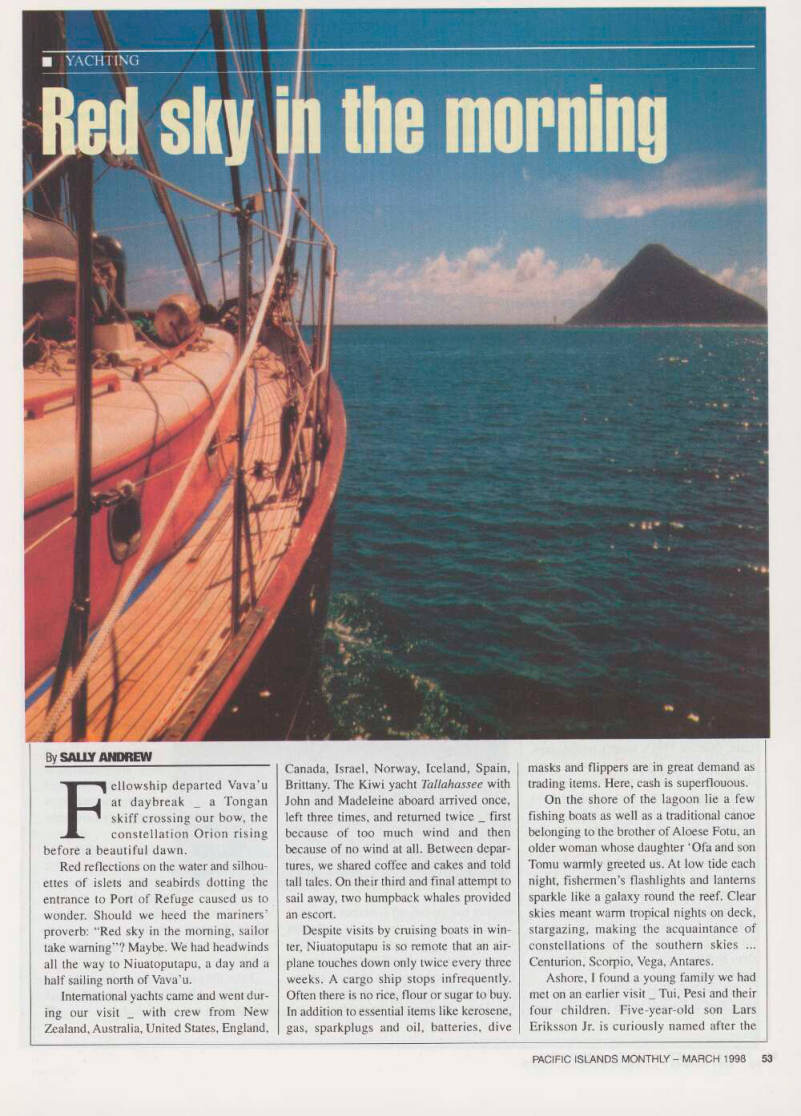
at daybreak a Tongan skiff crossing our bow, the constellation Orion rising before a beautiful dawn.
Red reflections on the water and silhou ettes of islets and seabirds dotting the entrance to Port of Refuge caused us to wonder. Should we heed the mariners’ proverb: “Red sky in the morning, sailor take warning”? Maybe. We had headwinds all the way to Niuatoputapu, a day and a half sailing north of Vava’u.
International yachts came and went dur ing our visit with crew from New Zealand, Australia, United States, England,
Canada, Israel, Norway, Iceland, Spain, Brittany. The Kiwi yacht Tallahassee with John and Madeleine aboard arrived once, left three times, and returned twice first because of too much wind and then because of no wind at all. Between depar tures, we shared coffee and cakes and told tall tales. On their third and final attempt to sail away, two humpback whales provided an escort.
Despite visits by cruising boats in win ter, Niuatoputapu is so remote that an air plane touches down only twice every three weeks. A cargo ship stops infrequently.
Often there is no rice, flour or sugar to buy.
In addition to essential items like kerosene, gas, sparkplugs and oil, batteries, dive
masks and flippers are in great demand as trading items. Here, cash is superflouous.
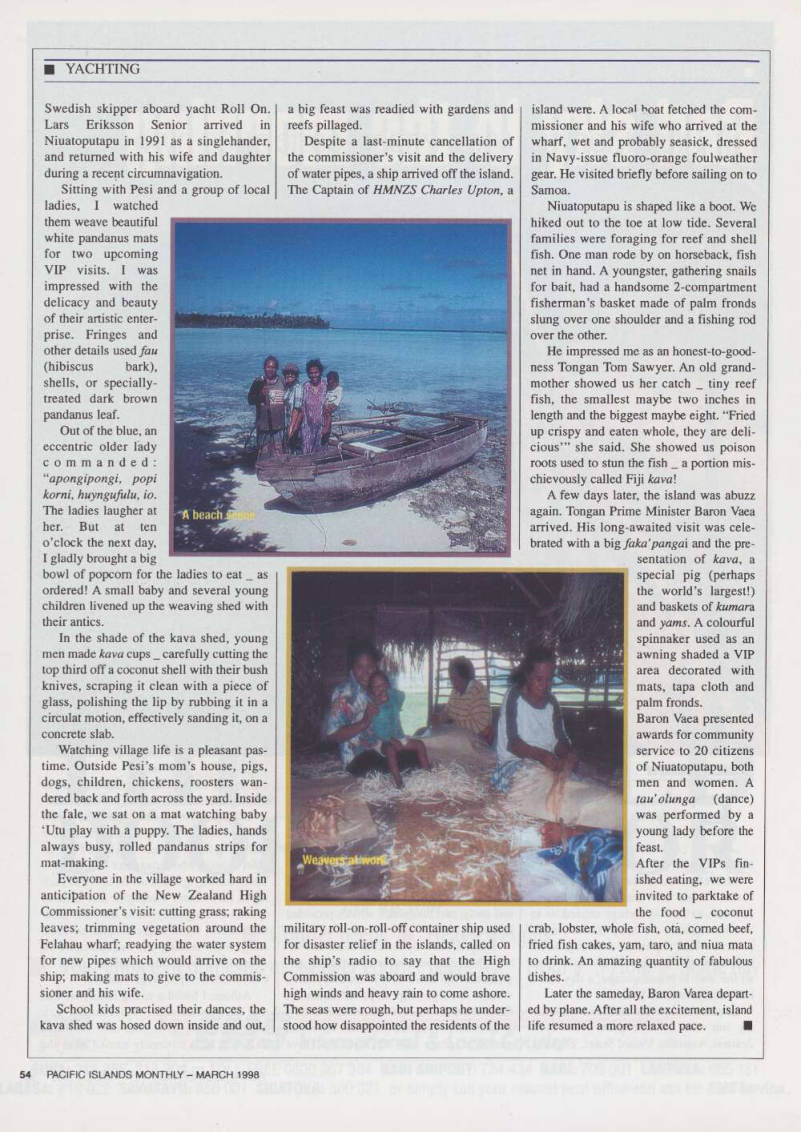
On the shore of the lagoon lie a few fishing boats as well as a traditional canoe belonging to the brother of Aloese Fotu, an older woman whose daughter ‘Ofa and son Tomu warmly greeted us. At low tide each night, fishermen’s flashlights and lanterns sparkle like a galaxy round the reef. Clear skies meant warm tropical nights on deck,
stargazing, making the acquaintance of
constellations of the southern skies ...
Centurion, Scorpio, Vega, Antares.
Ashore, I found a young family we had met on an earlier visit Tui, Pesi and their four children. Five-year-old son Lars Eriksson Jr. is curiously named after the
Swedish skipper aboard yacht Roll On.
Lars Eriksson Senior arrived in Niuatoputapu in 1991 as a singlehander, and returned with his wife and daughter
during a recent circumnavigation.
Sitting with Pesi and a group of local ladies, I watched
them weave beautiful white pandanus mats for two upcoming VIP visits. I was impressed with the delicacy and beauty of their artistic enter prise. Fringes and other details used fau (hibiscus bark), shells, or specially treated dark brown pandanus leaf.
Out of the blue, an eccentric older lady commanded: u apongipongi, popi korni, huyngufulu, io.
The ladies laugher at her. But at ten o’clock the next day, I gladly brought a big
bowl of popcorn for the ladies to eat as ordered! A small baby and several young children livened up the weaving shed with their antics.
In the shade of the kava shed, young men made kava cups carefully cutting the top third off a coconut shell with their bush knives, scraping it clean with a piece of glass, polishing the lip by rubbing it in a circulat motion, effectively sanding it, on a concrete slab.
Watching village life is a pleasant pas time. Outside Pesi’s mom’s house, pigs, dogs, children, chickens, roosters wan dered back and forth across the yard. Inside the fale, we sat on a mat watching baby ‘Utu play with a puppy. The ladies, hands
always busy, rolled pandanus strips for
mat-making.
Everyone in the village worked hard in anticipation of the New Zealand High Commissioner’s visit: cutting grass; raking leaves; trimming vegetation around the Felahau wharf; readying the water system for new pipes which would arrive on the ship; making mats to give to the commis sioner and his wife.
School kids practised their dances, the kava shed was hosed down inside and out,
a big feast was readied with gardens and reefs pillaged.
Despite a last-minute cancellation of the commissioner’s visit and the delivery of water pipes, a ship arrived off the island.
The Captain of HMNZS Charles Upton, a
military roll-on-roll-off container ship used for disaster relief in the islands, called on the ship’s radio to say that the High Commission was aboard and would brave high winds and heavy rain to come ashore.
The seas were rough, but perhaps he under stood how disappointed the residents of the
island were. A local boat fetched the com missioner and his wife who arrived at the wharf, wet and probably seasick, dressed in Navy-issue fluoro-orange foulweather gear. He visited briefly before sailing on to Samoa.
Niuatoputapu is shaped like a boot. We hiked out to the toe at low tide. Several families were foraging for reef and shell fish. One man rode by on horseback, fish net in hand. A youngster, gathering snails for bait, had a handsome 2-compartment fisherman’s basket made of palm fronds slung over one shoulder and a fishing rod over the other.
He impressed me as an honest-to-good ness Tongan Tom Sawyer. An old grand mother showed us her catch tiny reef fish, the smallest maybe two inches in length and the biggest maybe eight. “Fried up crispy and eaten whole, they are deli cious’” she said. She showed us poison roots used to stun the fish a portion mis chievously called Fiji kava\ A few days later, the island was abuzz again. Tongan Prime Minister Baron Vaea arrived. His long-awaited visit was cele brated with a big faka’pangai and the pre
sentation of kava, a
special pig (perhaps
the world’s largest!) and baskets of kumara and yams. A colourful spinnaker used as an awning shaded a VIP area decorated with mats, tapa cloth and
palm fronds.
Baron Vaea presented awards for community service to 20 citizens of Niuatoputapu, both men and women. A tau’olunga (dance) was performed by a young lady before the feast.
After the VIPs fin ished eating, we were invited to parktake of the food coconut
crab, lobster, whole fish, ota, corned beef, fried fish cakes, yam, taro, and niua mata to drink. An amazing quantity of fabulous dishes.
Later the sameday, Baron Varea depart ed by plane. After all the excitement, island life resumed a more relaxed pace. ■
A beach scene
Weavers at work