Brain drain: The best and
pp. 29-30 · Read in the full issue
Migration
Brain drain: The best and brightest move away
By Florence Syme-Buchanan
Newly graduated
Bachelor of Arts Teremoana Kenneth Mato 26 and his half dozen close friends share several traits. They are intelligent, articulate, and keen.
And the big plus is; they’re qualified.
Exactly the type of people the Cook Islands Government is so desperate to keep at home to help get the cash strapped country back in shape.
But Mato, like many other graduates, isn’t so sure he wants to remain in the Cook Islands - saying there just aren’t enough of the right opportunities to keep them here.
Mato says he wants to gain a couple of years work experience at home before
leaving for bigger and hopefully better
things.
Attracted by opportunities overseas
and armed with his new degree in
Applied Psychology and a second major
in Business Management, there would
be few problems finding better paid
employment in New Zealand or
Australia.
“Here we graduates have to start from the bottom because seniority in government is according to length of service and not necessarily judged on what qualifications you have,” says Mato who believes there are even fewer jobs in the Cook Islands private sector.
Mato says he’s been advised by older peers to get out of the Cooks.
“They tell me Sydney is the place to be, my friends hold top positions there and feel they would be throwing away years of intensive study to come back to the Cook Islands and work as office
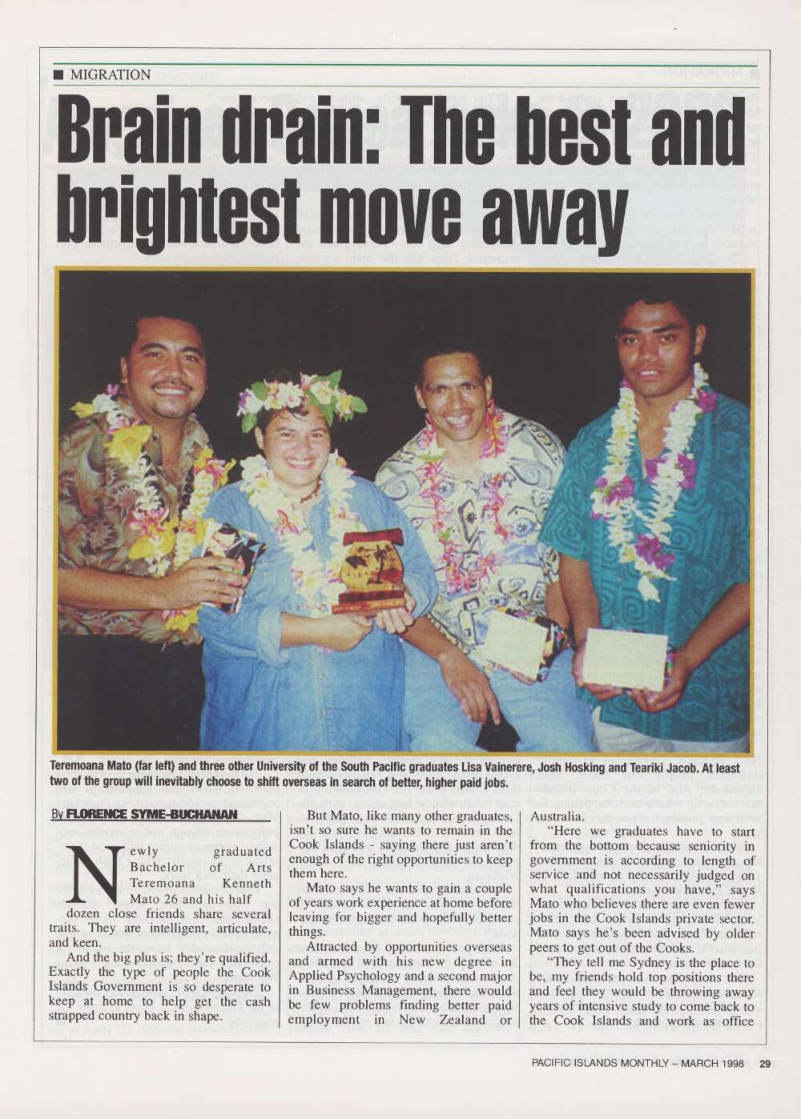
Teremoana Mato (far left) and three other University of the South Pacific graduates Lisa Vainerere, Josh Hosking and Teariki Jacob. At least two of the group will inevitably choose to shift overseas in search of better, higher paid jobs.
clerks.” Mato’s skills have enabled the Ministry of Education to establish the new position of Career Counsellor and he’s hoping to be paid $24,000 a year.
It’s unlikely the young graduate will actually get that salary as educators are amongst the lowest paid in the Cook Islands.
It’s likely Mato will choose to work in New Zealand or Australia where he’ll probably be paid in excess of $30,000.
The Cook Islands has experienced an exodus of young people since 1991 which has serious implications on the country’s social and economic well being, warns South Pacific Commission Demographer Gerald Haberkom.
Except for Niue whose population of just 2000 people is the result of massive emigration to New Zealand, the Cook Islands’ position is in stark contrast with the rest of the Pacific.
Statistics Haberkom has collected show in 1991 there were 3800 young people in the Cooks - by 1996 that figure had dropped to 3000. For a country of
just 19,000 people “that’s quite phenom
enal ,” says Haberkom.
“If left unabated, the Cook Islands can end up with a dormant population of
just old people.”
He says most productive workers have left which will have “serious eco nomic and social consequences on the
country.”
The demographer says the “problem is a vicious circle as the few remaining young people feel compelled to leave because they have no peers.” Haberkom says the Cooks population growth, or near lack of it at 0.2 percent, is also due to the “incredible advantage of Cook Islanders having New Zealand passports which has relieved the country of any
over-population problems.
Over 40,000 Cook Islanders live in New Zealand. During an economic downturn people can leave, says Haberkom. And in the Cook Islands that’s exactly what’s been happening in worrying numbers over the last two years.
There’s concern that a “brain drain” has occurred in the Cooks - skilled younger people leaving to seek jobs in New Zealand and Australia.
University of Bradford educated Vaine Wichman, a former economist with the Ministry of Finance and now a freelance consultant makes no excuses for the Government.
She says there have been some reforms in the public sector making hir ing and firing similar to the employment principles of the private sector.
“You have the skills, attitude and qualifications, in that order, and you have the job.” “However there is still some disbelief with the new public ser vice recruitment process, as at the senior levels of the service, political coercing and influence still prevails,” says Wichman.
Limited job opportunities, absence of adequate welfare benefits, fewer social attractions, high cost of living and the economic crisis are the main reasons which keep Cook Islanders from return ing in their thousands. Probably just as well.
The infrastructure of main island Rarotonga could not support a big, per manent population increase - the island is already struggling to support its 50,000 visitors a year.
An increase in tourism is much need ed by the country which has been in the throes of a crippling economic crisis for over two years.
But first, water, electricity, solid and liquid waste disposal and an ineffective government Environmental Service seri ously need upgrading to cope with a tourism boom. Wichman says the prob lem in recent times is that the Government expects to expand new infrastructure arrangements without
ensuring existing infrastructure was
improved on a par.
Added to that she says is the Government’s financial mismanagement “and so maintenance on existing infras tructure such as roads, water and airports was deferred in favour of less essential priorities, for example trips to exotic places for Government officials.” From an economic point of view, emmigration in response to land, population and eco nomic pressures has acted as a safety valve in times of recession.
“New Zealand is an example - at the turn of the last century qualified and excess Irish, Scots and English moved there to start a new life - the only differ ence with what’s happening with the Cooks now is that skills and qualifica tions aren’t in excess and the Cooks can ill afford to lose this skill and qualifica tion base at this stage, says Vaine Wichman.”
Wichman shares the same view as Haberkom, who warns the exodus of young people will have serious implica tions.
Both say a casualty of the current downturn in the economy will be the loss of the economically active at a time when the country needs their energies most to sustain the transition from a pub lic sector led economy to a private sector
growth one.”
Wichman says probably one of the attributes lacking in the economically active,qualified and skilled group of young people; is the attitude to set up private sector initiatives and businesses on their own.
“There still is that attitude of working for someone and getting a pay packet rather than putting all one’s energies behind a dream, and with a little support making that dream work.”.
She points out the few displaced pub lic servants who have remained in the country and developed viable private sector initiatives, have been surprised with their achievements and wondered why they have stayed in the public sec tor for so long.
“Unfortunately, these cases aren’t common for the majority of displaced public and private sector employees who have been put off work and the option of migrating to dole queues and employ ment opportunities overseas is more attractive.”
The Government’s economic policies point to supporting and growing the pro ductive sectors of agriculture, marine resources, tourism and offshore banking and home industry type initiatives.
Since the inception of the reform in March 1996 these sectors are still adjust ing and finding a way to grow, and it appears with a fiscal shortfall projected for March 1998, the country will still be a few years lagging behind the ambitious reform targets of March 1996.
Wichman says what this means for current and future levels of young people coming out of schools is that education standards will still be wanting.
Due to the lack of adequate funding “the quality of service delivery in educa tion and health is ebbing, and isn’t expected to improve for at least the next two to three years.”
She says this’ll mean the system stays as it is; those with scholarships will leave and seek employment elsewhere after studies are completed, and those unfortunate enough not to receive sub sidised overseas studies will exert them selves in the country taking a job or cre ating their own work.
That of course would be the ideal for the ever-optimistic Cook Islands Government. But the most likely sce nario is that this group of young people will more readily leave the island for
overseas job opportunities warns
Wichman.
This could well cause further disarray to the Government’s plans to grow the economy. ■