American Samoa looks to 2000
pp. 31-33 · Read in the full issue
Advertising Feature
By Rob Shaffer
JUST over one year ago, with in the very first week he took office, Governor Tauese P.F.
Sunia of American Samoa turned his thoughts to the year 2000.
For all the problems facing his new administration, one thought persistently remained at the forefront of his conscious ness: Within three years, this tiny South Pacific territory would be celebrating its 100th anniversary commemorating the raising of the United States flag over these five lushly beautiful islands.
To Governor Sunia, there will be noth ing more critical to the future of this terri tory, nor more symbolic, than marking 100 years of this very special, even unique rela tionship between American Samoa and the United States. When the Stars and Stripes were raised over the territory on the morn ing of April 17, 1900, the islands became
the only piece of US real estate in the southern hemisphere. The relationship began in the 1870 s when the US Navy, seeking to protect American interests in the region, steamed into Pago Pago Harbour and found it to be the finest natural har bour in the Pacific. At the time, the German navy was flexing its muscles as Berlin seriously considered annexing the entire Samoan chain.
As civil war raged on the island of Upolu over Germany’s heavy-handed attempts at colonization, the US navy, needing to establish a coaling station, was granted that authority by Pago Pago’s paramount chief in return for the “friend ship and protection of the great govern ment of the United States.”
The Berlin Act of 1889 signed by the US, Great Britain and Germany, granted the Navy exclusive rights to Pago Pago Harbour. The US had then become,
through international treaty, inexorably tied to Samoa.
By 1899, Samoan chiefs on the island of Tuituila, where the harbour is located, had ceded their islands outright to the US and the Navy took charge of the islands’ administration. During World War II the Samoan islands became the US Marine Corps’ major staging and training area for its push against Japan.
The war had a profound effect on American Samoans. Ultimately, the strong affection they felt toward the US turned into fierce loyalty. By the end of the war, the people of these islands considered themselves American, and all that being American implied. In 1951 the Navy relin quished its administrative authority to the Department of the Interior. With the Navy gone, the territory quickly became America’s most distant and forgotten back water. Not until an article appeared in
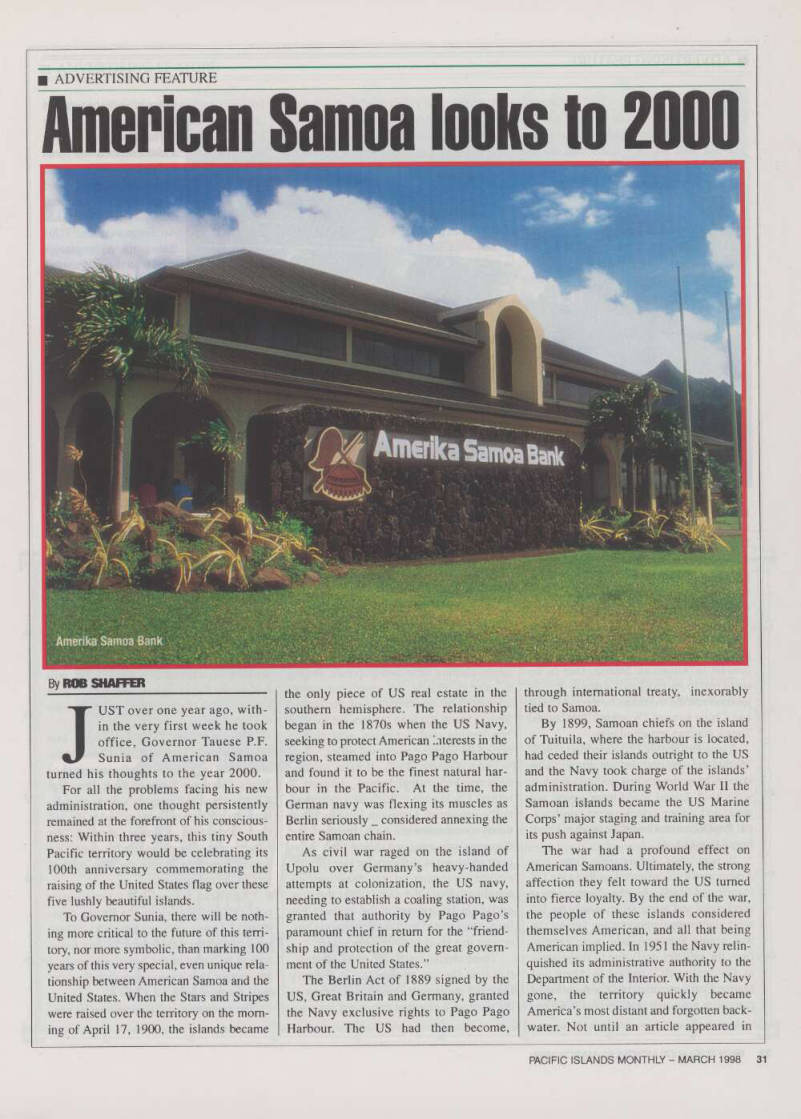
Amerika Samoa Bank
Reader’s Digest in 1961 severely criticis ing the US Congress and Interior Department’s financial neglect of American Samoa, did Congress, under the prodding of President John F. Kennedy, finally begin to appropriate the sums nec essary to bring American Samoa into the 20th century.
Through the 1960 s and 19705, the US government maintained a period of intense interest in American Samoa. Due in no small part to the territory’s strategic Pacific location and the overtures by the old USSR and China toward (Western) Samoa and Tonga, concern remained high.
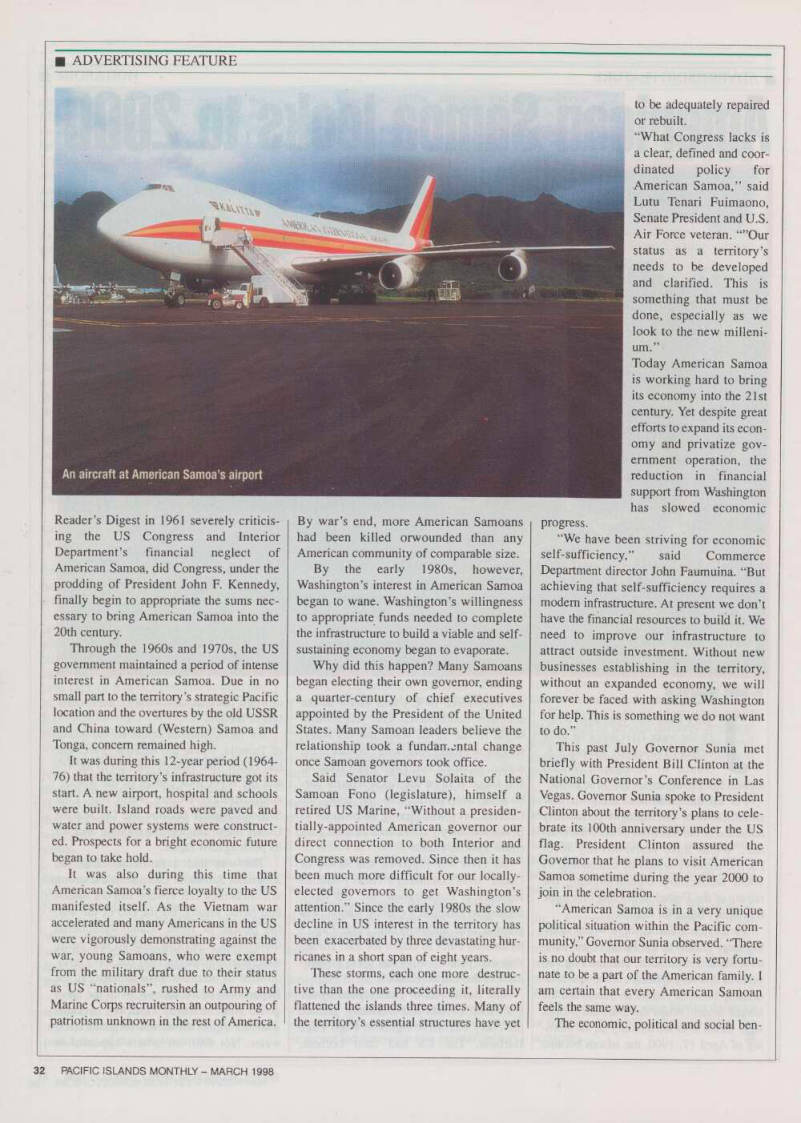
It was during this 12-year period (1964- 76) that the territory’s infrastructure got its start. A new airport, hospital and schools were built. Island roads were paved and water and power systems were construct ed. Prospects for a bright economic future began to take hold.
It was also during this time that American Samoa’s fierce loyalty to the US manifested itself. As the Vietnam war accelerated and many Americans in the US
were vigorously demonstrating against the
war, young Samoans, who were exempt from the military draft due to their status as US “nationals”, rushed to Army and Marine Corps recruitersin an outpouring of patriotism unknown in the rest of America.
By war’s end, more American Samoans had been killed orwounded than any American community of comparable size.
By the early 1980 s, however, Washington’s interest in American Samoa began to wane. Washington’s willingness to appropriate funds needed to complete the infrastructure to build a viable and self sustaining economy began to evaporate.
Why did this happen? Many Samoans began electing their own governor, ending a quarter-century of chief executives appointed by the President of the United States. Many Samoan leaders believe the relationship took a fundamental change once Samoan governors took office.
Said Senator Levu Solaita of the Samoan Fono (legislature), himself a retired US Marine, “Without a presiden tially-appointed American governor our direct connection to both Interior and Congress was removed. Since then it has been much more difficult for our locally elected governors to get Washington’s attention.” Since the early 1980 s the slow decline in US interest in the territory has been exacerbated by three devastating hur ricanes in a short span of eight years.
These storms, each one more destruc tive than the one proceeding it, literally flattened the islands three times. Many of the territory’s essential structures have yet
to be adequately repaired
or rebuilt.
“What Congress lacks is a clear, defined and coor dinated policy for American Samoa,” said Lutu Tenari Fuimaono, Senate President and U.S.
Air Force veteran. “”Our status as a territory’s needs to be developed and clarified. This is something that must be done, especially as we look to the new milleni um.”
Today American Samoa is working hard to bring its economy into the 21st century. Yet despite great efforts to expand its econ omy and privatize gov ernment operation, the reduction in financial support from Washington has slowed economic
progress.
“We have been striving for economic self-sufficiency,” said Commerce Department director John Faumuina. “But achieving that self-sufficiency requires a modem infrastructure. At present we don’t have the financial resources to build it. We need to improve our infrastructure to attract outside investment. Without new businesses establishing in the territory, without an expanded economy, we will forever be faced with asking Washington for help. This is something we do not want to do.”
This past July Governor Sunia met briefly with President Bill Clinton at the National Governor’s Conference in Las Vegas. Governor Sunia spoke to President Clinton about the territory’s plans to cele brate its 100th anniversary under the US flag. President Clinton assured the Governor that he plans to visit American Samoa sometime during the year 2000 to join in the celebration.
“American Samoa is in a very unique political situation within the Pacific com munity,” Governor Sunia observed. “There is no doubt that our territory is very fortu nate to be a part of the American family. I am certain that every American Samoan feels the same way.
The economic, political and social ben
An aircraft at American Samoa’s airport
efits our people and territory have received by being part of the US have been enor mous. “Yet, because of our status as a US territory we cannot deal directly with for eign governments. As a result, we cannot seek foreign aid and assistance. Therefore we have to rely entirely on the US govern ment for financial support. In our quest for US financial support we are competing against every state and territory in the union. Because of our small size and dis tance from Washington, DC we often get lost in the big picture.” Governor Sunia continued: “Nor can the American Samoa Government take a strong leadership role in South Pacific island affairs to organiza tions such as the SPC.
That jurisdiction lies within the US State Department. For these reasons our status as a US territory makes us unique within independent Pacific island govern ments.” American Samoans, both those in the islands and those who have migrated to the States, take great pride in their patrio tism and love of country.
As Senator Moaaliitele Tuufuli, chair man of the American Samoa Democratic
Party, put it: “Those chiefs who signed the Deed of Cession (ceding the islands to the US) gave their descendants the greatest gift anyone could ask for the gift of being American.” It is with that loyalty and love of country that American Samoans look forward to the year 2000 and celebrating their Centennial.
So now, 14 months into his four-year term of office, and less than two years away from his territory’s Centennial year, Governor Sunia has begun planning the Centennial celebrations. His government and territory are looking with much pride and anticipation to their Centennial. And with the Centennial Governor Sunia hopes that a new era in American Samoa’s rela tionship with the United States will begin.
“During my term of office,” said Sunia, “I hope I can convince members of Congress as to the strategic value our terri tory provides the United States.” “What I would hope to see,” Sunia continued, “is that as we approach our Centennial Congress recognises the value our partner ship has been throughout this century to both the United States and American
Samoa.
“We plan to display our loyalty and appreciation for being part of America dur ing our centennial year. We look forward to participation by President Clinton, members of Congress and other officials in Washington who have worked so closely with us over the years.
“We also hope that the leaders of all the South Pacific islands and nations will join us during the week of April 17th, in the year 2000. Between now and then I hope to speak personally with the leaders of every Pacific island government and extend a personal invitation for them to join usduring the most important week in our history.”
About the author: Rob Shaffer has lived in Samoa for 22 years. He has served on the executive staff for four American Samoa governors. He was a Peace Corps volunteer!staff member for two and a half years in (Western) Samoa; he served as the desk officer for American Samoa in the Office of Territorial & International Affairs, Department of the Interior, Washington DC. ■