A language in crisis
pp. 27-28 · Read in the full issue
Culture
By Florence Syme-Buchanan
Educators and Cook Islands Maori language enthusiasts have fears that the Cook Islands tongue will continue to disappear unless something is done to rescue it on a nationwide scale. The Cook
Islands language is being used less and less.
Only a fraction of advertisements on television are in Maori. Of the three newspapers, only the daily will carry an article in Maori and that per haps only once a week.
The language makes up less than
half of what’s spoken on either radio station.
The official language of Parliament’s Hansard debates is English, business and government let terheads are in English and casual conversations amongst Cook Islanders, especially in Rarotonga, are
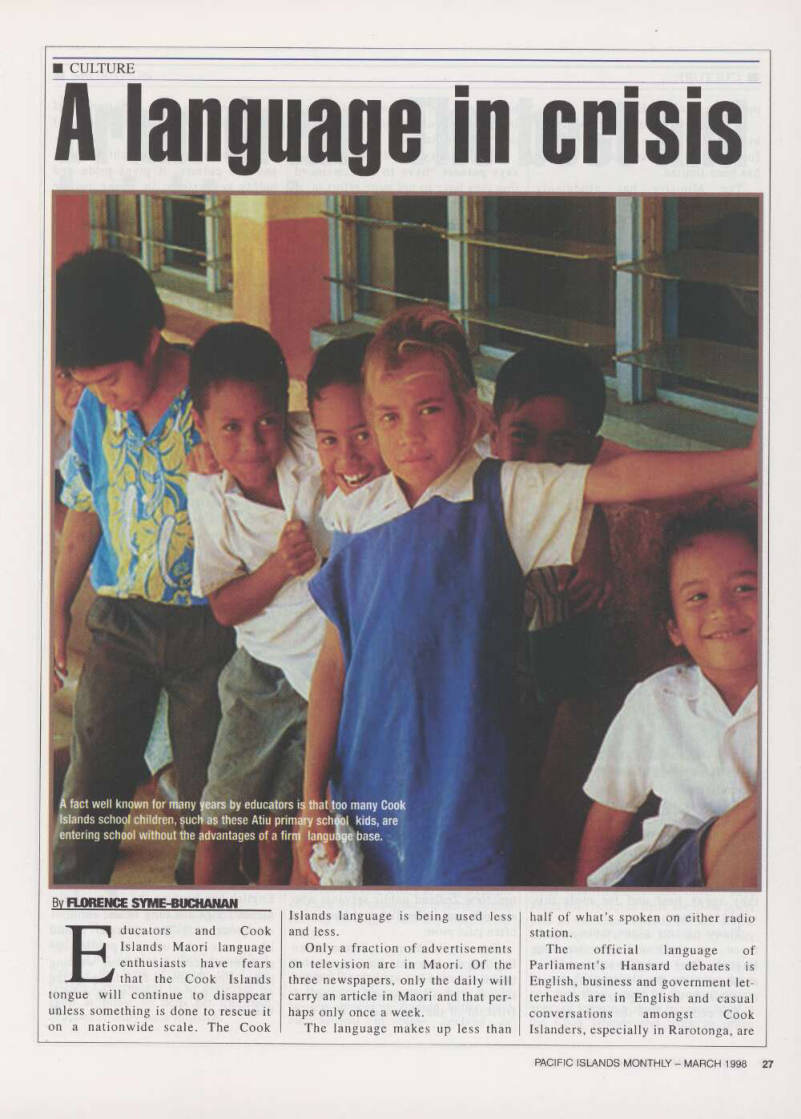
A fact well known for many years by educators is that too many Cook Islands school children, such these Atiu primary school kids, are entering school without the advantages of a firm language base.
more often held in English.
A Ministry of Education policy of bi-lingual education has been in place for a number of years, but its success has been limited..
The Ministry has grudgingly acknowledged too many children were still entering school and more dis turbingly, high school with only limit ed comprehension or communication skills in either English or Maori.
Because of this, many were failing and
dropping out.
To find out why, the Ministry of Education contracted Language Consultant Elaine Lameta from New Zealand to carry out a comprehensive study of the problems in the Cook Islands and produce a report.
That report would be used to for mulate language policies for the Ministry.
But typical of Cook Islands govern ment behaviour, the report is being kept hush - hush by the Ministry of Education , ossibly because it discuss es how the Ministry has failed to fully address and cope with the language
problem.
Elaine Lameta spent two and a half months in the Cooks collecting data and conducting her study. The main areas of concern were leaked by an educatorconcerned over the disappear ance of the Cook Islands language and the fact that “so little is being done to save our mother tongue.”
Lameta has made bold recommen dations - one of the most significant is that the country needs an Official Language Act recognising Maori and a statutory body, possibly modelled on the New Zealand Language Commission.
This body would ensure the preser vation and increased usage of the Maori language. In her study Lameta points to part of the language problem starting at home. Parents are not teaching their children the language they speak best and for most this would be Maori.
Many parents place more impor tance on their children learning English. They struggle to teach their children in the English language even
though they speak it poorly.
The end result is the child speaks
little Maori and has very limited read ing comprehension and communica tion skills in English.
The Ministry of Education source says parents “have to be convinced that they have to put more effort in, if they speak Maori better, then teach their kids in Maori.”
“Parents are not doing the kids a favour by teaching poor English.”
Having a strong language base, whichever one it may be, gives any child an advantage at school, says the source.
Lameta also points to the various Cook Islands dialects as being some thing which the Ministry of Education must address. She supports the con cept that children have the right to be taught - at least for most of their pri mary years - whatever dialect is spo ken on their home island.
A Pukapuka student has to sit Grade Six National Exams in the Rarotongan dialect. Pukapukan Maori and Rarotongan Maori are virtually two separate languages. The language problems, says the source, have been around for many years but the Ministry of Education “hasn’t
acknowledged the problem,” the
source says.
The source believes it could take up to ten years to put the language situa tion right and past small, sporadic efforts to address the issue havehad only limited success.
What is recognised is that it will take a major, national effort to elevate the use of Maori and give eloquence
in the language prestige.
Language problems aren’t unique to the Cook Islands. But Elaine Lameta’s study notes in New Zealand where Maori had virtually died out 15 years ago, there’s now a lot more respect and awareness for the lan guage. Much more Maori is spoken in New Zealand today and proficiency in the language carries considerable sta tus. New Zealand public servants who are bilingual in English and Maori are often paid more.
But why bother with Maori when English, the international language of business is far more useful to a Cook Islander, particularly when overseas?
Director of the Curriculum Unit Gill
Vaiimene says the importance of Cook Islands Maori can’t be stressed enough.
“Its the language of our heritage and our culture, it gives pride and builds self-esteem in young people who can speak it, because of this, those who are fluent in Maori and English are more likely to succeed in life than those who aren’t.”
Minister of Education Ngereteina Puna says he’s all for raising the sta tus of the Cook Islands Maori lan guage.
He’s now awaiting the final report from'Lameta. The language policies that will be drafted from the report will first haveto be approved by the Minister. Once this has been done, workshops will be run to familiarise teachers with the new policies and new programmes will be developed.
It’s expected a lotmore Maori reading material will be developed for Cook Islands schools.
Puna wants to take the Maori lan guage issue further by making spoken Maori “one of the requirements before being given permanent residence.” He would eventually like to see this legis lated and although Puna hasn’t “set out to convince” his Cabinet col leagues some do agree with him while others haven’t expressed a firm view on the issue yet.
He says at present “permanent resi dence applicants don’t seem to be tak ing much notice of the Maori lan guage” and “being a Cook Islander is being able to speak the language and people who wanted to adopt the coun try as their home should learn Cook Islands Maori.”
Minister Puna believes Cook
Islands society is showing signs that
the native tongue could die “if we don’t do something about it quickly.”
“In ordinary conversation, a lot of our people are more comfortable speaking English, in our churches English has become the language the sacred songs are sung in and sermons are preached.” The minister would like to see more obvious public sup port for the concept of those wanting permanent residence first learning the language, but to date, there’s been very little. ■