Pitcairn finds its saviour
p. 22 · Read in the full issue
By Michael Field
THE tiny community on isolated Pitcairn Island is on the edge of extinction but a saviour is in the offering in the form of an Australian electronics retailer. Pitcairn was made famous as the hideout for the mutineers from the Royal Navy’s 18th Century HMS Bounty but nowadays its isolation, 2160
kilometres southeast of Tahiti, is a severe
disadvantage.
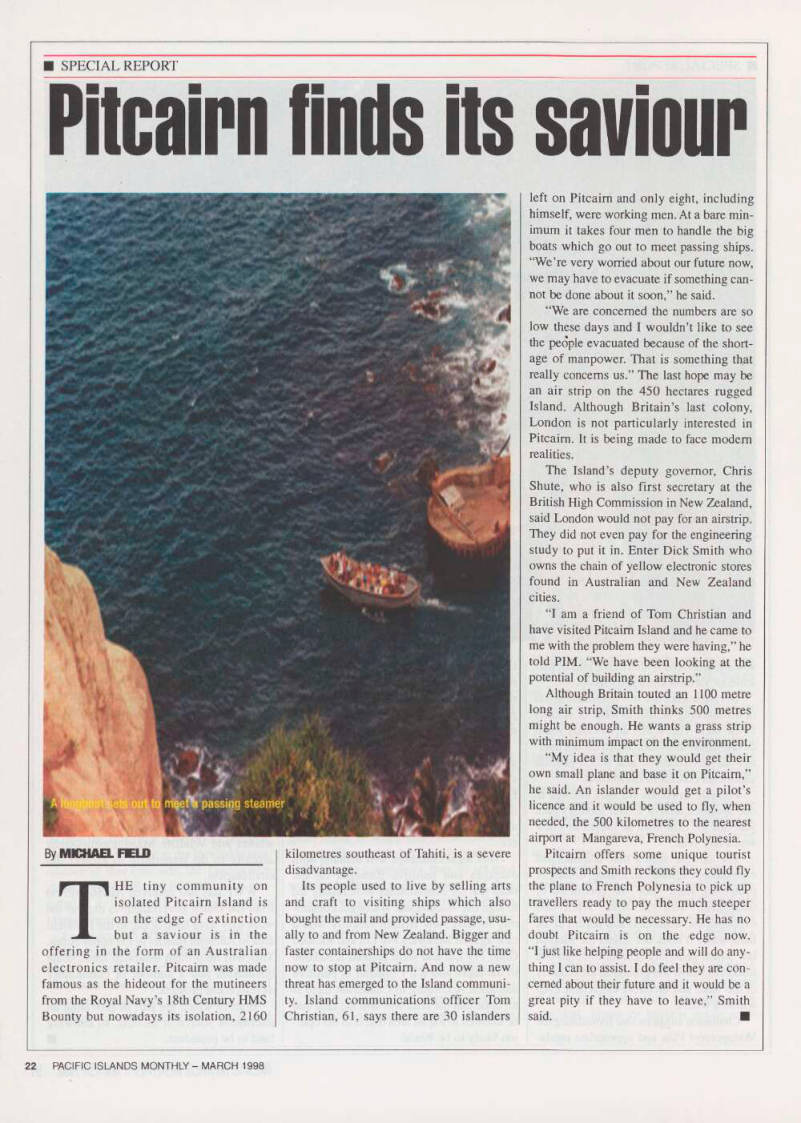
Its people used to live by selling arts and craft to visiting ships which also bought the mail and provided passage, usu ally to and from New Zealand. Bigger and faster containerships do not have the time now to stop at Pitcairn. And now a new threat has emerged to the Island communi ty. Island communications officer Tom Christian, 61, says there are 30 islanders
left on Pitcairn and only eight, including himself, were working men. At a bare min imum it takes four men to handle the big boats which go out to meet passing ships.
“We’re very worried about our future now, we may have to evacuate if something can not be done about it soon,” he said.
“We are concerned the numbers are so low these days and I wouldn’t like to see the people evacuated because of the short age of manpower. That is something that really concerns us.” The last hope may be an air strip on the 450 hectares rugged Island. Although Britain’s last colony, London is not particularly interested in Pitcairn. It is being made to face modem realities.
The Island’s deputy governor, Chris Shute, who is also first secretary at the British High Commission in New Zealand, said London would not pay for an airstrip.
They did not even pay for the engineering study to put it in. Enter Dick Smith who owns the chain of yellow electronic stores found in Australian and New Zealand cities.
“I am a friend of Tom Christian and have visited Pitcairn Island and he came to me with the problem they were having,” he told PIM. “We have been looking at the potential of building an airstrip.”
Although Britain touted an 1100 metre long air strip, Smith thinks 500 metres might be enough. He wants a grass strip with minimum impact on the environment.
“My idea is that they would get their own small plane and base it on Pitcairn,” he said. An islander would get a pilot’s licence and it would be used to fly, when needed, the 500 kilometres to the nearest airport at Mangareva, French Polynesia.
Pitcairn offers some unique tourist prospects and Smith reckons they could fly the plane to French Polynesia to pick up travellers ready to pay the much steeper fares that would be necessary. He has no doubt Pitcairn is on the edge now.
“I just like helping people and will do any thing I can to assist. I do feel they are con cerned about their future and it would be a great pity if they have to leave,” Smith said. ■
A longboat sets out to meet a passing steamer