protect the Hunstein
pp. 19-21 · Read in the full issue
The struggle to protect the Hunstein
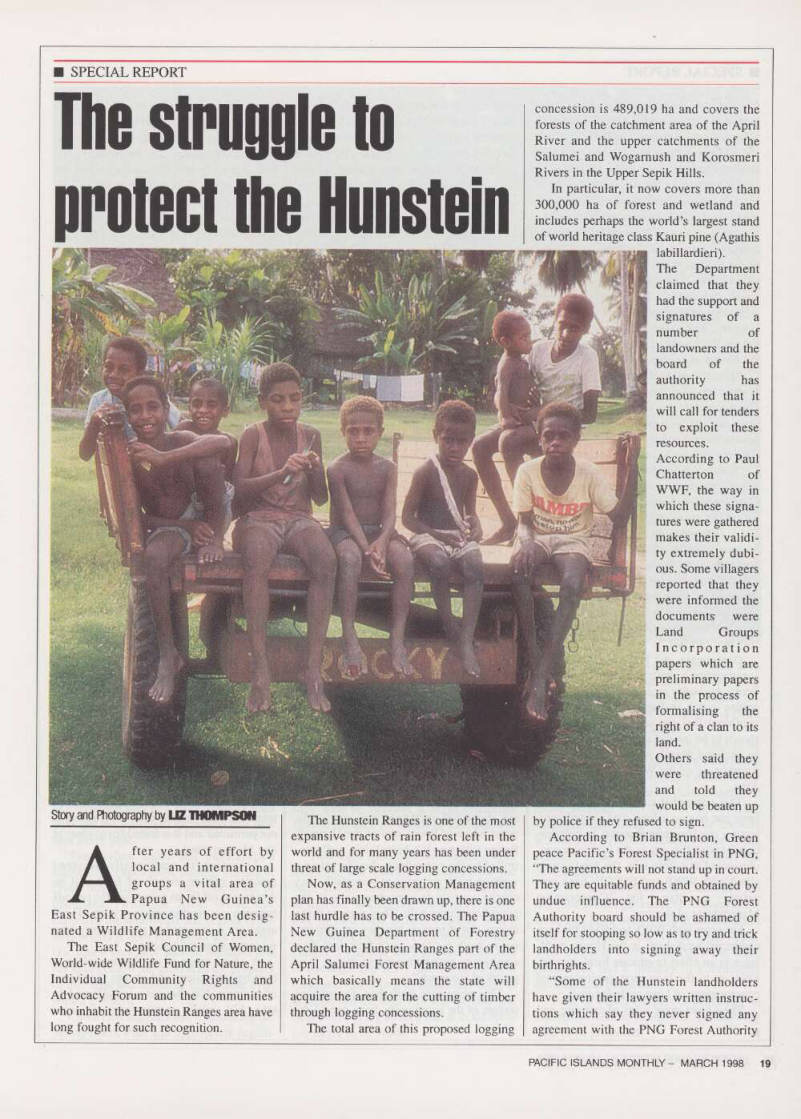
After years of effort by local and international groups a vital area of Papua New Guinea’s East Sepik Province has been desig nated a Wildlife Management Area.
The East Sepik Council of Women, World-wide Wildlife Fund for Nature, the
Individual Community Rights and
Advocacy Forum and the communities who inhabit the Hunstein Ranges area have long fought for such recognition.
The Hunstein Ranges is one of the most expansive tracts of rain forest left in the world and for many years has been under threat of large scale logging concessions.
Now, as a Conservation Management plan has finally been drawn up, there is one last hurdle has to be crossed. The Papua New Guinea Department of Forestry declared the Hunstein Ranges part of the April Salumei Forest Management Area which basically means the state will acquire the area for the cutting of timber through logging concessions.
The total area of this proposed logging
concession is 489,019 ha and covers the forests of the catchment area of the April River and the upper catchments of the Salumei and Wogamush and Korosmeri Rivers in the Upper Sepik Hills.
In particular, it now covers more than 300,000 ha of forest and wetland and includes perhaps the world’s largest stand of world heritage class Kauri pine (Agathis
labillardieri).
The Department claimed that they had the support and signatures of a number of landowners and the board of the authority has announced that it will call for tenders to exploit these resources.
According to Paul Chatterton of WWF, the way in which these signa tures were gathered makes their validi ty extremely dubi ous. Some villagers reported that they were informed the documents were
Land Groups
Incorporation papers which are preliminary papers in the process of
formalising the
right of a clan to its land.
Others said they were threatened and told they would be beaten up
by police if they refused to sign.
According to Brian Brunton, Green peace Pacific’s Forest Specialist in PNG, “The agreements will not stand up in court.
They are equitable funds and obtained by undue influence. The PNG Forest Authority board should be ashamed of itself for stooping so low as to try and trick landholders into signing away their
birthrights.
“Some of the Hunstein landholders have given their lawyers written instruc tions which say they never signed any agreement with the PNG Forest Authority
Story and Photography by LIZ THOMPSON
that any agreement signed, have been
signed by people without proper authority
who are not traditional landholders; that the FMA was done through the backdoor dealings and they want FMA cancelled.”
“A member of the Ambunti Council of Women who was present at the time of the signing of some agreements has said in writing that landowners were told that their lawyers know about the forms they were about to sign. If this statement is true then some of the signatures to the FMA have been obtained by fraud, as the Forest Authority never contacted the landholders lawyers, and went out of their way to ensure the lawyers could be present when the FMAs were signed.
“The Forest Authority knows that the landholders were represented by ICRAF’s lawyers and they nevertheless went on and dealt directly with landholders in order to secure their consent to what are substan dard one-sided and unfair agreements.
“Landholders report the involvement of Martin Golman, a senior officer in the PNG Forest Authority in obtaining the sig natures of some of the landholders to the FMA. Golman knew full well that ICRAF lawyers represented some of the Hunstein Ranges landholders. He, nevertheless, went ahead and persuaded landholders who had no opportunity to consult with their lawyers over the text of a contract that is worth hundreds of millions of kina, to sign that contract.”
Greenpeace and ICRAF are currently spearheading a challenge to the right of the Forest Authority to declare this FMA. All parties in this challenge seem to feel very confident that the claims will easily be shown to be invalid and that the FMA will be declared illegal, paving the way to the formalising of the Wildlife Management Area.
This somewhat substantial hiccup has been just one on a long road towards pro tecting the Hunstein Ranges. In prepara tion for what they see as the inevitable con clusion of this epic tale, the landowners along with WWF and ESCOW have pre pared a plan for Conservation Management of the area.
For years both WWF and ESCOW have conducted workshops in the Hunstein vil lages in an effort to educate local commu nities as to the long term environmental consequences of large scale logging.
They have done a lot of training and
gone out on numerous patrols with com munity members. All the rules which now form the outline for the WMA were work shopped, long talks were had, games were played in the village helping work out land boundaries and individual communities’ needs.
According to Chatterton representatives of these organisations have spent at least a couple of weeks in each village in the Hunstein, in many, much more. They have, he says, been “helping them think things through, draw maps of their land, we have gone out and looked at parts of the envi ronment important to them, talked about what aspects of their culture are most important to them, lots of stuff has been written down and there has been a great deal of talking”.
It is through this sustained and resilient effort that awareness as to the need for environmental protection has been raised.
It is now widely appreciated that large scale logging is not sustainable, that it does damage gardens, that frequently the landowners do not benefit or receive ade quate compensation from logging compa nies.
It is this raised awareness, in conjunc tion with the steady promotion of econom ic alternatives to logging which has led to the gradually increased support of the local community for the establishement of a
Wma.
To replace the cash earned through the logging of trees, both WWF and ESCOW have promoted, among other things, the development of eco-tourism. Communities are realising it is the very idea than an area has been classified a Wildlife Management Area which attracts tourists.
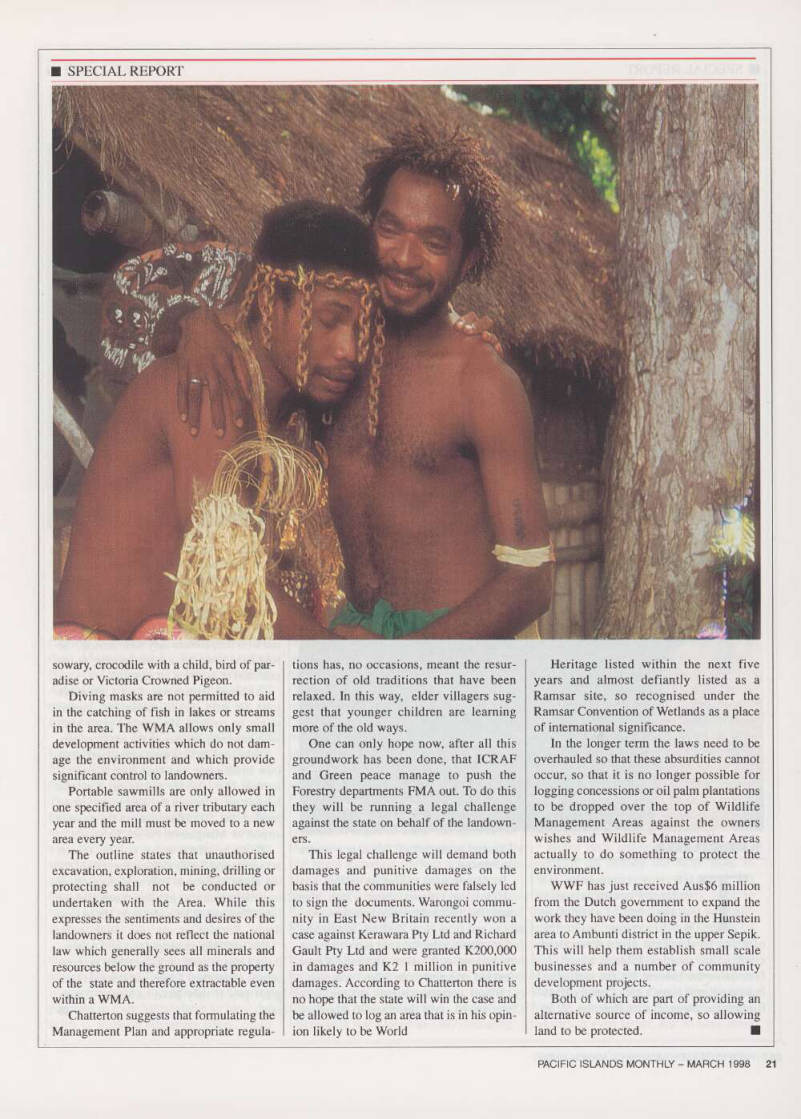
According to Chatterton, when he first went up to the Hunstein in 1991 there were about five to 10 tourists coming into the region each year. “Now”, he says, “there are about 200 each year who stay in the guest house at Wagu, one of the Hunstein Range villages. It’s been fairly well con trolled by the community, they’ve set up a walking track and trips to waterfalls, they charge tourists to stay overnight in the guest house they built. They want to make money out of tourists but they are also try ing to work out how to fit them into their community without having to change their practices too much”.
This economic issue has, for various sectors of the community, been one of the
main deterrents to creating a Wildlife Management Area in the Hunstein Ranges.
The desire to earn an income is increas ingly compelling as traditional life becomes more and more entwined in the cash economy. It is this issue, which has, to a large extent, divided the community and hence made it difficult to present a united front. It is this unity of objectives which has had to be achieved before it was possible to draw up a plan of Conservation
Management.
A conservation committee has been set up to deal with creating, maintain and ensuring the enforcement of the rules of the WMA.
This committee is comprised of one representative of each land group in the area as well as other persons from each vil lage who acts as a chair for that village.
These committee members are appointed through discussion among all adult mem bers of each land group. The rules not only apply to the local community but to all those visitors entering the park area.
Some of the regulations that have been established include the protection of local Masalai sites. Masalai places are consid ered to be areas which are the domain of forest spirits. In these areas only those given permission by the particular land group on which these areas sit may enter.
Customary restrictions, such as avoid ance of noise, must be respected and it is forbidden to take or kill animals in any Masalai area. Menstruating women may not catch fish, swim or wash in the canals or lakes of the WMA.
This regulation was decided upon by the women in the communities. Visitors may only enter the area accompanied by a guide appointed by the committee and fees may be charged by the committee for guid ing services.
Clearing of forest, cutting of trees or tree buttresses in land used for hunting is not permitted and it is forbidden to clear in any Masalai place.
According to traditionally accepted
practice, certain parcels of land will be designated off limits to hunting for periods between six months and two years. These
areas are designated to provide breeding
refuges for hunted species.
A whole range of regulations relate to hunting restrictions and also to the means of hunting. No shotguns are allowed to take, kill, injure or harvest a pig, cas-
sowary, crocodile with a child, bird of par adise or Victoria Crowned Pigeon.
Diving masks are not permitted to aid in the catching of fish in lakes or streams in the area. The WMA allows only small development activities which do not dam age the environment and which provide significant control to landowners.
Portable sawmills are only allowed in one specified area of a river tributary each year and the mill must be moved to a new area every year.
The outline states that unauthorised excavation, exploration, mining, drilling or protecting shall not be conducted or undertaken with the Area. While this expresses the sentiments and desires of the landowners it does not reflect the national law which generally sees all minerals and resources below the ground as the property of the state and therefore extractable even within a WMA.
Chatterton suggests that formulating the Management Plan and appropriate regula
tions has, no occasions, meant the resur rection of old traditions that have been relaxed. In this way, elder villagers sug gest that younger children are learning more of the old ways.
One can only hope now, after all this groundwork has been done, that ICRAF and Green peace manage to push the Forestry departments FMA out. To do this they will be running a legal challenge against the state on behalf of the landown ers.
This legal challenge will demand both damages and punitive damages on the basis that the communities were falsely led to sign the documents. Warongoi commu nity in East New Britain recently won a case against Kerawara Pty Ltd and Richard Gault Pty Ltd and were granted K 200,000 in damages and K 2 1 million in punitive damages. According to Chatterton there is no hope that the state will win the case and be allowed to log an area that is in his opin ion likely to be World
Heritage listed within the next five years and almost defiantly listed as a Ramsar site, so recognised under the Ramsar Convention of Wetlands as a place of international significance.
In the longer term the laws need to be overhauled so that these absurdities cannot occur, so that it is no longer possible for logging concessions or oil palm plantations to be dropped over the top of Wildlife Management Areas against the owners wishes and Wildlife Management Areas actually to do something to protect the environment.
WWF has just received Auss6 million from the Dutch government to expand the work they have been doing in the Hunstein area to Ambunti district in the upper Sepik.
This will help them establish small scale businesses and a number of community
development projects.
Both of which are part of providing an alternative source of income, so allowing land to be protected. ■