The Lincoln Agreement
pp. 16-18 · Read in the full issue
Bougainville
By Michael Field
I feel compelled by the grace of God that the time has come to say ‘sorry’ and ask for your forgiveness.”
Those were the remarkable words of Papua New Guinea Prime Minister Bill Skate to the war-weary people of Bougainville who are now giving peace a chance after 10 years of being the victims of one of the world’s truly forgotten wars.
The conflict had a long gestation but burst into the open on November 22, 1988, when a worker at the huge Panguna copper mine on the island raided Bougainville Copper Ltd’s armoury and stole explosives before destroying company installations.
That worker was Francis Ona, soon to be the president of the break-away state.
On December 23, 1988, PNG declared a state of emergency on Bougainville and civil war was under way.
To the few who watched, it was appar ent last year that the war was nearlyover neither side could hope to effect a military victory and the formal end came in the gentile surroundings of one of New
Zealand’s leading agricultural colleges,
Lincoln University.
There, on January 23, 1998, the oppos ing sides in the war signed the Lincoln Agreement on Peace, Security and Development on Bougainville which acknowledged “the suffering, pain and loss on all sides of the conflict that they have agreed to end forever”. They renounced the use of armed forces and violence and set April 30, 1998, as the date for ending the current truce and replacing it with a “permanent and irrevocable ceasefire”.
It was an intriguing document for the two issues it did not directly address.
It was a war of independence, yet the Lincoln Agreement makes no reference to
I the issue. It was also something of an I environmental war over the Panguna h mine. The mine is not mentioned.
The absence of the two issues is, how- I ever, a master-stroke. Plainly neither are I off the agenda and will, in time, be debat- I e d. but Lincoln was about “promoting
I reconciliation between Bougainvilleans
* and with other individuals, groups and . organisations in Papua New Guinea”.
I Towards the end of the war it was pre
f dominantly Bougainvillean killing
I Bougainvillean. The agreement requires
I more talks on “the political issue” before ’ the end of June this year and as they will I be on Bougainville they are likely to be key to the permanent peace. Ona might I even attend.
I He was not at Lincoln and the deal was
signed instead by Bougainville Interim
Government vice-president Joseph Kabui who had, for nearly a year, led the drive for peace. Ona’s own stance remained a mystery, although the presence of four of his senior commanders from “A Company” was taken as a strong sign that he endorsed what was happening. Mr Kabui said Bougainville could not be part of PNG under the current Constitution, adding the rebels expected the Lincoln talks to pave the way for negotiations on constitutional change.
“We are here to undertake substantive negotiation on those processes of change that will have to take place in the forth coming months and years,” Mr Kabui said.
“It is the position of the (rebels) that the answer to our problems does not lie in the PNG Constitution. That, in fact, the PNG Constitution can no longer be applied to Bougainville.
“The violation of the Bougainvillean people’s fundamental human rights by instruments of the PNG Constitution, and violation of the Constitution itself by suc cessive PNG governments, at any time that it suited them to do so throughout this con flict, means to us that the Constitution can no longer be applied to Bougainville in its present state.” He said his people were “seeking a solution based on the funda mental human right of self-determination”.
Australian Foreign Minister Alexander Downer showed some of the thinking
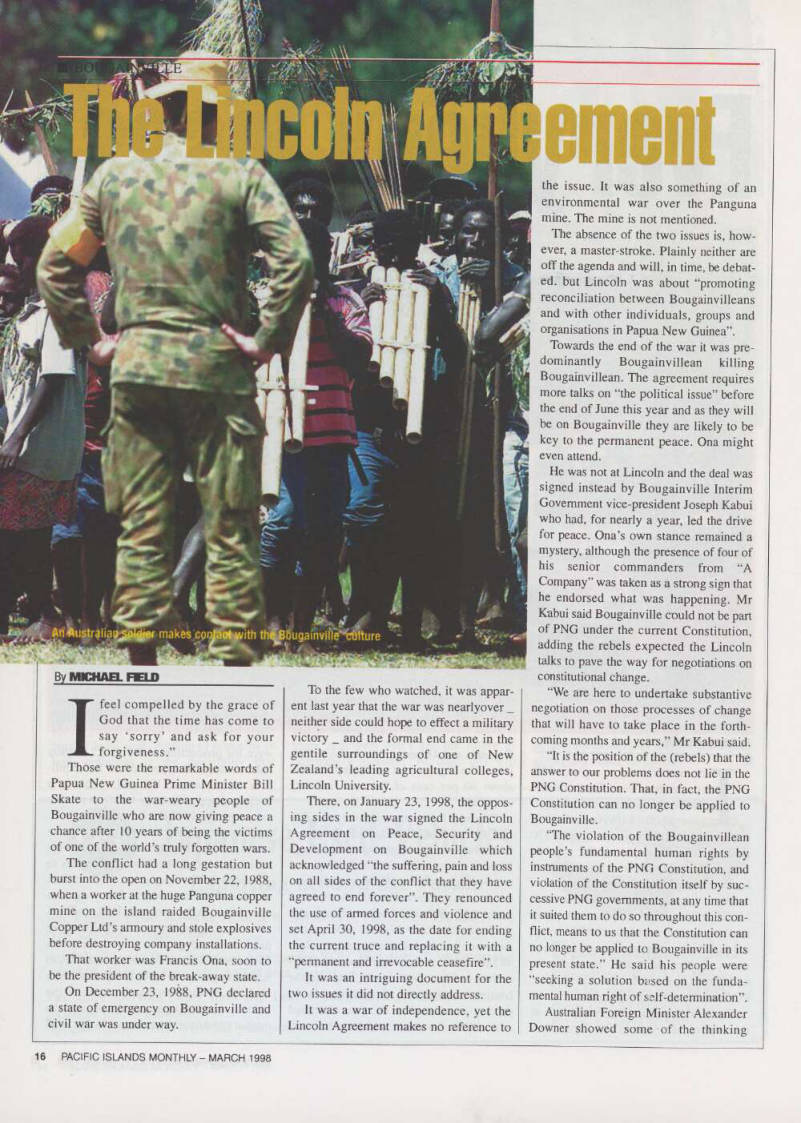
An Australian soldier makes contact with the Bougainville culture
going on over Panguna by saying he had worked very hard “to make sure we keep the mine completely out of sight for all of these talks. It is the most emotive and the most difficult issue of all.”
Mr Skate, in domestic trouble anyway, now has within his grasp the possibility of ending the draining conflict that has cost so much in lives. With the deal signed, Mr Skate released an open letter to the people of Bougainville in which he said a final ceasefire should not have taken nine years to achieve. Quoting Isaiah he urged all par ties to “forget the past”.
“Forget the former things; do not dwell on the past. See, I am doing a new thing ...
Do you not perceive it? I am making a way through the desert and streams in the waste land.” During the talks Mr Skate announced the bounties on the heads of the rebels would be lifted and those living in exile could now return home safely. The rebels had K 5250,000 rewards, dead or alive, placed on them. “Paying bounties for the death of enemies is not how my Government does things.
Those days are gone,” Mr Skate said.
Mr Kabui, welcomed the agreement, and thanked New Zealand for seeing the need to restart peace talks last year. “In Bougainville people are once again smil ing. The fear that has surrounded them in the last nine years of war in Bougainville is gradually disappearing,” he said.
“People are once again experiencing freedom of movement, freedom of associ ation . . . normal day-to-day living.”
The war was mostly fought behind a blockade which kept aid agencies and the media out. To this day it is not clear how many people have died. The estimated pop ulation of Bougainville in the late 1980 s was around 160,000 people. There is no independent confirmation of the death toll but it has become something of a mantra to say that 20,000 people died directly or indi rectly from the war. We may never really know. The island’s infrastructure has been destroyed or left to decay. Schools have been closed for nine years and a genera tion of children has been without educa tion.
There are 30,000-40,000 displaced peo ple living in 35 Government care centres on Bougainville. Australia and New Zealand have committed themselves to
rebuilding Bougainville with Australia
promising Asl3o million over the next five years for reconstruction. ■
THE government of Papua New Guinea, the Bougainville Transitional Government, Bougainville Resistance Force, the Bougainville Interim Government, the Bougainville Revolutionary Army and Bougainville Leaders (the “Parties”) having met in Lincoln University, Christchurch, New Zealand, from 19-23 January 1998: Praying for the Almighty’s forgiveness, guidance and blessing for their common endeavours; Emphasising their firm commitment to peace by building on the achieve ments in the Burnham Truce and the Cairns Commitment; Acknowledging the suffer ing, pain and loss on all sides of the conflict that they have agreed to end forever; Committing themselves to peace, reconciliation and working together for the common good; Engaging in a process of consultation and co-oper ation, initiated by Bougainvillean leaders, which they will continue; Hereby agree;
1. Peaceful Means
The parties will co-operate to achieve and maintain peace by peaceful means.
They also pledge to renounce the use of armed forces and violence, and agree to resolve any differences, by consultation,
both now and in the future. They confirm also their respect for human rights and the rule of law.
2. Extension Of
The Truce
The parties agree to extend the period of the Truce currently in force to the 30th of April 1998 to allow for consultation as regards the establish ment of the ceasefire.
3. Cease Fire
3.1 A permanent and irrevocable ceasefire will take effect in
Bougainville at 2400 hours on 30 April 1998. 3.2 The parties will co-operate to reduce fear in Bougainville and take urgent steps to co-operate in promoting public aware ness of, and respect for, the ceasefire. 3.3 Immediately the ceasefire takes effect, the parties will refrain from use of arms, ammunition, explosives and other instruments of death, injury or destruction
in Bougainville.
3.4 The parities will not manufacture, trade or distribute weapons and ammuni tions. 3.5 The parties will co-operate in accor dance with law in reporting and preventing the use, manufacture, importation, sale, trade, exchange of weapons and ammuni tions. 3.6 The parties will co-operate with the successor to the TMG in recording, locat ing and arranging disposal of all arms, ammunitions, explosives and other instru ments of death, injury and destruction, including parts and ingredients of all the parties in Bougainville.
4. Withdrawal Of Defence
Force From Bougainville
The parties agree to a phased withdraw al of the PNG Defence Force from Bougainville subject to restoration of civil
authority.
5. Peace Monitoring Group
5.1 The Papua New Guinea National Government undertakes to conclude the arrangements required for deployment of the successor to the neutral regional Truce Monitoring Group (TMG) by no later than 30 April 1998
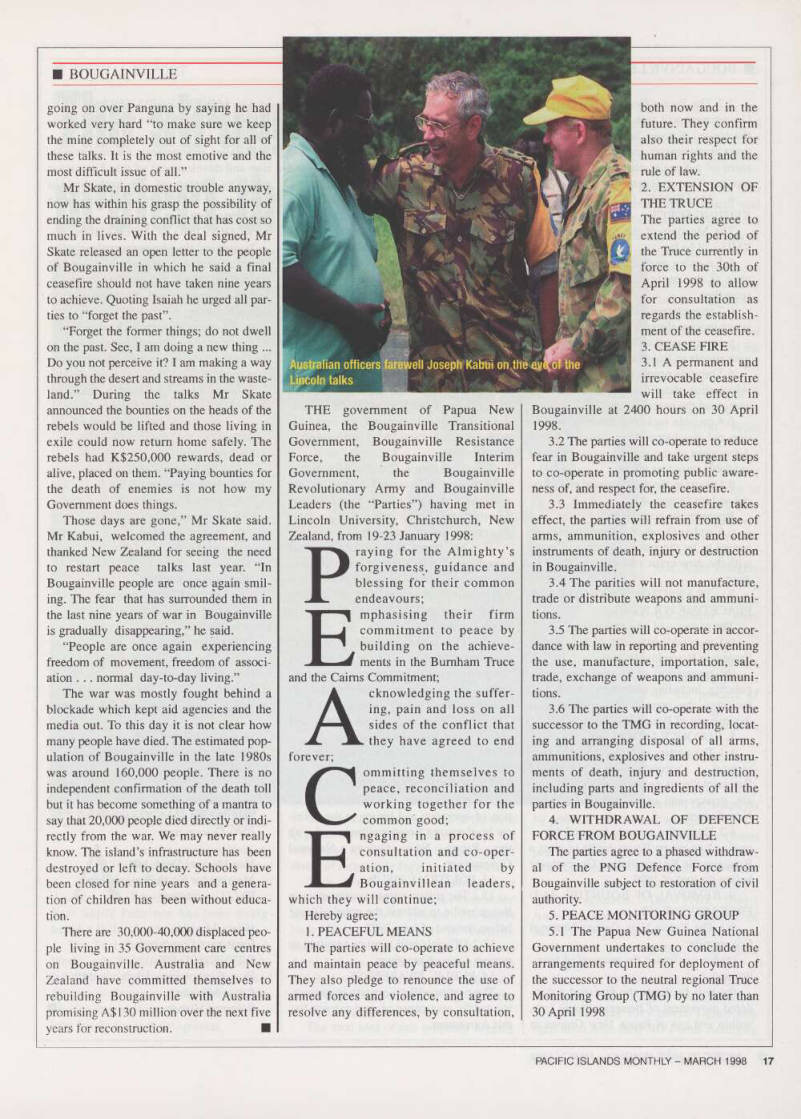
Australian officers farewell Joseph Kabui on the eve of the Lincoln talks
5.2 The Papua New Guinea National Government will seek the endorsement of the United Nations Security Council for these arrangements, including the appoint ment of a Special observing mission to monitor these arrangements.
6. Mandate Of The Peace
Keeping Force
The Mandate of the Successor to the TMG will be to; 6.1 monitor and report on the compli ance of the parties to all aspects of the ceasefire; 6.2 promote and instil confidence in the peace process through its presence, good offices and interactions with people in Bougainville;
6.3 provide people in Bougainville with
information about the ceasefire and other aspects of the peace process; 6.4 provide such assistance in restora tion and development consistent with this Agreement as the parties may agree and available resources allows. 6.5 assist in the development and train ing and institution of a Bougainville constabulary. 6.6 and such other matters as may be agreed to by the parties which will assist with the democratic resolution of the situ ation.
7. Transition To Civilian
Peacetime Policing
The parties will co-operate in: (a) re-establishing the Village Court System in Bougainville; and (b) restoration of civilian peacetime policing, including arrangements that will facilitate the recruitment, training and
deployment of Bougainvillean police.
8. Reconciliation
8.1 The parties will co-operate in pro moting reconciliation between Bougainvilleans and with other individu als, groups and organisations in Papua New Guinea. 8.2 The parties agree to free and demo cratic elections on Bougainville to elect a Bougainville Reconciliation Government before the end of 1998.
9. Removal Of Bounties And
Free Movement
9.1 The Papua New Guinea National Government: (a) has confirmed the removal of boun ties and: (b) will facilitate the free and unhin dered movement of Bougainvilleans into, within and out of Papua New Guinea in
accordance with law:
10. Amnesty And Pardon
The Papua New Guinea National Government will:- (a) grant amnesty to persons involved in crisis-related activities on all sides; (b) following receipts of advice from the Advisory Committee on the Power of Mercy, recommend pardons for persons convicted of crisis related offences.
11. Restoration And Develop
Ment
11.1 The parities will co-operate in restoration and development in Bougainville in both the public and private sectors, with particular emphasis on rural areas. 11.2 The Papua New Guinea National Government will seek appropriate forms of assistance from international organisa tions, foreign governments and organisa tions for restoration and development in Bougainville. 11.3 Assistance for restoration and development in Bougainville will, to the maximum practical extent, be sought and administered so as to promote
Bougainvillean participation.
11.4 The Papua New Guinea National Government will prepare an Indicative program in consultation with the parties to help secure funding and other resources to assist in restoration and development in
Bougainville.
11.5 The parties agree to co-operate in restoring normalcy, including the return of Bougainvilleans in care centres to their vil lages and resuming development in Bougainville by acting without delay to: (a) facilitate communications and access to villages on Bougainville (b) provide essential services, such as health and education.
12. Consultation And Liaison
The parties agree to promote consulta tion co-operation and liaison at the politi cal level among Bougainvilleans and with the Papua New Guinea National Government.
13. Political Issue
13.1 The parties agree to meet again in Bougainville to address the political issue before the end of June 1998. 13.2 Officials will meet as required to prepare for such meetings.
14. Public Awareness
The parties will co-operate in promot ing public awareness of, and respect for, this Agreement.
15. Annexes To This Agree
Ment And Subsidiary Arrange
Ments
Detailed arrangements for implementa tion and development of this Agreement may, by agreement, be embodied in Annexes or subsidiary arrangements to this Agreement.
16. Ongoing Co-Operation
In signing this Agreement the parties whose signatures appear below commit themselves to working together for peace, justice, security and development in Bougainville by: (a) co-operating with each other; and (b) promoting a bipartisan approach in the National Parliament and the communi ty as a whole.
Done at Lincoln, Christchurch, New Zealand this 23rd day of January 1998.
Signed:
Sir John Kaputin Mr Joseph Kabui Chief Negotiator Vice President PNG Government Bougainville Interim Government Hon Sam Akoitai MP General Sam Kauona Minister for Bougainville Affairs Commander BRA PNG Government Hon. Gerard Sinato Premier Bougainville Transitional Government Hon John Momis, MP Member for Bougainville Regional PNG Government Hon. Michael Laimo MP Member for South Bougainville PNG Government Hon Michael Ogio, MP Member for North Bougainville PNG Government Hilary Masiria Resistance Commander
Witnessed By;
Hon. Bartholomew Ulufa’alu, MP Prime Minister Solomon Islands. ■