Marshall islanders
pp. 23-24 · Read in the full issue
Employment
Marshalls promotes seagoing job opportunities
By Giff Johnson
Marshall islanders
are gaining a first
class reputation
among U.S. longline fishing companies, so much so that the Majuro-based Fisheries and Nautical Center is now being asked by American purse seine companies to produce islanders trained to work on their large tuna fishing boats.
But, says FNTC Principal/Captain Larry Muller, the real job opportunities for Marshall Islanders are on the dozens of ships now flying Marshall Islands flags.
The Majuro school is hustling to add a purse seining curriculum to meet the demand of American tuna fishing compa nies, produce new courses designed for cargo vessels and passenger liners, and to get the Marshall Islands Government to take advantage of these major opportuni ties at a time of severe economic problems in the country.
The FNTC has already placed more than 30 graduates in high-paying jobs with mostly US-based fishing companies, and is now preparing to upgrade its training program to train Marshallese to have the skills to work on passenger liners, cargo
ships and tankers, Muller said, adding that for the first time, FNTC plans to offer training opportunities to Marshallese women.
Marshallese working aboard American
longliners have received such high praise
that now US purse seine companies and passenger lines are expressing interest to hire trained Marshallese, Muller said.
FNTC is adding a two-month long purse seining course module to the curriculum.
“We’ll start in February with with a crash training program for pur~e seiners,” he said. “We’ll bring in all the students who have already graduated but didn’t get jobs and train them for working on purse sein ers.”
The American Tuna Association Foundation wants to know the number of Marshallese in the training program and will begin recruiting workers at the end of March, Muller said. “The purse seine com panies are interested because other American boat owners are recommending Marshallese,” he said.
“They tell us they are very happy with their Marshallese crews.” Another reason for the increasing demand for trained Marshallese is that the marine training school in the Federated States of Micronesia was closed in 1997, reducing
the pool of skilled fisher men for the American fish
ing fleet.
FNTC must be doing some thing right, if the demand from young Marshallese men to get into the school is any indication. Word is getting around that the ear lier graduates are earning good money from their jobs in Hawaii and on the US west boast. Currently, the program can handle only 24 students for its nine months training. In January, more than 200 Marshall Islanders applied. “This program is very popular with young people because they know when they graduate they will get jobs,” Muller said.
To do what Muller would like expand will require the outlay of money by the
Government for staff and facilities at a time of serious cutbacks in government subsidies and funding. But Miller believes that FNTC has shown that it can success fully provide jobs for Marshallese and expand to provide hundreds of new job
opportunities. Selling parliamentarians in
a time of fiscal austerity will be Muller’s challenge.
Based on the current 165 ships flying Marshall Islands flags, Muller estimates that 30 per cent of the crews would amount to 442 jobs for Marshall Islanders as “rat ings” (seamen). At the minimum salary of $6,000 per year, that would mean 442 Marshallese would earn $2.65 million a year. The benefit to the local economy, even if only a quarter or half of those salaries came back here, is obvious.
Muller isn’t just talking. He’s seen the result of the money the more than 30 FNTC graduates now working with US
fishing companies are sending back to
their families. “These fishermen are really helping the economy of the Marshalls by sending money back to their families,” he said. By the year 2002, more than 2,000 Marshallese seamen would be needed on Marshall Islands flag ships alone, he said.
And the job market in the world shipping industry is even larger. But to have these
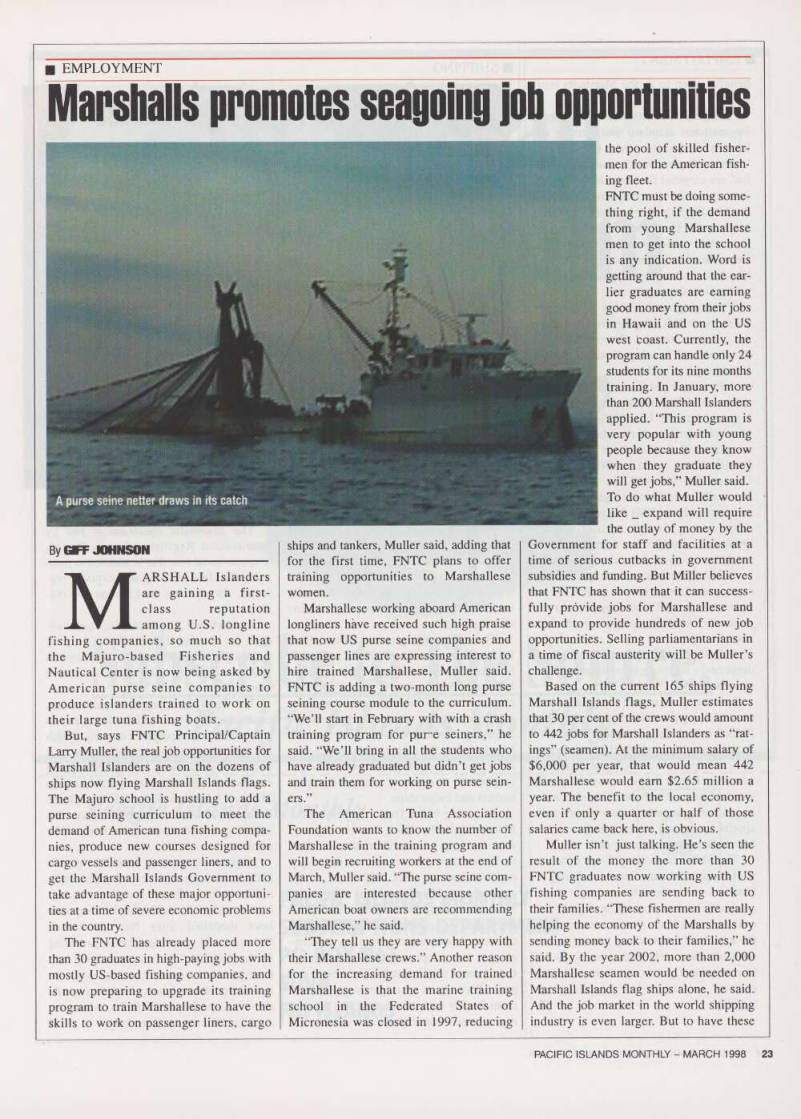
A purse seine netter draws in its catch
benefits open to it, the Marshalls must act.
Bringing Marshall Islands laws up to international standard and getting the Marshalls on to the International Maritime Organisation’s so-called “white list” are essential first steps if the country is to realise the economic benefits that the world shipping market has to offer, Muller said. In a special report prepared for the national Government in December, Muller recommended that the Marshalls take advantage of the job
potential in shipping by:
* Bringing national laws into confor mance with IMO regulations, including the International Convention on Standards and Training, Certification and Watchkeeping for Seafarers.
* Passing legislation requiring that a
minimum of 30 per cent of seamen work ing on Marshall Islands flag ships be Marshall Islanders. If the Marshalls fully complies with the Standards of Training, Certification and Watchkeeping Convention “it will be easier for Marshallese seafarers to gain employ ment not only on RMI flagged ships but also on any foreign register ships,” because the certification from the FNTC would be recognised worldwide, he said.
“This will enhance the expansion of employment opportunities which is the main concern of the Government to reduce the increasing unemployment situ ation.”
Indeed, the Marshalls Government is
desperately seeking job-creating develop
ment projects.
Late last year, it gave the go-ahead to a tuna Joining plant that the shipping line PM&O is backing for Majuro. That plant,
though providing relatively low paying
jobs, is expected to employ at least 300 islanders. But as donor money decreases and the Compact with the US (and its pro vision of guaranteed levels of aid) approaches its end in just three years, the Marshalls prospects are limited.
The FNTC is showing it can turn out well-trained fishermen, and is offering a blueprint to the Government to get thou sands of islanders working on ships in the next ten years. If the Government can get the wheels of bureaucracy turning to act on Muller’s recommendations, it could turn what has essentially been a “pilot project” into a serious job-producing
industry. ■