Women on women
pp. 47-48 · Read in the full issue
Art
By Liz Thompson
A desire to celebrate the work of women photog raphers was the inspira tion behind WOW (Women on Women) an exhibition fea turing the work of eight photogra phers.
The brief given was for them to select a series of images on the subject of women.
The show which is on at Stills Gallery in Sydney from February 18 to March 14 ere
ates a dynamic exhibition, celebrating the diversity of women’s experience.
Ranging of the gritty photojournal
ism of Lorrie Graham to the stylised images of Melissa McCord to the fan tasy world of Wendy McDougall, the exhibition ranges from the everyday to a unique illustration of the dreams, spirit and strength of women as a whole.
Graham chose to show a selection of her hard hitting news images. These include two pictures from Nicaragua, one of two female soldiers carrying guns, the other an intimate portrait of a woman on a bus. At the time Graham took the photograph, the Sandinstas were in power but the United States backed contras had blown up the bus the previous day.
“Anyone who wasn’t a Sandinsta was under a great deal of stress,” says Graham - the expression on the women’s face seems to sum up the situation.
The first female to secure a cadetship in the Sydney Morning Herald in 1975, Graham went on to work for the Observer in London, she was the first staff photogra pher for the National Times and picture editor and chief photographer for the British Times on Sunday. Since then she had travelled extensively and produced two major projects within Australia.
Australians Today, published in 1983, is a superb collection of portraits and inter views with people around the country which highlights the multicultural nature of the community. On the Edge, published
in 1993 and produced with journalist Robert Milliken, explores the crisis which has hit the pockets and hearts of families in rural Australia. Graham’s work is highly acclaimed and is part of collections at the Australian National Gallery in Canberra and the Performing Arts Museum in Victoria.
McCord’s contribution is an example of her distinctive style of poetic colour images. Her book Outback Women, an extraordinary testament to the lives of women living in remote outback Australia,
is now in its sixth print run and McCord is preparing a second edition along with a documentary film to accompany it. Her other second book, A field of Short Poppies produced with Philip Anastassiou, com bines interviews with and photographs of ordinary-extraordinary people. It was nominated for Talking Book of the Year in 1993. One of the images she shows in WOW is a portrait of the wonderful female artist, Vali Myers whose work explores recurring themes of fertility rites, gypsy myths, women’s spirituality and the mirac ulous wonder of creation.
McDougall has, for many years, pho tographed musicians and entertainers and recently moved into the world of theatre. A source which, in many ways, complements
the fertile imagination evident in much of her work.
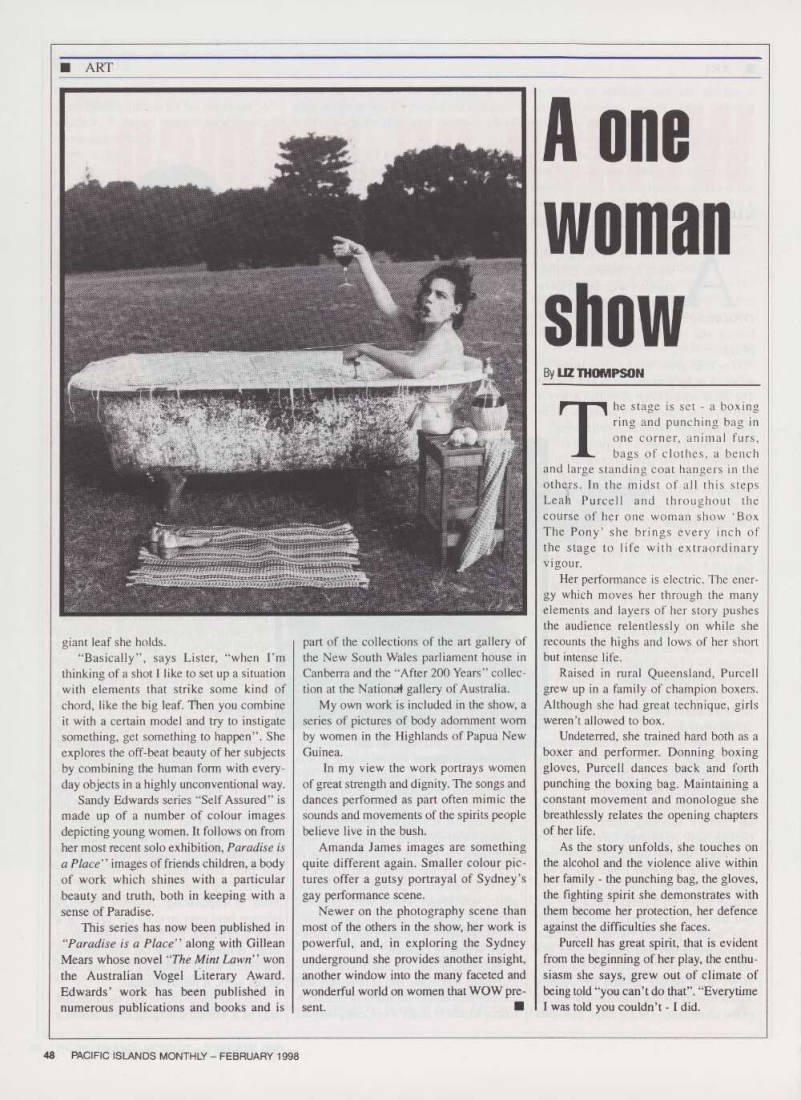
One of the images in WOW depicts a woman in a bath filled with spaghetti in the middle of a field. She appears fairly relaxed and is sipping red wine. Another shows a woman lying at one end of the bath while from the other end, a pair of long hairy legs emerge. On the floor in the front of the image is a towel and a slipper.
The other slipper is in the photograph.
Playfully she creates surreal images which are often both humorous and provocative.
Penny Boyer has chosen to exhibit her work in a different way. Rather than sin gle images she has enlarged contact sheets on which there are nine different frames. These pictures are all of families, different generations of women, grand mother, mother and grandchild.
The work explores the relationships between the women and their home envi ronment. By providing a contact sheet Boyer does not freeze the images in a single frame but allows us to observe the passing of time, the changing of posture, of gesture, of expression, of interaction so that the series of tell time passing, of transitions. Boyer who lives in Canberra is currently working as a photography teacher at the Canberra Institute of
Technology.
Loiuse Lister exhibits an impressive
series of nudes but avoids the cliche of woman as sex object, instead leaving the viewer completely captivated by the con nections she establishes between the female form and the other often natural objects around her. One of the images in WOW shows a pregnant woman surround ed by water melon, holding one in front of her face, the beauty of the relationship between the form of the fruit and of the
body is captivating. Another
woman bent over to echo the shape of a wiry greyhound, her ribcage, like that of dogs, is obvious, again the echo between the forms works brilliantly and, like most of her work, is highly sensual.
Another image shows only the arms and legs of a woman emerging from behind a
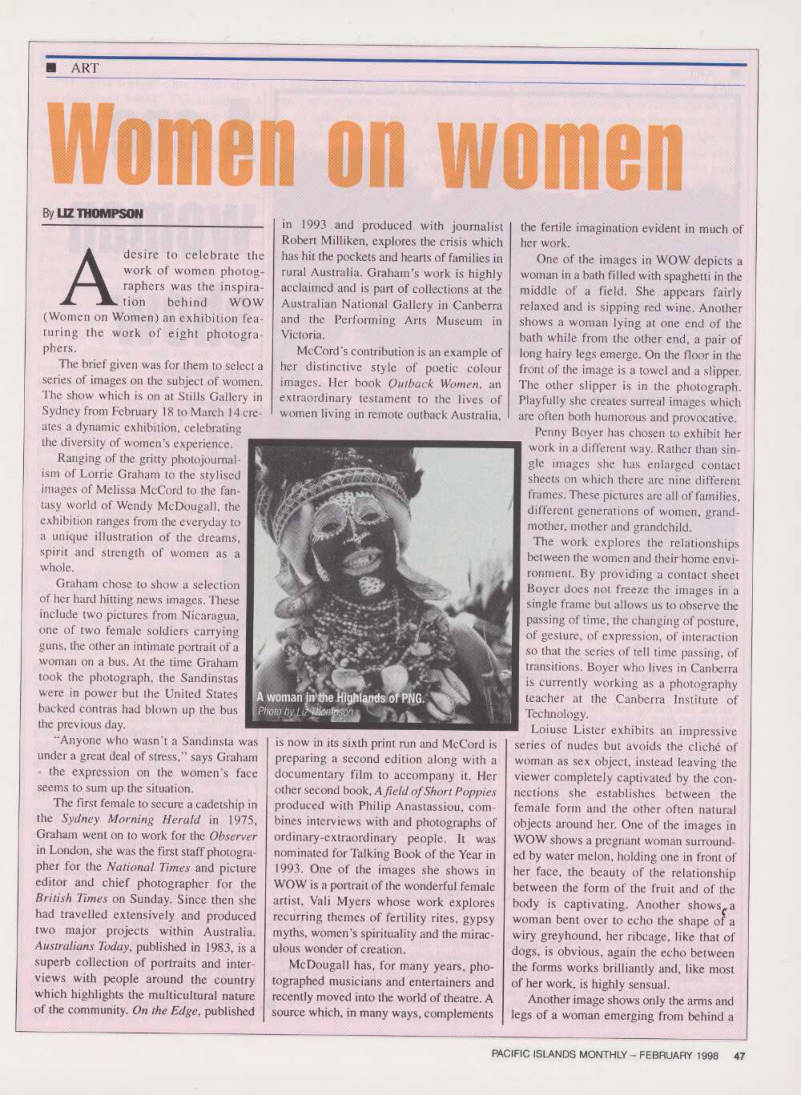
A woman in the Highlands of PNG.
Photo by Liz Thompson
giant leaf she holds.
“Basically”, says Lister, “when I’m thinking of a shot I like to set up a situation with elements that strike some kind of chord, like the big leaf. Then you combine it with a certain model and try to instigate something, get something to happen”. She explores the off-beat beauty of her subjects by combining the human form with every day objects in a highly unconventional way.
Sandy Edwards series “Self Assured” is made up of a number of colour images depicting young women. It follows on from her most recent solo exhibition, Paradise is a Place ” images of friends children, a body of work which shines with a particular beauty and truth, both in keeping with a sense of Paradise.
This series has now been published in "Paradise is a Place ” along with Gillean Mears whose novel “The Mint Lawn ” won the Australian Vogel Literary Award.
Edwards’ work has been published in numerous publications and books and is
part of the collections of the art gallery of the New South Wales parliament house in Canberra and the “After 200 Years” collec tion at the National gallery of Australia.
My own work is included in the show, a series of pictures of body adornment worn by women in the Highlands of Papua New Guinea.
In my view the work portrays women of great strength and dignity. The songs and dances performed as part often mimic the sounds and movements of the spirits people believe live in the bush.
Amanda James images are something
quite different again. Smaller colour pic
tures offer a gutsy portrayal of Sydney’s gay performance scene.
Newer on the photography scene than most of the others in the show, her work is powerful, and, in exploring the Sydney
underground she provides another insight,
another window into the many faceted and wonderful world on women that WOW pre sent. ■