A one
pp. 48-49 · Read in the full issue
woman show
By Liz Thompson
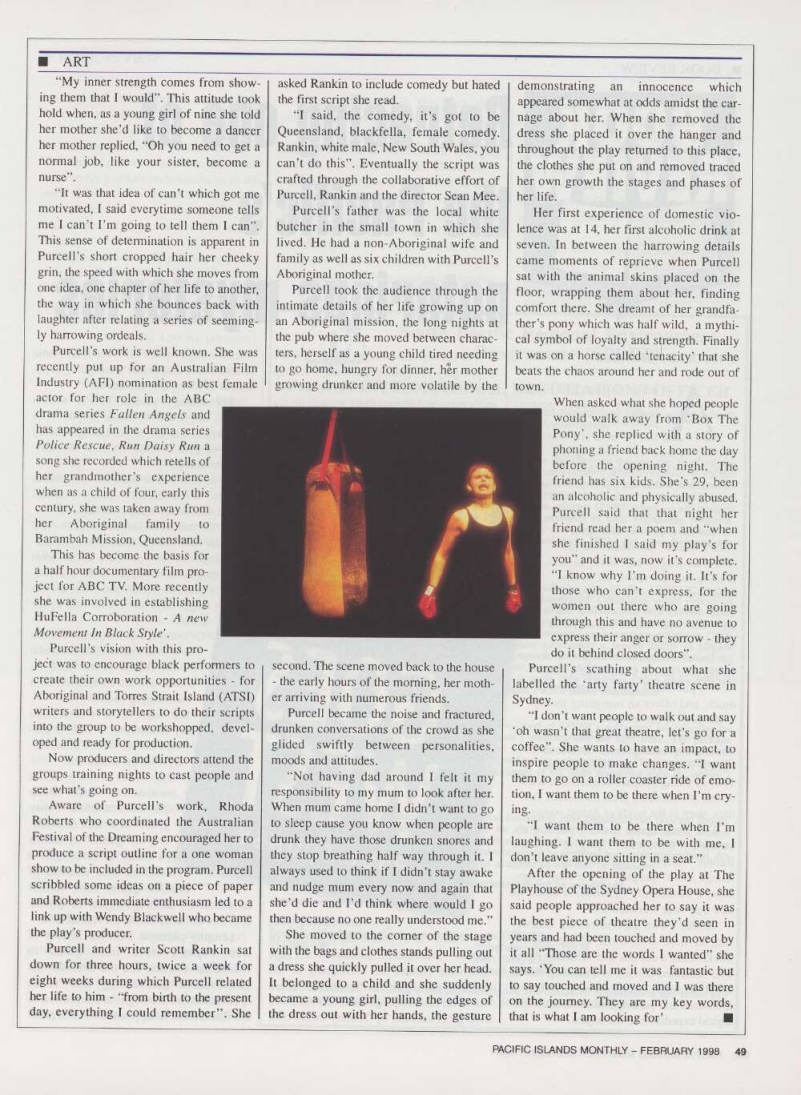
The stage is set - a boxing ring and punching bag in one corner, animal furs, bags of clothes, a bench and large standing coat hangers in the others. In the midst of all this steps Leah Purcell and throughout the course of her one woman show 'Box The Pony’ she brings every inch of the stage to life with extraordinary vigour.
Her performance is electric. The ener gy which moves her through the many elements and layers of her story pushes the audience relentlessly on while she recounts the highs and lows of her short but intense life.
Raised in rural Queensland, Purcell grew up in a family of champion boxers.
Although she had great technique, girls weren’t allowed to box.
Undeterred, she trained hard both as a boxer and performer. Donning boxing gloves, Purcell dances back and forth punching the boxing bag. Maintaining a constant movement and monologue she breathlessly relates the opening chapters of her life.
As the story unfolds, she touches on the alcohol and the violence alive within her family - the punching bag, the gloves, the fighting spirit she demonstrates with them become her protection, her defence against the difficulties she faces.
Purcell has great spirit, that is evident from the beginning of her play, the enthu siasm she says, grew out of climate of being told “you can’t do that”. “Everytime I was told you couldn’t - I did.
“My inner strength comes from show ing them that I would”. This attitude took hold when, as a young girl of nine she told her mother she’d like to become a dancer her mother replied, “Oh you need to get a normal job, like your sister, become a nurse”.
“It was that idea of can’t which got me motivated, I said everytime someone tells me I can’t I’m going to tell them I can”.
This sense of determination is apparent in Purcell’s short cropped hair her cheeky grin, the speed with which she moves from one idea, one chapter of her life to another, the way in which she bounces back with laughter after relating a series of seeming ly harrowing ordeals.
Purcell’s work is well known. She was recently put up for an Australian Film Industry (AFI) nomination as best female
actor for her role in the ABC drama series Fallen Angels and has appeared in the drama series Police Rescue, Run Daisy Run a song she recorded which retells of her grandmother’s experience when as a child of four, early this century, she was taken away from her Aboriginal family to Barambah Mission, Queensland.
This has become the basis for a half hour documentary film pro ject for ABC TV. More recently she was involved in establishing HuFella Corroboration - A new Movement In Black Style’.
Purcell’s vision with this pro
ject was to encourage black performers to create their own work opportunities - for Aboriginal and Torres Strait Island (ATSI) writers and storytellers to do their scripts into the group to be workshopped, devel oped and ready for production.
Now producers and directors attend the groups training nights to cast people and see what’s going on.
Aware of Purcell’s work, Rhoda Roberts who coordinated the Australian Festival of the Dreaming encouraged her to produce a script outline for a one woman show to be included in the program. Purcell scribbled some ideas on a piece of paper and Roberts immediate enthusiasm led to a link up with Wendy Blackwell who became the play’s producer.
Purcell and writer Scott Rankin sat down for three hours, twice a week for eight weeks during which Purcell related her life to him - “from birth to the present day, everything I could remember”. She
asked Rankin to include comedy but hated the first script she read.
“I said, the comedy, it’s got to be Queensland, blackfella, female comedy.
Rankin, white male, New South Wales, you can’t do this”. Eventually the script was crafted through the collaborative effort of Purcell, Rankin and the director Sean Mee.
Purcell’s father was the local white butcher in the small town in which she lived. He had a non-Aboriginal wife and family as well as six children with Purcell’s
Aboriginal mother.
Purcell took the audience through the intimate details of her life growing up on an Aboriginal mission, the long nights at the pub where she moved between charac ters, herself as a young child tired needing to go home, hungry for dinner, her mother growing drunker and more volatile by the
second. The scene moved back to the house - the early hours of the morning, her moth er arriving with numerous friends.
Purcell became the noise and fractured, drunken conversations of the crowd as she glided swiftly between personalities, moods and attitudes.
“Not having dad around I felt it my responsibility to my mum to look after her.
When mum came home I didn’t want to go to sleep cause you know when people are drunk they have those drunken snores and they stop breathing half way through it. I always used to think if I didn’t stay awake and nudge mum every now and again that she’d die and I’d think where would I go then because no one really understood me.”
She moved to the corner of the stage with the bags and clothes stands pulling out a dress she quickly pulled it over her head.
It belonged to a child and she suddenly became a young girl, pulling the edges of the dress out with her hands, the gesture
demonstrating an innocence which appeared somewhat at odds amidst the car nage about her. When she removed the dress she placed it over the hanger and throughout the play returned to this place, the clothes she put on and removed traced her own growth the stages and phases of her life.
Her first experience of domestic vio lence was at 14, her first alcoholic drink at seven. In between the harrowing details came moments of reprieve when Purcell sat with the animal skins placed on the floor, wrapping them about her, finding comfort there. She dreamt of her grandfa ther’s pony which was half wild, a mythi cal symbol of loyalty and strength. Finally it was on a horse called ‘tenacity’ that she beats the chaos around her and rode out of town.
When asked what she hoped people would walk away from ‘Box The Pony’, she replied with a story of phoning a friend back home the day before the opening night. The friend has six kids. She’s 29, been an alcoholic and physically abused.
Purcell said that that night her friend read her a poem and “when she finished I said my play’s for you” and it was, now it’s complete.
“I know why I’m doing it. It’s for those who can’t express, for the women out there who are going through this and have no avenue to express their anger or sorrow - they do it behind closed doors”.
Purcell’s scathing about what she labelled the ‘arty farty’ theatre scene in
Sydney.
“I don’t want people to walk out and say ‘oh wasn’t that great theatre, let’s go for a coffee”. She wants to have an impact, to inspire people to make changes. “I want them to go on a roller coaster ride of emo tion, I want them to be there when I’m cry
ing.
"I want them to be there when I’m laughing. I want them to be with me, I don’t leave anyone sitting in a seat.”
After the opening of the play at The Playhouse of the Sydney Opera House, she said people approached her to say it was the best piece of theatre they’d seen in years and had been touched and moved by it all “Those are the words I wanted” she says. ‘You can tell me it was fantastic but to say touched and moved and I was there on the journey. They are my key words, that is what I am looking for’ ■