A Chip of the old block
pp. 45-46 · Read in the full issue
By Atama Raganivatu
After an absence of six years, the name J Stanley has again appeared on the All
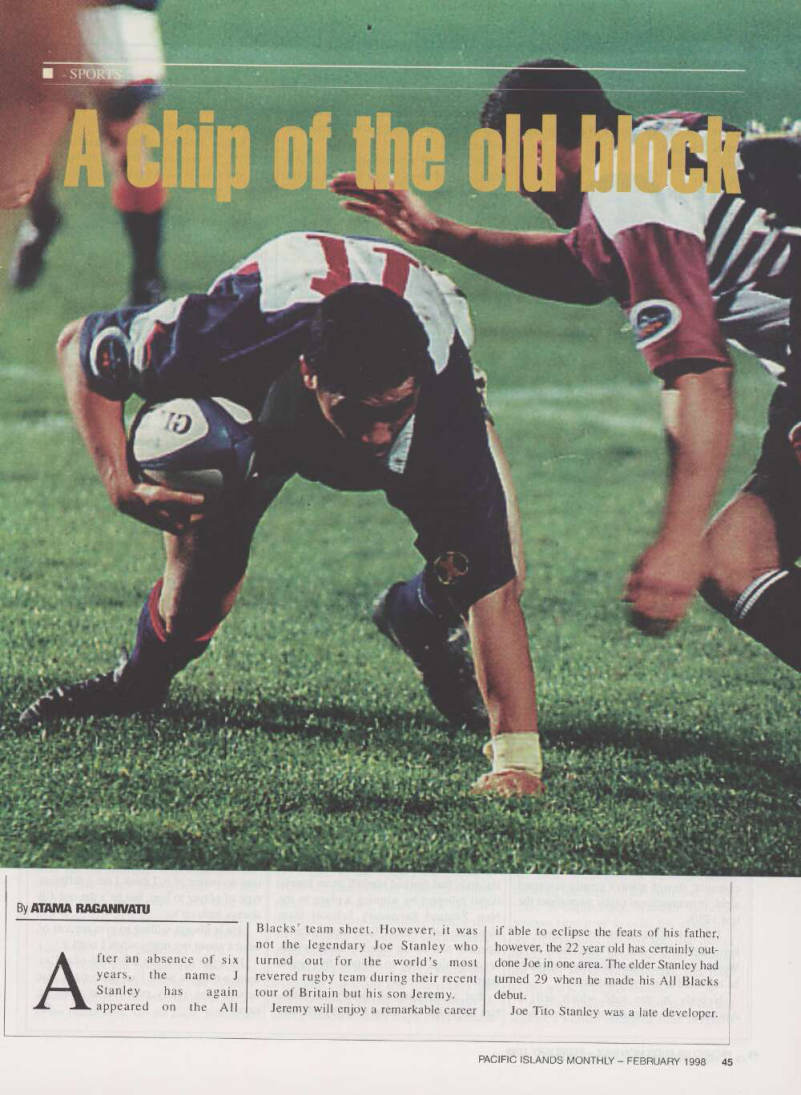
Blacks' team sheet. However, it was not the legendary Joe Stanley who turned out for the world’s most revered rugby team during their recent tour ot Britain but his son Jeremy.
Jeremy will enjoy a remarkable career
if able to eclipse the feats of his father, however, the 22 year old has certainly out done Joe in one area. The elder Stanley had turned 29 when he made his All Blacks debut.
Joe Tito Stanley was a late developer.
He had just celebrated his 25th birthday when initially chosen for the Auckland “A” selection. A call up into the New Zealand sevens combination
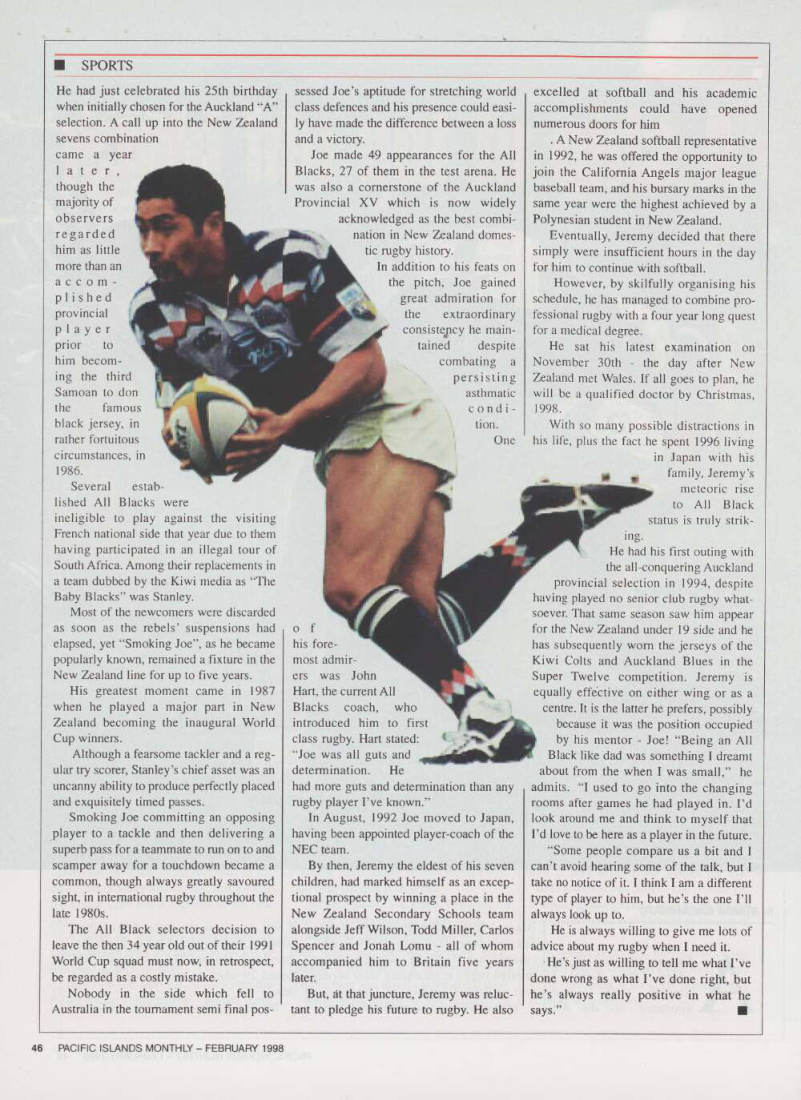
came a year later, though the m majority of 4| observers ■ regarded him as little \ more than an acco m - j plis h e d ' provincial player n prior to him becom ing the third Samoan to don the famous black jersey, in rather fortuitous circumstances, in 1986.
Several estab lished All Blacks were ineligible to play against the visiting French national side that year due to them having participated in an illegal tour of South Africa. Among their replacements in a team dubbed by the Kiwi media as “The Baby Blacks” was Stanley.
Most of the newcomers were discarded as soon as the rebels’ suspensions had elapsed, yet “Smoking Joe”, as he became popularly known, remained a fixture in the New Zealand line for up to five years.
His greatest moment came in 1987 when he played a major part in New Zealand becoming the inaugural World
Cup winners.
Although a fearsome tackier and a reg ular try scorer, Stanley’s chief asset was an uncanny ability to produce perfectly placed and exquisitely timed passes.
Smoking Joe committing an opposing player to a tackle and then delivering a superb pass for a teammate to run on to and scamper away for a touchdown became a common, though always greatly savoured
sight, in international rugby throughout the
late 1980 s.
The All Black selectors decision to leave the then 34 year old out of their 1991 World Cup squad must now, in retrospect, be regarded as a costly mistake.
Nobody in the side which fell to Australia in the tournament semi final pos
sessed Joe’s aptitude for stretching world class defences and his presence could easi ly have made the difference between a loss and a victory.
Joe made 49 appearances for the All Blacks, 27 of them in the test arena. He was also a cornerstone of the Auckland Provincial XV which is now widely
acknowledged as the best combi nation in New Zealand domes tic rugby history. ln addition to his feats on ■K the pitch, Joe gained great admiration for the extraordinary jf consistency he main r Jjm tained despite combating a persisting asthmatic condi |F tion.
' <***'A One
o f * fore most admir ers was John Hart, the current All Blacks coach, who introduced him to first A class rugby. Hart stated; i "Joe all guts and determination. He had more guts and determination than any rugby player I’ve known.”
In August, 1992 Joe moved to Japan, having been appointed player-coach of the NEC team.
By then, Jeremy the eldest of his seven children, had marked himself as an excep tional prospect by winning a place in the New Zealand Secondary Schools team alongside Jeff Wilson, Todd Miller, Carlos Spencer and Jonah Lomu - all of whom accompanied him to Britain five years later.
But, at that juncture, Jeremy was reluc tant to pledge his future to rugby. He also
excelled at softball and his academic accomplishments could have opened numerous doors for him . A New Zealand softball representative in 1992, he was offered the opportunity to
join the California Angels major league
baseball team, and his bursary marks in the same year were the highest achieved by a Polynesian student in New Zealand.
Eventually, Jeremy decided that there simply were insufficient hours in the day for him to continue with softball.
However, by skilfully organising his schedule, he has managed to combine pro fessional rugby with a four year long quest for a medical degree.
He sat his latest examination on November 30th - the day after New Zealand met Wales. If all goes to plan, he will be a qualified doctor by Christmas, 1998.
With so many possible distractions in his life, plus the fact he spent 1996 living in Japan with his m 9 family, Jeremy’s meteoric rise “ lo All Black status is truly strik jKfr ' He had his first outing with fr the all-conquering Auckland provincial selection in 1994, despite having played no senior club rugby what soever. That same season saw him appear for the New Zealand under 19 side and he has subsequently worn the jerseys of the Kiwi Colts and Auckland Blues in the Super Twelve competition. Jeremy is equally effective on either wing or as a centre. It is the latter he prefers, possibly because it was the position occupied ■ by his mentor - Joe! “Being an All * Black like dad was something I dreamt about from the when I was small,” he admits. “I used to go into the changing rooms after games he had played in. I’d look around me and think to myself that I’d love to be here as a player in the future.
“Some people compare us a bit and I can’t avoid hearing some of the talk, but I take no notice of it. I think I am a different type of player to him, but he’s the one I’ll always look up to.
He is always willing to give me lots of advice about my rugby when I need it.
He’s just as willing to tell me what I’ve done wrong as what I’ve done right, but he’s always really positive in what he says.” ■