veitayaki's
pp. 43-44 · Read in the full issue
Sports
veitayaki's winding road to the top
By Atama Raganivatu
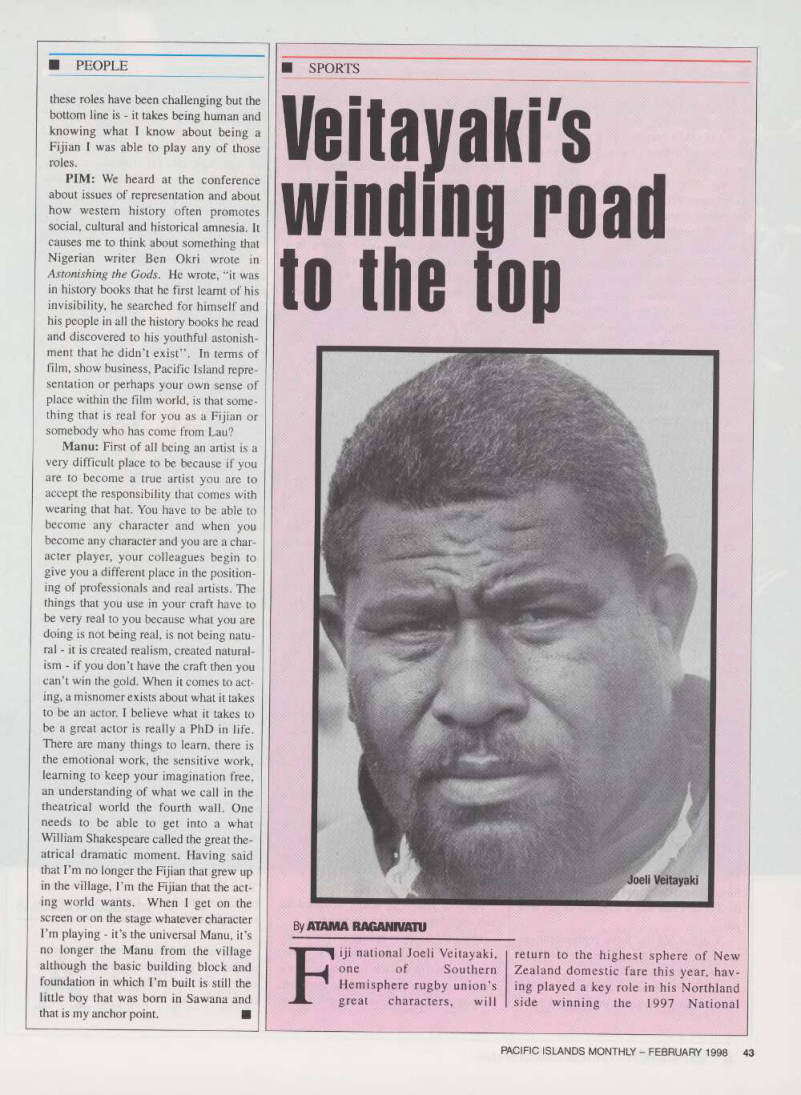
Fiji national Joeli Veitayaki, one of Southern Hemisphere rugby union’s great characters, will
return to the highest sphere of New Zealand domestic fare this year, hav ing played a key role in his Northland side winning the 1997 National
Joeli Veitayaki
Championship Division Two title with a 100 per cent record.
Veitayaki’s reappearance is sure to be welcomed by fans of every division one province.
Not only does the hefty prop inject excitement through his bulldozing upfield surges, he is respected far and wide for the great determination he has displayed in fighting to the top.
Veitayaki would never claim to be a naturally gifted footballer.
As a youth, he was clumsy and over weight and all sporting talent he possessed was well hidden - in sharp contrast to elder brother Viliame Saulekaleka, who won a South Pacific Games gold medal in the 100 metres sprint.
Even in his home village of Yoroi, on the island of Matuku in the Lau Group, young Joeli made little impact on the rugby pitch.
“I often think of Yoroi,” Veitayaki admitted recently. “It’s a beautiful, basic existence back there. There’s no electricity, but you can get by on $5 a week.
“There’s taro growing in the plantations and you can take a boat and catch fish or, if you prefer, you can sleep throughout the day. It’s a magical world.”
Magical world or not, Yoroi is hardly the place to stay if you have ambitions of becoming a leading rugby player and Veitayaki astonished his friends by claim ing he would someday be a leading light in the game. They had every reason to be dumbfounded.
Matuku has just four rugby clubs, yet Veitayaki still experienced difficulty in winning a place in its representative XV.
Once doing so, in 1985 as an 18 year old, he took the first step towards realising his boast.
His form for Matuku in the Island Zone Competition staged at Suva encouraged Veitayaki to move to the capital, where he had relatives and could participate in a
superior grade of rugby.
He played for the Nuku and St John Marist outfits before being recruited by the Suva constabulary and finding that joining the Police Club was a requisite of his new
job.
A debut for the Suva representatives eventuated in 1988 and selection for Fiji B followed 12 months later.
However the next elevation - into the Fijian senior combination - proved more
difficult. Six times he was called upon for trials and on six occasions he was over looked.
Among the selectors concerns over Veitayaki must have been his weight. This often bloated out to 142 kilograms, due to a self-confessed liking for beer and an express dislike of training. His love affair with the amber fluid ended as a conse quence of him waking one morning in a Suva Central Police Station cell with a sore head and little memory of the previous evening, much of which, it transpired, was spent in a brawl at one of the local clubs.
As he lay among the mosquitoes being
mocked by his police colleagues, Veitayaki
pledged he would never allow himself to be similarly embarrassed again. In the six intervening years, he has remained a strict teetotaller.
That fateful episode was a principal turning point in Veitayaki’s career. The next occurred when the former Fiji nation al team coach George Simpkin arranged for him to join the Tokoroa club in New Zealand.
Veitayaki had been keen to play in the land of the long white cloud since 1988, when he made a brief visit to Auckland in the service of Fiji B. While there, he met Eric Rush and the former All Black subse quently wrote regularly to him and sent coaching material, all of which fuelled his enthusiasm.
Tokoroa represented a golden opportu nity. It was one Veitayaki very nearly squandered. Playing in the Waikato paper mill town, he was sent off for biting an
opponent’s ear.
A long suspension resulted, but admin istrators of the King Country Rugby Union mysteriously managed to have this greatly reduced soon after he moved to that province in 1991.
In King Country, Veitayaki really made
his presence felt. A sparsely populated sheep farming area in the middle of the North Island, King Country really had no right to mix it with the big guns of the National Provincial Championship’s divi sion one, but mix it they did.
For four years, The Rams’ thwarted the odds and clung on to top grade status.
Veitayaki came to epitomise their defi ance with his uncompromising style.
Despite a definite lack of elegance, his
commitment was always beyond question.
Veitayaki’s efforts, at last, gained due
recognition by Fiji’s selectors and, in 1994, he was engaged for the national team’s tour of Japan and New Zealand and, merely a year later, the humble Yoroi villager who had only captained his club twice, found himself being asked to skipper his coun try!
“It was a major surprise,” he concedes.
“And it seemed an awesome responsibility, having to make speeches and all that I phoned the selectors and informed them I didn’t want to be captain. They told me either I went on the tour of Ireland and Wales as captain or I wouldn’t go at all. So, I went as captain.”
Since then, Veitayaki has happily relin quished the Fijian captaincy to Greg Smith and King Country, much less eagerly, have relinquished division one rank.
After King Country were relegated at the end of the 1996 season, rumours began to circulate that Veitayaki, then 29, was about to retire. According to those stories, he wished to spend further time with his wife Paea, daughter Raijieli and son Manawa.
The failure of media members to locate him as holidayed on Matuku seemed to add credence to the retirement theory.
When Veitayaki did eventually re emerge, he was still wearing rugby kit and enjoying a short stint with a Welsh Club.
Upon returning to New Zealand, he linked up with Northland and proved the final piece in the jigsaw for a province which had narrowly failed to gain promotion in each of the previous four seasons.
Veitayaki now laughs off the idea of any imminent retirement. He says; “When I was in Wales, I talked to the coach of the French national team and he assured me most prop forwards don’t reach their peaks until they are in their mid-thirties.
“I am happy to carry on and keep my fingers crossed he is right! I have always worked hard to improve my game and I am willing to work hard to maintain my fit ness.”
He also hopes his longevity will enable him to play many more games for Fiji.
“Brad Johnston has done a marvellous job in instilling discipline. I believe we have a wonderful future and I intend to be part of it.”
Although alcohol no longer plays a sig nificant part in Veitayaki’s life, he is happy to be compared with good wines. They improve with age too. ■