Manu-Pacific's pride in Hollywood
pp. 42-43 · Read in the full issue
People
Do Pacific Islanders have a role in Hollywood’s productions? If so, what is our role? Do we want or need to take up show business? Can we use drama to help advance a change (in representation) to the way we prefer? Do we strive to make our unique Pacific art internationally accessible? Are we as Pacific Island nations considering how we might capitalise on the money to be made in this area? Do we take on western mod els and values or should we adapt our practises to suit the time and needs of our societies? These were some of the ques tions that the Fijian award-winning actor, director and producer Manu Tupou, posed to his audience during his recent keynote speech at the University of Hawaii’s Featuring Paradise Conference. The con ference was timed to coincide with the 1997 Hawaiian International Film Festival.
During his presentation Tupou spoke about his life since he left Fiji’s’ shores 30 years ago bound for America in pursuit of an acting career. Film buffs, movie goers, academics and Tupou fans listened atten tively as he displayed his vast knowledge and unique perspective’s regarding Pacific Islanders in film, Broadway and Hollywood. On television he has played roles in Hawaii Five-0 and Magnum P.I.
He has played opposite many of Tinsel
Town’s greats including Katherine
Hepburn, Warren Beatty, Ingrid Bergman,
and Stacy Keach to name a few. Today Tupou is the founder and artistic director of the American Repertory Company, based in Hollywood. In an exclusive inter view with PlM’ s Lili Tuwai, the quietly spoken yet charismatic Tupou reflected on an array of issues and topics that enabled us to glimpse a small fragment of his bril liant mind and the worlds he inhabits. He spoke passionately about his current involvement in a project - that is aiming to establish a national theatre in Fiji, that will highlight and celebrate performing art and culture from the South Pacific region.
Tupou exudes a generosity of spirit and an unwavering love for his country of birth.
PIM: Manu you have been a pioneer for many Pacific people - wealth or mone tary wise where would you say your riches lay?
Manu: My riches lay in acting and now that I’m putting my energy to direct ing, it’s starting to show that it can be in directing also. My riches lay in the trans lation of the words of the writers into images on the stage or on the screen. I believe the core value system that I was brought up in as a child taught me certain essences of cultural values that have given me a sense of meaning in life and I have been able to make money through this. I feel very safe to use the values of being a
Fijian or the logic that I could use to rea son out human emotions, reactions and behaviour and events involving any kind of human drama. I attribute this to having been Fijian born and raised. I am very proud that I can make money as a Fijian, as an actor, director and more recently as a writer also.
PIM: The key concern of the Featuring Paradise conference was to examine repre sentation of Pacific Islanders in film over the past 100 years. Is it true that on Broadway and in Hollywood you have played many characters but never a Fijian or Tongan - does that bother you ?
Manu: While I have enjoyed participat ing in this conference and I must say I think the idea, to hold such a forum is a very noble idea but as I listened to the papers presented over the three day period I was shocked and baffled by the minimal amount of awareness on a craft (acting) which is fundamental to the success of show business whether its film, television or the stages of Broadway. According to research it takes between 10-20 years to really know the art of creation and acting. I have been fortunate to have been trained in New York by the best teachers in the world. Over the years I have been able to tap into my own personal resources to be able to take up the role of a Spanish, a Chinese, a Japanese, a Latino, a South African, an American Indian, a Hawaiian,
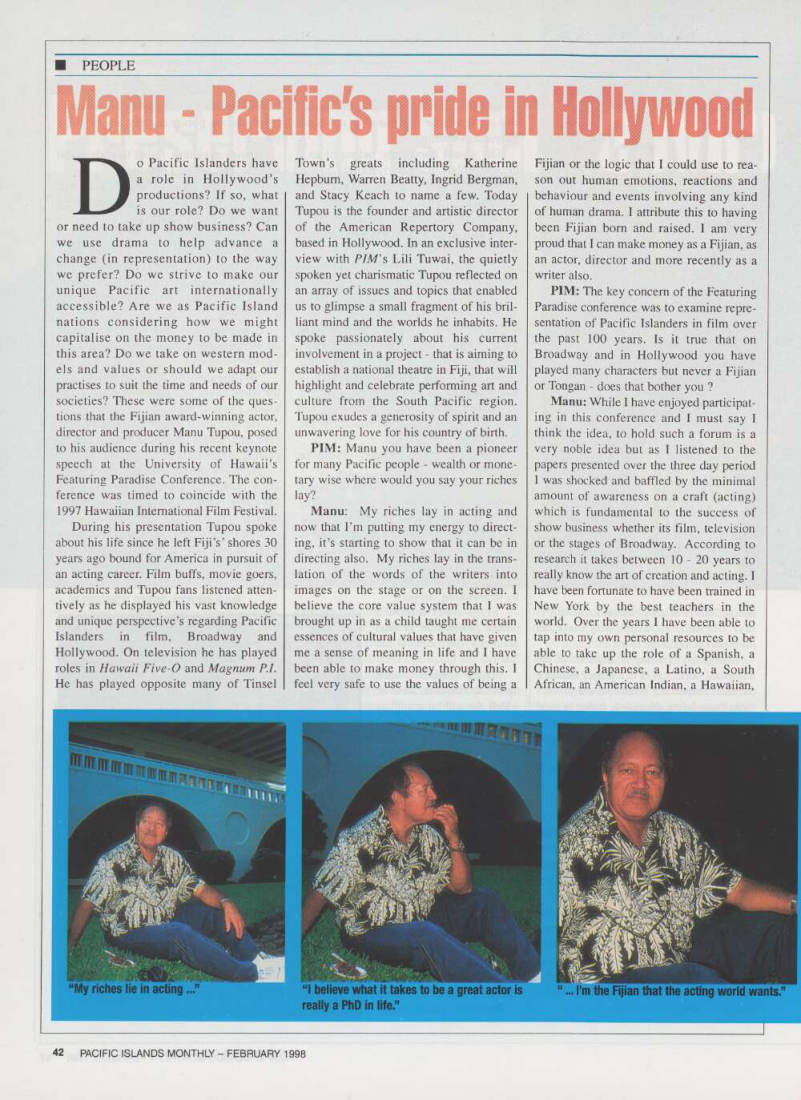
“My riches lie in acting...”
“I believe what it takes to be a great actor is really a PhD in life.”
“...I’m the Fijian that the acting world wants.”
these roles have been challenging but the bottom line is - it takes being human and knowing what I know about being a Fijian I was able to play any of those roles.
PIM: We heard at the conference about issues of representation and about how western history often promotes social, cultural and historical amnesia. It causes me to think about something that Nigerian writer Ben Okri wrote in Astonishing the Gods. He wrote, i4 it was in history books that he first leamt of his invisibility, he searched for himself and his people in all the history books he read and discovered to his youthful astonish ment that he didn’t exist”. In terms of film, show business, Pacific Island repre sentation or perhaps your own sense of place within the film world, is that some thing that is real for you as a Fijian or somebody who has come from Lau?
Manu: First of all being an artist is a very difficult place to be because if you are to become a true artist you are to accept the responsibility that comes with wearing that hat. You have to be able to become any character and when you become any character and you are a char acter player, your colleagues begin to give you a different place in the position ing of professionals and real artists. The things that you use in your craft have to be very real to you because what you are doing is not being real, is not being natu ral - it is created realism, created natural ism - if you don’t have the craft then you can’t win the gold. When it comes to act ing, a misnomer exists about what it takes to be an actor. I believe what it takes to be a great actor is really a PhD in life.
There are many things to leam, there is the emotional work, the sensitive work,
learning to keep your imagination free,
an understanding of what we call in the theatrical world the fourth wall. One needs to be able to get into a what William Shakespeare called the great the atrical dramatic moment. Having said that I’m no longer the Fijian that grew up in the village, I’m the Fijian that the act ing world wants. When I get on the screen or on the stage whatever character I’m playing - it’s the universal Manu, it’s no longer the Manu from the village although the basic building block and foundation in which I’m built is still the little boy that was bom in Sawana and that is my anchor point. ■