Preserving sacred buri[?] caves
pp. 40-41 · Read in the full issue
Archaeology
By Florence Syme-Buchanan
Dark and still. These are the resting places of hundreds of long-dead Polynesians, the sacred burial caves of Atiu and Mangaia in the Cook Islands.
They are the remains of the men and women of dramatic legends; tales of war fare and love, of cannibalism and conquer ing warriors.
But Atiu elders don’t really approve of their legends being told to outsiders. They prefer to be thought of as God-fearing, staunch Christians, glossing over their roots among a warring people who killed and sometimes ate each other.
It is difficult to find any elder who will tell the stories of their ancestors. More dif ficult still to find any young people who know the unabridged legends of the caves as supposedly passed on from generation to generation.
Some young people complain that the true legends are not being passed on and
they are missing out on their heritage.
Like Koro, a young Atiuan who some times guides small tours through some of the caves but doesn’t like to tell any stories because he doesn’t know if they are true.
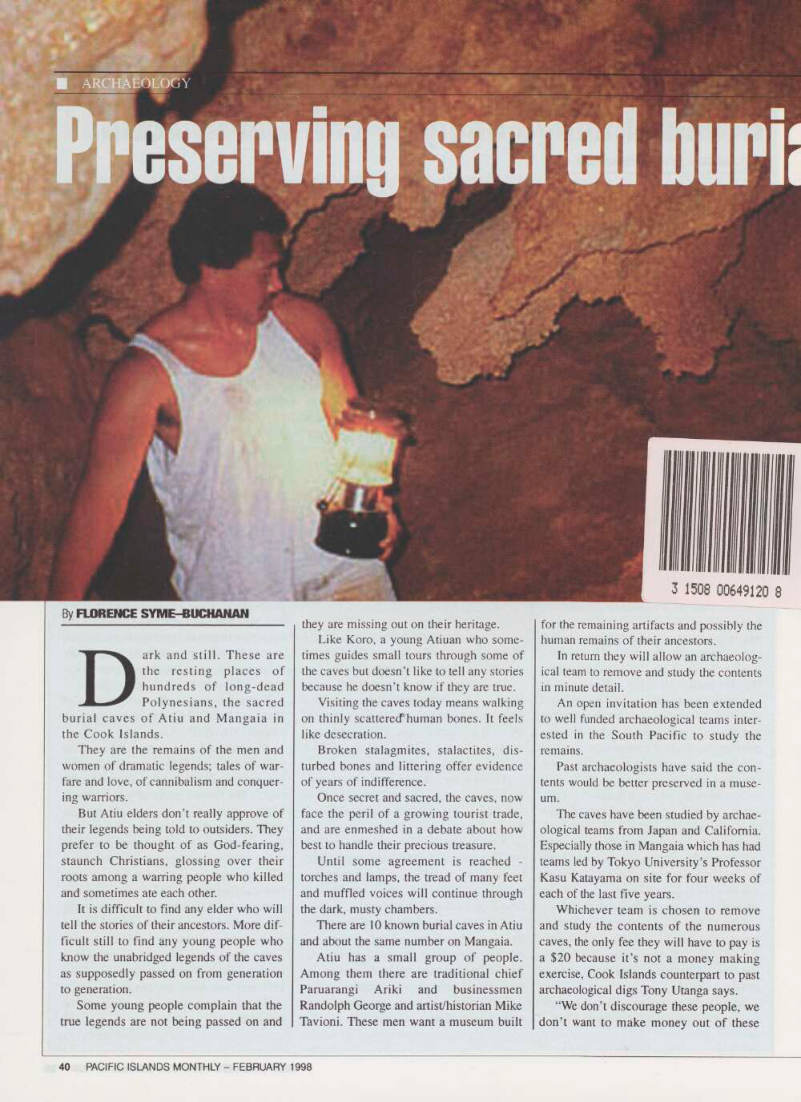
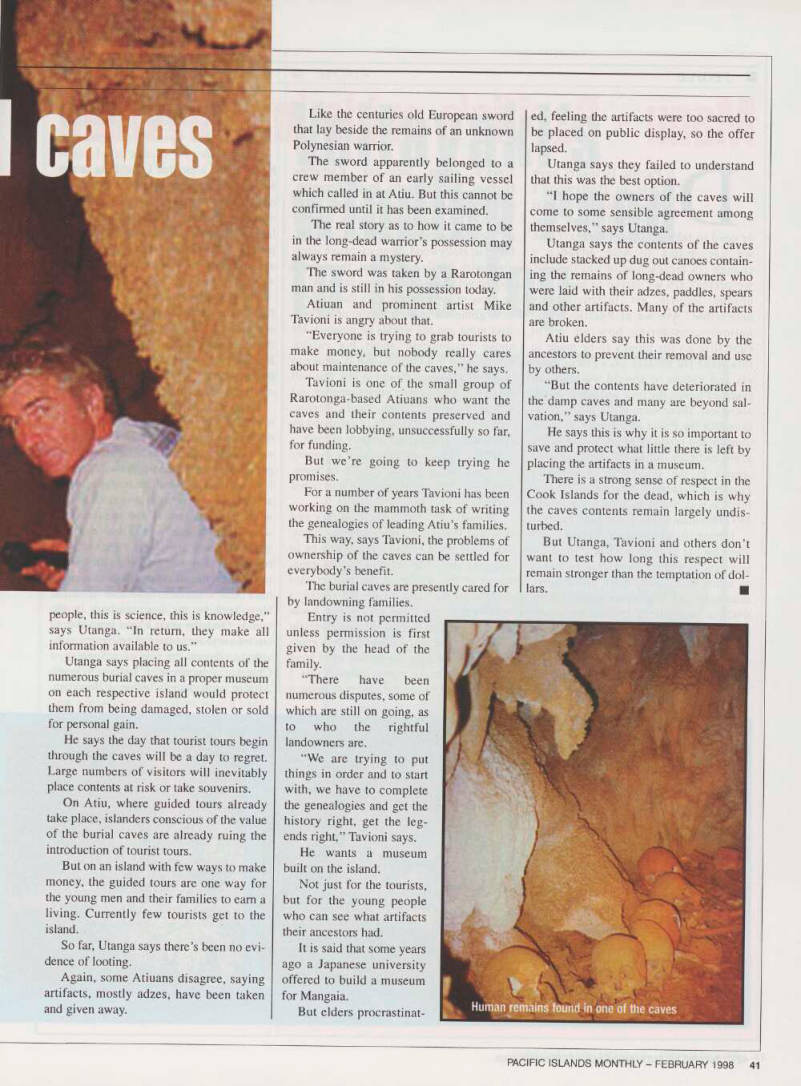
Visiting the caves today means walking on thinly scattered^human bones. It feels like desecration.
Broken stalagmites, stalactites, dis turbed bones and littering offer evidence of years of indifference.
Once secret and sacred, the caves, now face the peril of a growing tourist trade, and are enmeshed in a debate about how best to handle their precious treasure.
Until some agreement is reached torches and lamps, the tread of many feet and muffled voices will continue through the dark, musty chambers.
There are 10 known burial caves in Atiu and about the same number on Mangaia.
Atiu has a small group of people.
Among them there are traditional chief Paruarangi Ariki and businessmen Randolph George and artist/historian Mike Tavioni. These men want a museum built
for the remaining artifacts and possibly the human remains of their ancestors.
In return they will allow an archaeolog ical team to remove and study the contents in minute detail.
An open invitation has been extended to well funded archaeological teams inter ested in the South Pacific to study the remains.
Past archaeologists have said the con tents would be better preserved in a muse um.
The caves have been studied by archae ological teams from Japan and California.
Especially those in Mangaia which has had teams led by Tokyo University’s Professor Kasu Katayama on site for four weeks of each of the last five years.
Whichever team is chosen to remove and study the contents of the numerous caves, the only fee they will have to pay is a $2O because it’s not a money making exercise, Cook Islands counterpart to past archaeological digs Tony Utanga says.
“We don’t discourage these people, we don’t want to make money out of these
people, this is science, this is knowledge,” says Utanga. “In return, they make all information available to us.”
Utanga says placing all contents of the numerous burial caves in a proper museum on each respective island would protect them from being damaged, stolen or sold for personal gain.
He says the day that tourist tours begin through the caves will be a day to regret.
Large numbers of visitors will inevitably place contents at risk or take souvenirs.
On Atiu, where guided tours already take place, islanders conscious of the value of the burial caves are already ruing the introduction of tourist tours.
But on an island with few ways to make money, the guided tours are one way for the young men and their families to earn a living. Currently few tourists get to the island.
So far, Utanga says there’s been no evi dence of looting.
Again, some Atiuans disagree, saying artifacts, mostly adzes, have been taken and given away.
Like the centuries old European sword that lay beside the remains of an unknown
Polynesian warrior.
The sword apparently belonged to a crew member of an early sailing vessel which called in at Atiu. But this cannot be confirmed until it has been examined.
The real story as to how it came to be in the long-dead warrior’s possession may always remain a mystery.
The sword was taken by a Rarotongan man and is still in his possession today.
Atiuan and prominent artist Mike Tavioni is angry about that.
“Everyone is trying to grab tourists to make money, but nobody really cares about maintenance of the caves,” he says.
Tavioni is one of the small group of Rarotonga-based Atiuans who want the caves and their contents preserved and have been lobbying, unsuccessfully so far,
for funding.
But we’re going to keep trying he promises.
For a number of years Tavioni has been working on the mammoth task of writing the genealogies of leading Atiu’s families.
This way, says Tavioni, the problems of ownership of the caves can be settled for everybody’s benefit.
The burial caves are presently cared for
by landowning families.
Entry is not permitted unless permission is first given by the head of the
family.
“There have been numerous disputes, some of which are still on going, as to who the rightful landowners are.
“We are trying to put things in order and to start with, we have to complete the genealogies and get the history right, get the leg ends right,” Tavioni says.
He wants a museum built on the island.
Not just for the tourists, but for the young people who can see what artifacts their ancestors had.
It is said that some years
ago a Japanese university
offered to build a museum
for Mangaia.
But elders procrastinat
ed, feeling the artifacts were too sacred to be placed on public display, so the offer
lapsed.
Utanga says they failed to understand that this was the best option.
“I hope the owners of the caves will come to some sensible agreement among themselves,” says Utanga.
Utanga says the contents of the caves include stacked up dug out canoes contain ing the remains of long-dead owners who were laid with their adzes, paddles, spears and other artifacts. Many of the artifacts are broken.
Atiu elders say this was done by the ancestors to prevent their removal and use by others.
“But the contents have deteriorated in the damp caves and many are beyond sal vation,” says Utanga.
He says this is why it is so important to save and protect what little there is left by placing the artifacts in a museum.
There is a strong sense of respect in the Cook Islands for the dead, which is why the caves contents remain largely undis turbed.
But Utanga, Tavioni and others don’t want to test how long this respect will remain stronger than the temptation of dol lars. ■
Human remains found in one of the caves