Freedom's gains and setbacks in the Pacific
p. 37 · Read in the full issue
By Susan Prokop
Some of the most encourag ing trends” in freedom and
democracy are occurring in
the Asia/Pacific region according to an organisation that mon itors political rights and civil liberties around the world. In its annual Survey of Freedom, Freedom House reported that two-thirds of the countries in the Asia/Pacific region - some 24 coun tries - are now electoral democracies.
Using regional experts, consultants and human rights specialists, Freedom House has been compiling an annual assessment of electoral democracies, constitutional monarchies, emerging democracies and totalitarian regimes since 1955. As its 1997 report states, the Survey of Freedom “does not rate governments per se but rather the rights and freedoms individuals have in each country and territory.” While govern ment policies and actions have a signifi cant impact on peoples’ rights, the survey also takes into account situational factors such as war or terrorism which may also affect political and civil freedoms.
According to the survey, at the end of 1997, there were 81 countries listed in the survey as free, up two from 1996. Fifty seven countries were identified as partly free, down from 59 the year before.
Representing no change from last year, 53 nations were ranked as not free.
Within the categories of free, partly free and not free, countries are evaluated on a variety of factors and given a numerical ranking from one to seven. These factors include questions such as - are government officials selected through free and fair elections? Are rights to autonomy and par ticipation for cultural, ethnic, religious and other minority groups protected? Is the media free and independent? Is there an
independent judiciary? Is there protection
from political terror? Are individuals free from exploitation by employers, landlords, bureaucrats or union leaders?
A ranking of one goes to countries that are free and a rating of seven is assigned to the most repressive nations. Countries can have a ranking of one to 2.5 and still be considered free. Nations ranked three to five are considered partly free and coun tries ranked from 5.5 to seven fall into the
not free category. Free countries are defined as those in which basic civil liber ties and political rights are respected.
Those labelled partly free generally have limited political rights and civil liberties which often exist within an environment of corruption, ethnic unrest, civil war and ineffective law enforcement. Those coun tries designated not free are typically run by authoritarian or totalitarian regimes that deny civil liberties and suppress basic
human rights.
Of the 38 nations and territories in the Asia/Pacific region, the Survey of Freedom placed 16 in the free column, 11 under partly free and 11 under not free.
The free category not only included the large established democracies like Australia and New Zealand but also small countries like Kiribati, Marshall Islands and Tuvalu. All these nations received the
highest numerical rankings including
Palau, at a rating of 1.5 and Nauru, Vanuatu, Western Samoa with ratings of two. Among the nations identified as part ly free are Papua New Guinea with three, Fiji with 3.5 and Tonga with four.
American Samoa and Guam attained the highest, both rating one in the free cat egory while their sister territory, the Commonwealth of the Northern Marianas achieved only 1.5. The lower rating of
CNMI is no doubt due to ongoing reports of labour abuses and abridgement of immi grant workers rights in that territory.
Ratings among othbr Pacific territories included the Cook Islands and French Polynesia both with 1.5, Wallis and Futuna, 2 and New Caledonia with 2.5 The Freedom House report listed five events during 1997 that represented the greatest gains for freedom. Among those events was the rejection of what it called “Asian values”, which have sometimes been used by certain governments to justi fy strict controls on the press or inattention to labour rights and civil liberties.
The survey also describes seven coun tries in which erosion of freedom took place this included Micronesia which had received the highest rating of one in a pre vious study (PIM February 1996) but slipped to a 1.5 ranking largely because, Freedom House said, “press inquiry was stifled.”
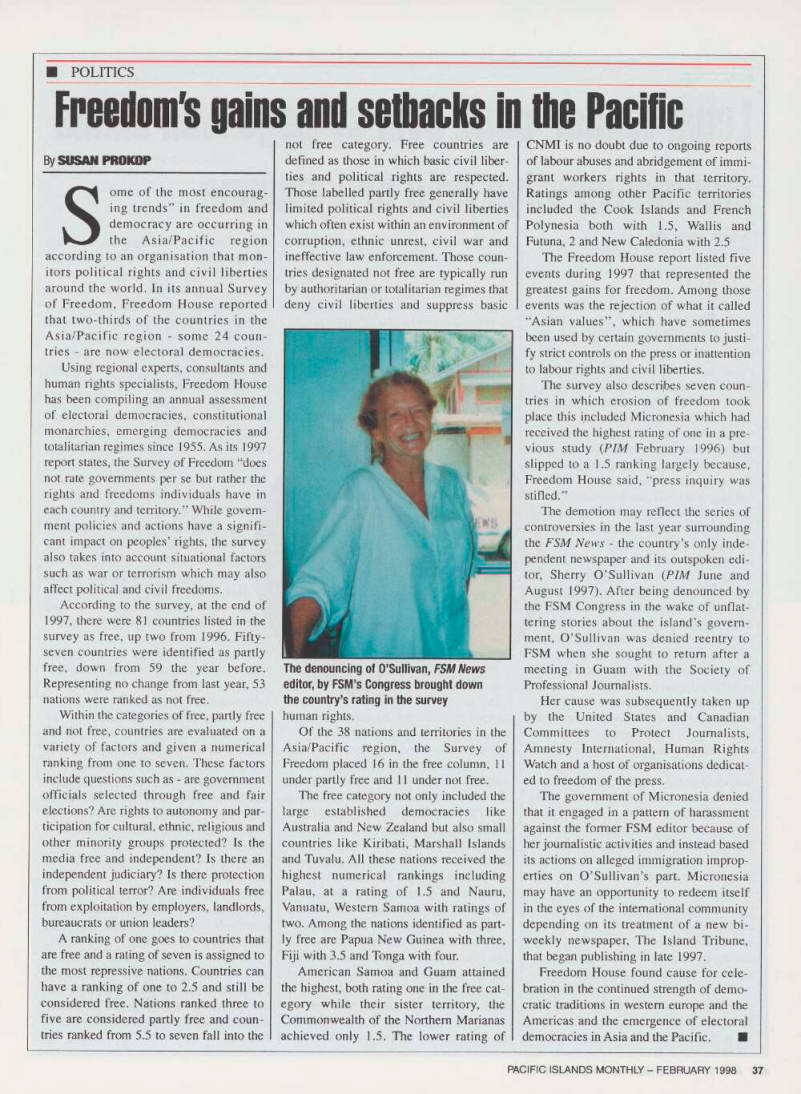
The demotion may reflect the series of controversies in the last year surrounding the FSM News - the country’s only inde pendent newspaper and its outspoken edi tor, Sherry O’Sullivan (PIM June and August 1997). After being denounced by the FSM Congress in the wake of unflat tering stories about the island’s govern ment, O’Sullivan was denied reentry to FSM when she sought to return after a meeting in Guam with the Society of Professional Journalists.
Her cause was subsequently taken up by the United States and Canadian Committees to Protect Journalists, Amnesty International, Human Rights Watch and a host of organisations dedicat ed to freedom of the press.
The government of Micronesia denied that it engaged in a pattern of harassment against the former FSM editor because of her journalistic activities and instead based its actions on alleged immigration improp erties on O’Sullivan’s part. Micronesia may have an opportunity to redeem itself in the eyes of the international community depending on its treatment of a new bi weekly newspaper, The Island Tribune, that began publishing in late 1997.
Freedom House found cause for cele bration in the continued strength of demo cratic traditions in western europe and the Americas and the emergence of electoral democracies in Asia and the Pacific. ■
The denouncing of O’Sullivan, FSM News editor, by FSM’s Congress brought down the country’s rating in the survey