Leadership struggle on Tuvalu
pp. 35-36 · Read in the full issue
Politics
By Michael Field
Tuvalu might be small and remote but when it comes to dirty politics they are remarkably grubby.
The country, which Prime Minister
Bikenibeu Paeniu fears might be the world’s first causality from global warming, faces a general election on March 26 with the 12-seat parliament scheduled to meet 10 days later to elect a prime minister.
Paeniu, who is confident of returning, faces allegations of sexual abuse which he firmly denies and of impropriety over some mysterious Italian- German money.
Paeniu comes from Nukulaelae, 300 voters, where in 1993 he defeated one time finance minister Henry Naisali, who had just finished his term as secretary-general of the South Pacific Forum.
It was a ballot of great bitter ness and severe allegations have resurfaced this time around after an airing also in the last session of parliament.
Paeniu is accused of sexual wrong-doings which, in an interview with PIM, he firmly denies.
“The matter has been inves tigated by the police, they were all political plots and it has been closed,” Paeniu said.
When it came up in parlia ment, he gained popularity over his han dling of the issue, he said.
During the campaign other allegations have also surfaced, including claims that Paeniu was educating his children in Britain at the taxpayers expense, that MPs were flying frequently first class and that accounts were unaudited.
Paeniu, whose children are now with him in Tuvalu, agreed there was a lot of nastiness in the campaign.
“The problem is our people do not
understand the democracy you guys are used to, you vote on principles and plat forms and party lines. Here they vote more on friendship, family and really the princi ples are not important.”
He said politicians, such as Naisali, “blacked politics” as well.
“He tried very hard on the sexual alle gations and raised it in my island commu nity to try and run me down. Nothing hap pened ... It was really dirty politics.”
He said Nukulaelae had early this year decided they did not want any local elec tions, preferring that Paeniu return uncon tested. At the time of writing Naisali was not standing again, although was reconsid ering his position.
Tuvalu (“eight together”), 1046 km north-west of Fiji, has a population of
10,200 living on nine atolls, none more than 4.5 metres above sea-level, with a combined land area of 26 square kilome tres scattered across an exclusive econom ic zone of 1.3 million square kilometres.
Around 40 per cent of Funafuti, the seri ously overcrowded capital, is uninhabitable
because of pits and an airstrip dug out of the coral by United States troops in World War 11.
Tuvalu has a curious parlia ment - only one of the 12 members is without some kind of title and while their are no parties, government is a coali ■ tion of family and island inter i ests.
I Paeniu first became prime minister in 1989, defeating Dr Tom'asi Puapua. Paeniu held office until December 1993 elections when Kamuta Latasi took over. He survived until ; December 1996 when Paeniu I took control again.
Tuvalu is one of only seven states in the world not a mem ber of the United Nations yet it is in curious negotiations with I an unknown Italian who lives I in Germany, with the made-up I sounding name of Giovanni Di
Loreto.
I He says he has an agreement i with Tuvalu to become their I ambassador to the Vatican. ;He has paid A$ 15,000 i (SUS9OOO) into a Tuvalu gov- I ernment deposit account and when his accreditation comes through he has promised Asl.s
million ($US900,000) to construct a “boarding school for students from the outer islands”.
Tuvalu has 100 Catholics and one
priest.
Naisali suggests the money and the arrangement is of some benefit to Paeniu, but the prime minister washes his hands of the affair and says it was the product of Latasi.
“I have completely closed contacts with (Di Loreto),” Paeniu said. “This gentleman
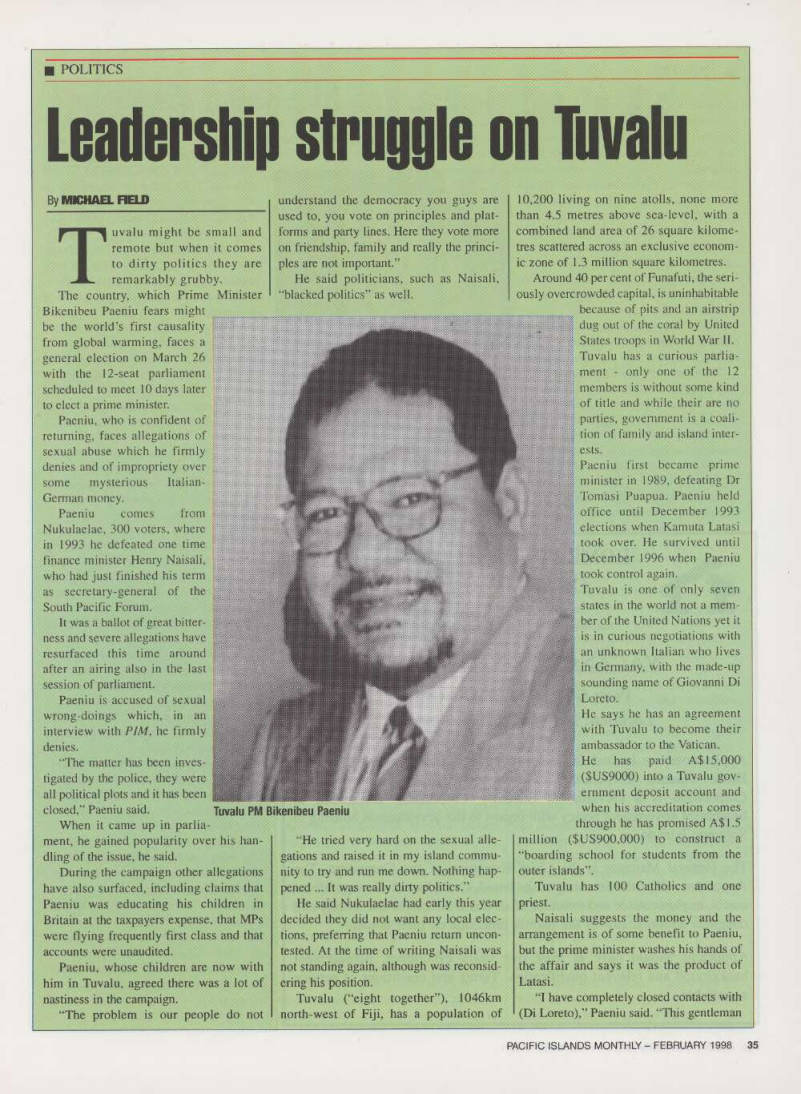
Tuvalu PM Bikenibeu Paeniu
had deals with the previous government.”
Paeniu said Latasi in December 1996, upon his return from Rome, “deposited a huge amount of money in the ANZ Bank in Suva.”
He said the money was not in Tuvalu and the government did not know where it was.
New Zealand based Papal Nuncio Archbishop Patrick Coveney said he was surprised at the affair, saying Tuvalu would have to establish diplomatic relations with the Vatican before appointing an ambas sador.
Under the Lateran Treaty of 1929 diplo mats cannot be accredited both to Rome and the Vatican.
It also sets up the tax free status of the separate Vatican State. People who work for the Vatican or who are accredited to the
Vatican, enjoy advantageous shopping
concessions which allow them to make a fortune on selling in Italy.
Paeniu goes to the polls with a conflict ing messages having told the developed world that because of their greenhouse gas emissions his nation is sinking.
To his own people, as he faces the gen eral election, the message is that his gov ernment, and God, are going to look after them.
“It is really normal living here in Tuvalu,” he says. “There is no fear at all, we have a faith in God and God will let us continue to live in our homeland.”
Now living in Auckland, Naisali admits
there is deep bitterness.
“It’s a dictatorship in Tuvalu,” he said.
"Paeniu believes he has more power than he really has under the constitution.”
Naisali’s main worry centres on the fate of Tuvalu Trust Fund he established in 1987, now worth around Ass 7 million (SUS 34 million) and yielding around As 7 million (SUS 4.2 million) annually.
Australia, Great Britain, Japan, South Korea and New Zealand set up the self perpetuating fund and they allow Tuvalu to set its own development priorities using
the earnings.
Although Tuvalu cannot unilaterally
break into the principal, Naisali believes the politicians are cutting back on re investing in the fund and are tempted to cash it up.
“I am not at all confident that Tuvalu will survive the next three or four years,” he said.
The more intriguing side of Tuvalu’s modest earnings is its telephone service which, thanks to a Sydney company, LSE Technology Pty, is now one of the world’s leading sex telephone servers.
Tuvalu’s 688 area code appeared in magazines around the world offering a variety of telephone sex services. None of the calls were actually answered in Tuvalu but the country made money on the area code.
For a country whose motto was “Tuvalu for God” it was embarrassing and Paeniu last year took the high moral ground and suggested it would be cut back, but it pro duces 10 per cent of the country’s revenue although it is now diminishing.
Paeniu said the phone services were
being moved over to gambling operations,
mainly out of Australia.
Tuvalu is, at the end of the day, an arti ficial state with few reasons for being one.
Without an airline, Tuvalu’s unity depends on the now ageing government vessel Nivaga.
The deep sea wharf at Funafuti is crum bling away and the hospital is in disrepair.
Little has been done to plan replacements.
Tuvalu has suffered with the return of the around 1000 people from the depleted phosphate mines on Nauru. They have come home to no jobs and little prospect of any.
These issues, rather than the Vatican and sex, are issues of greater concern to the tiny nation. ■
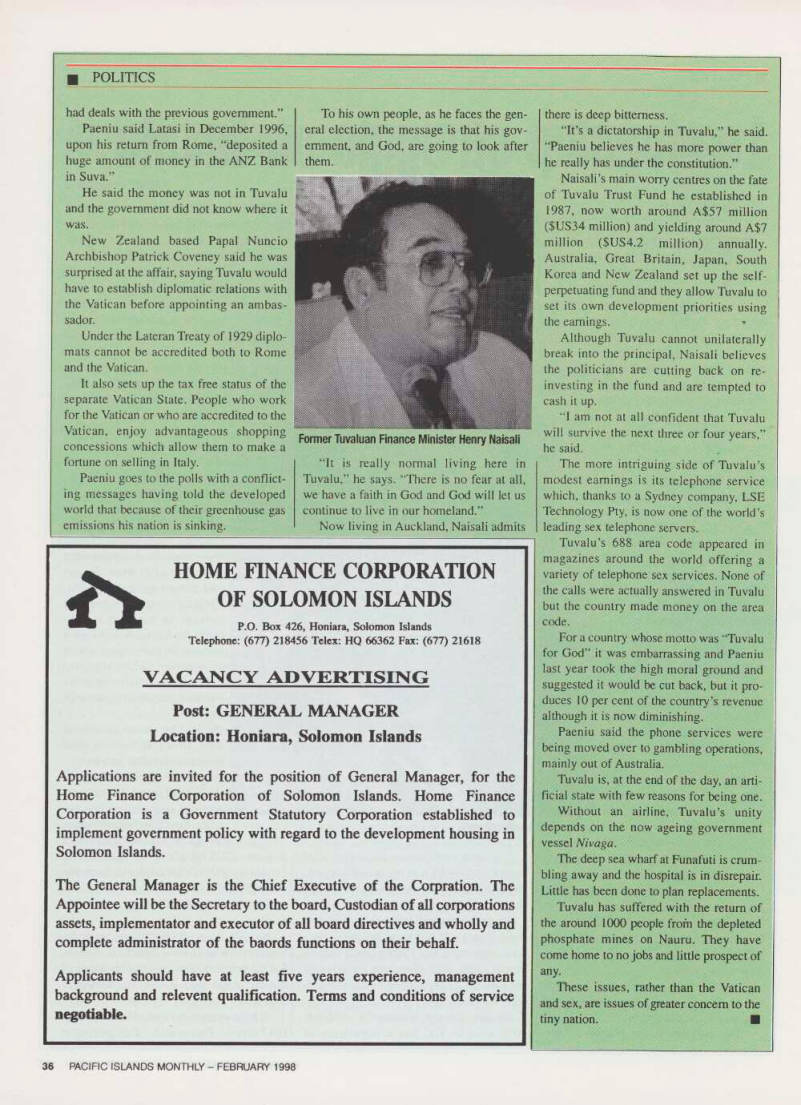
Former Tuvaluan Finance Minister Henry Naisali