Airline tragedy prompts family support act
p. 34 · Read in the full issue
Legislation
By Susan Prokop
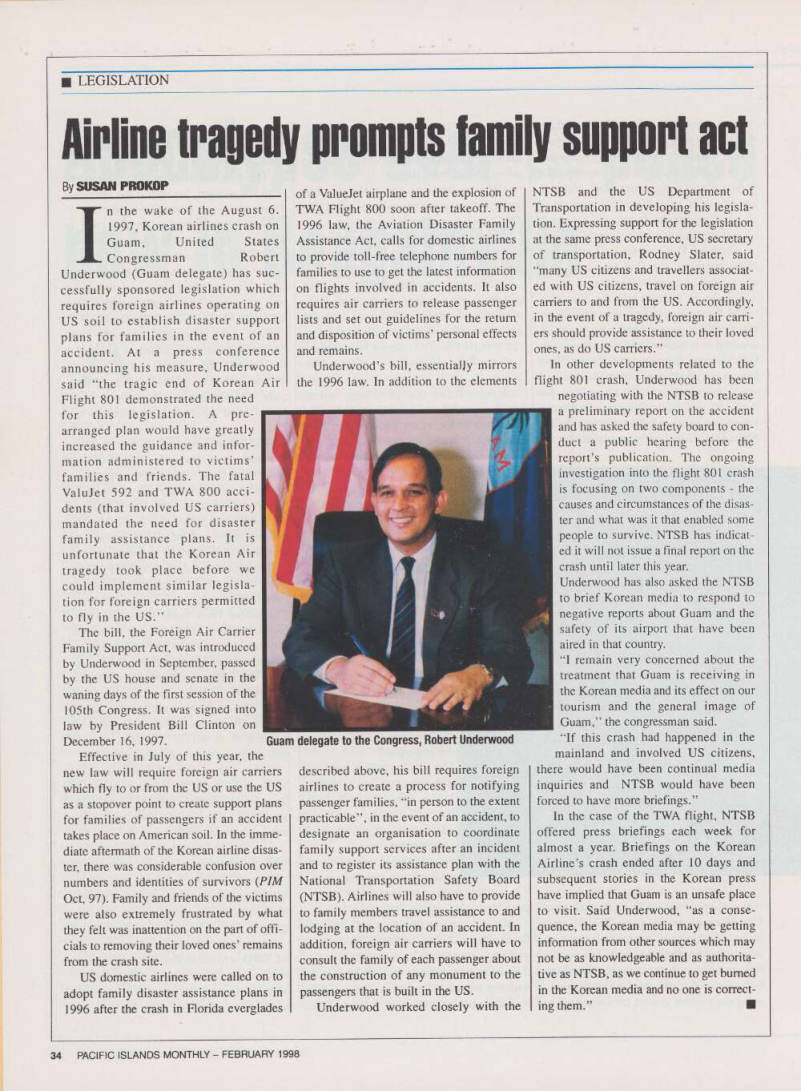
In the wake of the August 6. 1997, Korean airlines crash on Guam, United States Congressman Robert Underwood (Guam delegate) has suc cessfully sponsored legislation which requires foreign airlines operating on US soil to establish disaster support plans for families in the event of an accident. At a press conference announcing his measure, Underwood said “the tragic end of Korean Air
Flight 801 demonstrated the need for this legislation. A pre arranged plan would have greatly increased the guidance and infor mation administered to victims’ families and friends. The fatal ValuJet 592 and TWA 800 acci dents (that involved US carriers) mandated the need for disaster family assistance plans. It is unfortunate that the Korean Air tragedy took place before we could implement similar legisla tion for foreign carriers permitted to fly in the US.”
The bill, the Foreign Air Carrier Family Support Act, was introduced by Underwood in September, passed by the US house and senate in the waning days of the first session of the 105th Congress. It was signed into law by President Bill Clinton on December 16, 1997.
Effective in July of this year, the new law will require foreign air carriers which fly to or from the US or use the US as a stopover point to create support plans for families of passengers if an accident takes place on American soil. In the imme diate aftermath of the Korean airline disas ter, there was considerable confusion over numbers and identities of survivors (PIM Oct, 97). Family and friends of the victims were also extremely frustrated by what they felt was inattention on the part of offi cials to removing their loved ones’ remains from the crash site.
US domestic airlines were called on to adopt family disaster assistance plans in 1996 after the crash in Florida everglades
of a Value Jet airplane and the explosion of TWA Flight 800 soon after takeoff. The 1996 law, the Aviation Disaster Family Assistance Act, calls for domestic airlines to provide toll-free telephone numbers for families to use to get the latest information on flights involved in accidents. It also requires air carriers to release passenger lists and set out guidelines for the return and disposition of victims’ personal effects and remains.
Underwood’s bill, essentially mirrors the 1996 law. In addition to the elements
described above, his bill requires foreign airlines to create a process for notifying passenger families, "in person to the extent practicable”, in the event of an accident, to designate an organisation to coordinate family support services after an incident and to register its assistance plan with the
National Transportation Safety Board
(NTSB). Airlines will also have to provide to family members travel assistance to and lodging at the location of an accident. In addition, foreign air carriers will have to consult the family of each passenger about the construction of any monument to the passengers that is built in the US.
Underwood worked closely with the
NTSB and the US Department of Transportation in developing his legisla tion. Expressing support for the legislation at the same press conference, US secretary of transportation, Rodney Slater, said “many US citizens and travellers associat ed with US citizens, travel on foreign air carriers to and from the US. Accordingly, in the event of a tragedy, foreign air carri ers should provide assistance to their loved ones, as do US carriers.”
In other developments related to the flight 801 crash, Underwood has been
negotiating with the NTSB to release a preliminary report on the accident and has asked the safety board to con duct a public hearing before the
report’s publication. The ongoing
investigation into the flight 801 crash is focusing on two components - the causes and circumstances of the disas ter and what was it that enabled some people to survive. NTSB has indicat ed it will not issue a final report on the crash until later this year.
Underwood has also asked the NTSB to brief Korean media to respond to negative reports about Guam and the safety of its airport that have been aired in that country.
“I remain very concerned about the treatment that Guam is receiving in the Korean media and its effect on our tourism and the general image of Guam,” the congressman said.
“If this crash had happened in the
mainland and involved US citizens, there would have been continual media inquiries and NTSB would have been forced to have more briefings.”
In the case of the TWA flight, NTSB offered press briefings each week for almost a year. Briefings on the Korean Airline’s crash ended after 10 days and subsequent stories in the Korean press have implied that Guam is an unsafe place to visit. Said Underwood, “as a conse quence, the Korean media may be getting information from other sources which may not be as knowledgeable and as authorita tive as NTSB, as we continue to get burned in the Korean media and no one is correct ing them.” ■
Guam delegate to the Congress, Robert Underwood