Apocalypse over...peace
pp. 32-33 · Read in the full issue
Bougainville
Apocalypse over...peace now in Bougainville
By Michael Field
A strange peace - but calm nevertheless - has final ly arrived at Papua New
Guinea’s Bougainville
where, in the face of profound war weariness, a decade of savagery has given way to reconciliation.
But the issues which brought war are still unresolved.
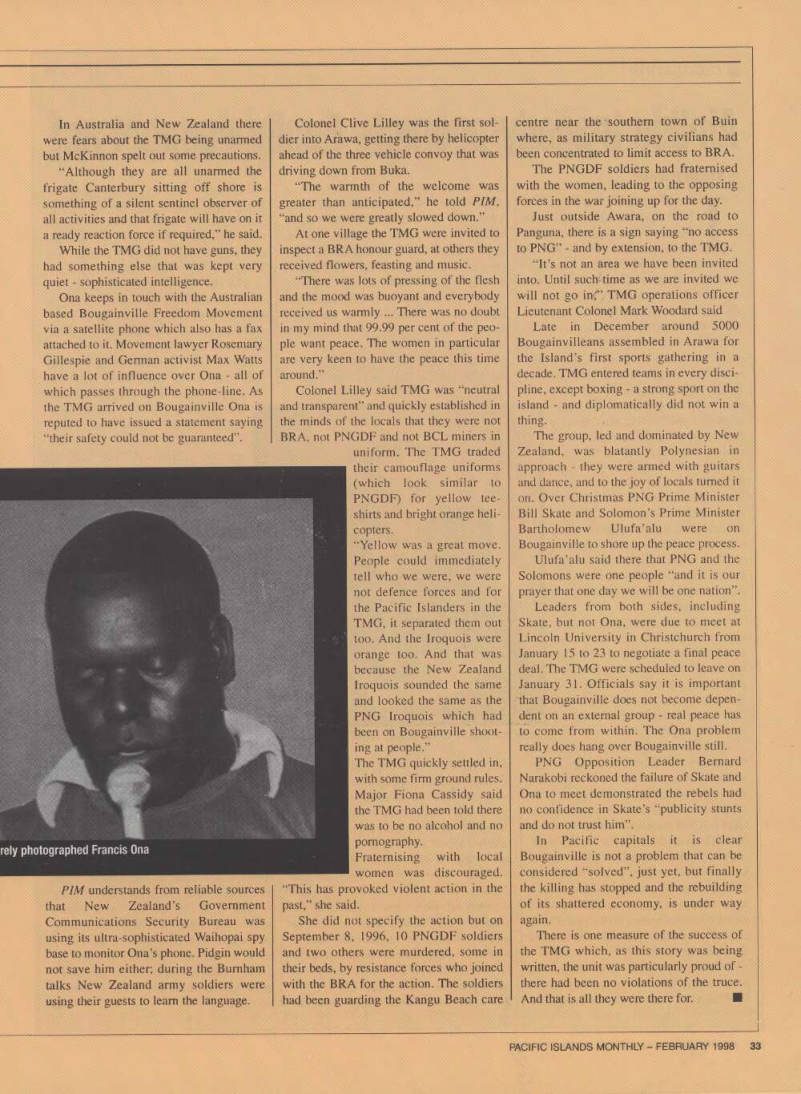
And atop his mountain is rebel leader Francis Ona, seemingly unable to detach himself from the old rhetoric of war.
He is now frighteningly like one of the spookier characters in 20th Century litera ture, Kurtz from Joseph Conrad’s Heart of Darkness. Isolated from the world up the Congo River Kurtz went mad, and finally had to be killed by his colonial masters. It was the same theme in the classic Vietnam War movie, Apocalypse Now, where Marlon Brando played Kurtz.
No one is going to play Francis Ona in any movie - the Bougainville civil war was always a conflict very few people were ever interested in - but as he sits with his 500 strong “A Company” in Guava village near the Panguna mine daily becoming irrelevant to the peace process.
Since 1988 rebels have fought for the independence of the lush, mineral rich tropical 10,660 square kilometre island.
The war initially started over the envi ronmental damage caused by RTZ-CRA owned Bougainville Copper Ltd’s (BCL) Panguna open cast mine. Ona is one of the original landowners at Panguna. Even though he has led the war Ona and his fam ily are now worth around SAUSIO million (SUS 6 million) - BCL has continued to pay the royalties into a trust fund.
The peace arrived by a series of convo luted events which, in historical shorthand, began in March 1996 when then PNG Prime Minister Sir Julius Chan launched
Operation High Speed against the rebels. It turned out to be a military debacle for the PNG Defence Force (PNGDF) prompting Chan to bring in mercenaries from the British Sandline company. When that news got out the PNGDF, which had proven inept on the battlefield, mutinied in Port Moresby, leading to what amounted to a bloodless coup against Chan. Sandline and the mutiny panicked
Australia and New Zealand who had steadfastly main tained the bankrupt South Pacific Forum line that Bougainville was an internal affair for PNG.
New Zealand Foreign Minister Don McKinnon and senior diplomat John Hayes then did what critics had said for years they should have been doing - worked toward peace.
While Port Moresby effectively had no govern ment Hayes managed, at great personal risk to him self, to get the Bougainville Interim Government (BIG) and its military wing the
Bougainville Revolutionary
Army (BRA) into Burnham Military Camp in Christchurch with the pro-
PNG Bougainville
Transitional Government (BTG). For two weeks the
talked and decided they wanted peace.
Ona was not there though and the senior BIG/BRA representative was deputy presi dent Joseph Kabui. It is his land the Panguna trailings are dumped on - and his family is worth a lot too. He led the move towards peace. Soon after a truce was agreed to and New Zealand was asked to
lead a force to monitor it. On November 20, an air force Hercules landed at Buka with 18 unarmed New Zealand soldiers who formed the advanced guard of the Truce Monitoring Group (TMG). Soldiers and civilians from Australia, Fiji and Vanuatu also joined the 260 strong TMG.
Tonga, in a classic foreign policy blun der, was asked to send six unarmed men
but said no. Defence Minister Crown Prince Tupuoto’a instead uselessly offered Tonga’s ex French Navy tanker Lomipeau, then undergoing SNZS million (SUS2m) worth of repairs in Auckland. Wellington said thanks, but no thanks, and only Nuku’alofa can answer why it has an army that does nothing.
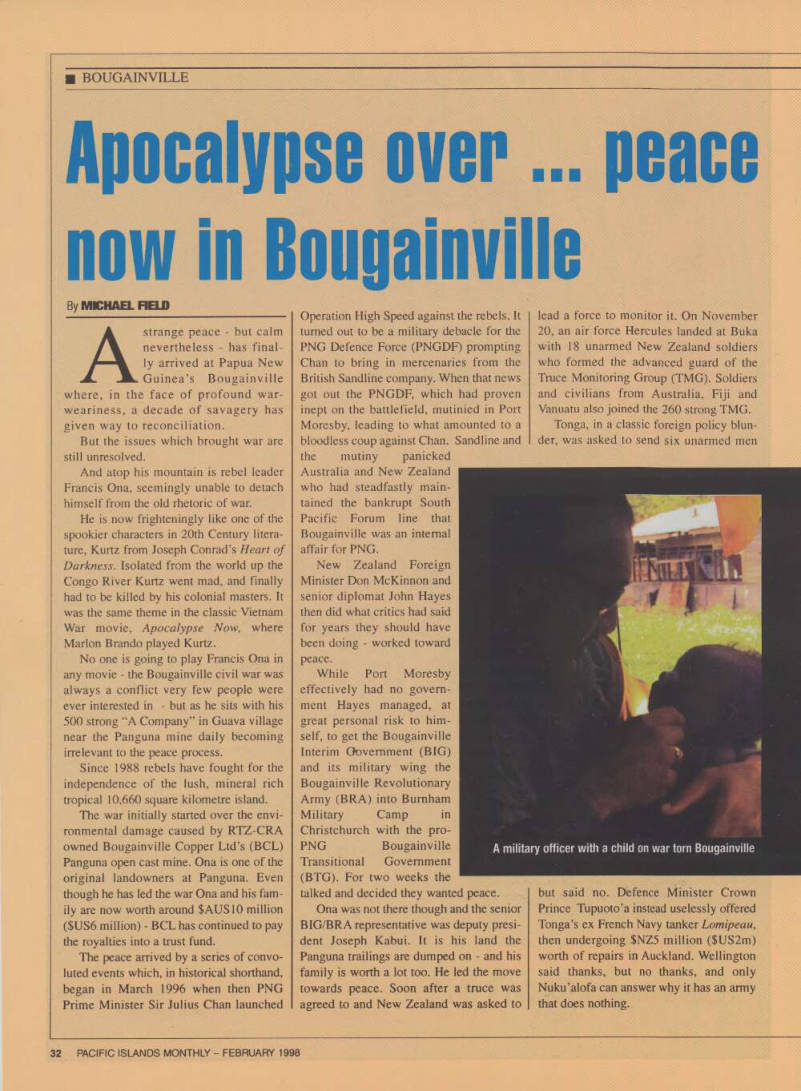
A military officer with a child on war torn Bougainville
In Australia and New Zealand there were fears about the TMG being unarmed but McKinnon spelt out some precautions.
“Although they are all unarmed the frigate Canterbury sitting off shore is something of a silent sentinel observer of all activities and that frigate will have on it a ready reaction force if required,” he said.
While the TMG did not have guns, they had something else that was kept very
quiet - sophisticated intelligence.
Ona keeps in touch with the Australian based Bougainville Freedom Movement via a satellite phone which also has a fax attached to it. Movement lawyer Rosemary Gillespie and German activist Max Watts have a lot of influence over Ona - all of which passes through the phone-line. As the TMG arrived on Bougainville Ona is reputed to have issued a statement saying “their safety could not be guaranteed”.
PIM understands from reliable sources that New Zealand’s Government Communications Security Bureau was using its ultra-sophisticated Waihopai spy base to monitor Ona’s phone. Pidgin would not save him either; during the Burnham talks New Zealand army soldiers were using their guests to leam the language.
Colonel Clive Lilley was the first sol dier into Arawa, getting there by helicopter ahead of the three vehicle convoy that was driving down from Buka.
“The warmth of the welcome was greater than anticipated,” he told PIM, “and so we were greatly slowed down.”
At one village the TMG were invited to inspect a BRA honour guard, at others they received flowers, feasting and music.
“There was lots of pressing of the flesh and the mood was buoyant and everybody received us warmly ... There was no doubt in my mind that 99.99 per cent of the peo ple want peace. The women in particular are very keen to have the peace this time around.”
Colonel Lilley said TMG was “neutral and transparent” and quickly established in the minds of the locals that they were not BRA, not PNGDF and not BCL miners in
uniform. The TMG traded their camouflage uniforms (which look similar to PNGDF) for yellow tee shirts and bright orange heli copters.
“Yellow was a great move.
People could immediately tell who we were, we were not defence forces and for the Pacific Islanders in the TMG, it separated them out too. And the Iroquois were orange too. And that was because the New Zealand Iroquois sounded the same and looked the same as the PNG Iroquois which had been on Bougainville shoot ing at people.”
The TMG quickly settled in, with some firm ground rules.
Major Fiona Cassidy said the TMG had been told there was to be no alcohol and no pornography.
Fraternising with local women was discouraged.
“This has provoked violent action in the past,” she said.
She did not specify the action but on September 8, 1996, 10 PNGDF soldiers and two others were murdered, some in their beds, by resistance forces who joined with the BRA for the action. The soldiers had been guarding the Kangu Beach care
centre near the southern town of Buin where, as military strategy civilians had been concentrated to limit access to BRA.
The PNGDF soldiers had fraternised with the women, leading to the opposing forces in the war joining up for the day.
Just outside Awara, on the road to Panguna, there is a sign saying “no access to PNG” - and by extension, to the TMG.
“It’s not an area we have been invited into. Until such time as we are invited we will not go inf’ TMG operations officer Lieutenant Colonel Mark Woodard said Late in December around 5000 Bougainvilleans assembled in Arawa for the Island’s first sports gathering in a decade. TMG entered teams in every disci pline, except boxing - a strong sport on the island - and diplomatically did not win a thing.
The group, led and dominated by New Zealand, was blatantly Polynesian in approach - they were armed with guitars and dance, and to the joy of locals turned it on. Over Christmas PNG Prime Minister Bill Skate and Solomon’s Prime Minister Bartholomew Ulufa’alu were on Bougainville to shore up the peace process.
Ulufa’alu said there that PNG and the Solomons were one people “and it is our prayer that one day we will be one nation”.
Leaders from both sides, including Skate, but not Ona, were due to meet at Lincoln University in Christchurch from January 15 to 23 to negotiate a final peace deal. The TMG were scheduled to leave on January 31. Officials say it is important that Bougainville does not become depen dent on an external group - real peace has to come from within. The Ona problem really does hang over Bougainville still.
PNG Opposition Leader Bernard Narakobi reckoned the failure of Skate and Ona to meet demonstrated the rebels had no confidence in Skate’s “publicity stunts and do not trust him”.
In Pacific capitals it is clear Bougainville is not a problem that can be considered “solved”, just yet, but finally the killing has stopped and the rebuilding of its shattered economy, is under way
again.
There is one measure of the success of the TMG which, as this story was being written, the unit was particularly proud of there had been no violations of the truce.
And that is all they were there for. ■
[?]ely photographed Francis Ona