Legal tender controversy dogs Marshalls
p. 38 · Read in the full issue
Economy
Legal tender controversy dogs Marshalls commemorative coin programme
By Giff Johnson
The filing of two lawsuits against the Marshall Islands at the end of 1997 by German coin collectors has put the spotlight on the govern ment’s claim that its commemorative coins are “legal tender”. The legal action resulted from the government’s refusal to redeem the tens of thou sands of dollars in coins that the two Germans arrived in Majuro with.
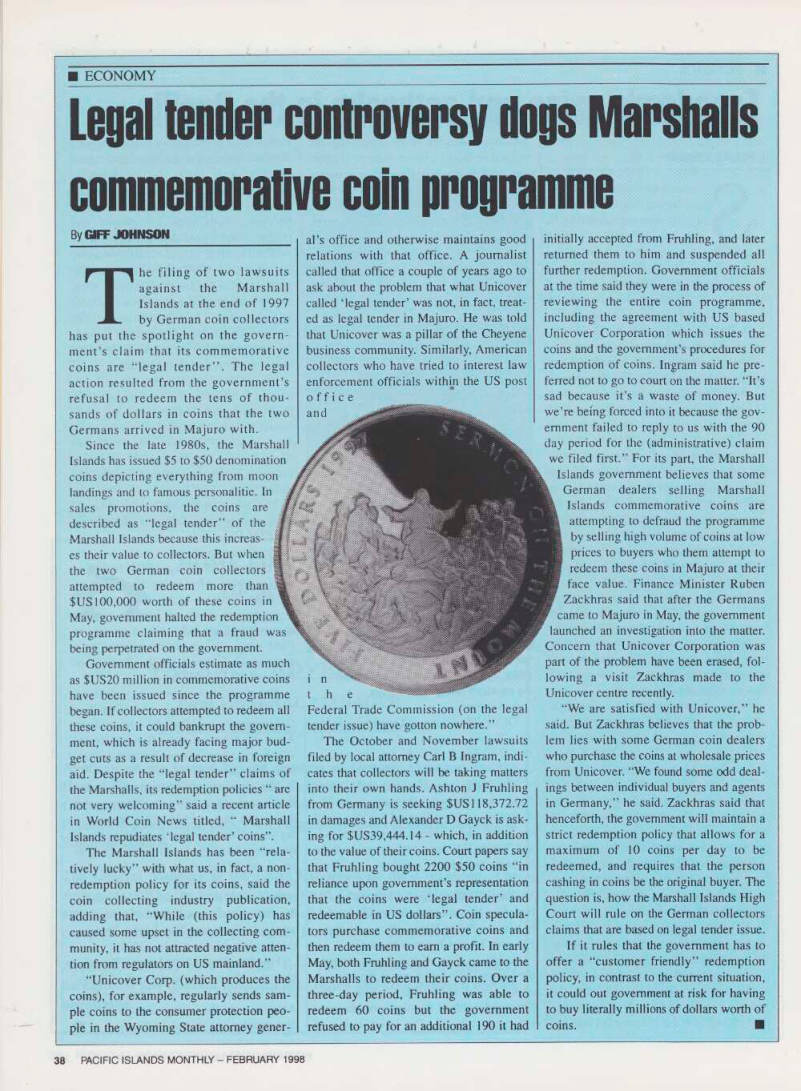
Since the late 1980 s, the Marshall Islands has issued $5 to $5O denomination coins depicting everything from moon landings and to famous personalitie. In J sales promotions, the coins are described as “legal tender” of the j Marshall Islands because this increas- §| ; es their value to collectors. But when M l the two German coin collectors % attempted to redeem more than » SUS 100,000 worth of these coins in l| May, government halted the redemption 1 programme claiming that a fraud was being perpetrated on the government.
Government officials estimate as much as SUS2O million in commemorative coins have been issued since the programme began. If collectors attempted to redeem all these coins, it could bankrupt the govern ment, which is already facing major bud get cuts as a result of decrease in foreign aid. Despite the “legal tender” claims of the Marshalls, its redemption policies “ are not very welcoming” said a recent article in World Coin News titled, “ Marshall Islands repudiates ‘legal tender’ coins”.
The Marshall Islands has been “rela tively lucky” with what us, in fact, a non redemption policy for its coins, said the
coin collecting industry publication,
adding that, “While (this policy) has caused some upset in the collecting com munity, it has not attracted negative atten tion from regulators on US mainland.”
“Unicover Corp. (which produces the coins), for example, regularly sends sam ple coins to the consumer protection peo ple in the Wyoming State attorney gener
al’s office and otherwise maintains good relations with that office. A journalist called that office a couple of years ago to ask about the problem that what Unicover called ‘legal tender’ was not, in fact, treat ed as legal tender in Majuro. He was told that Unicover was a pillar of the Cheyene business community. Similarly, American collectors who have tried to interest law enforcement officials within the US post office and
I Ii
t h e Federal Trade Commission (on the legal tender issue) have gotten nowhere.”
The October and November lawsuits filed by local attorney Carl B Ingram, indi cates that collectors will be taking matters into their own hands. Ashton J Fruhling from Germany is seeking $U5118,372.72 in damages and Alexander D Gayck is ask ing for $U539,444.14 - which, in addition to the value of their coins. Court papers say that Fruhling bought 2200 $5O coins “in
reliance upon government’s representation
that the coins were ‘legal tender’ and redeemable in US dollars”. Coin specula tors purchase commemorative coins and then redeem them to earn a profit. In early May, both Fruhling and Gayck came to the Marshalls to redeem their coins. Over a three-day period, Fruhling was able to redeem 60 coins but the government refused to pay for an additional 190 it had
initially accepted from Fruhling, and later
returned them to him and suspended all further redemption. Government officials at the time said they were in the process of reviewing the entire coin programme, including the agreement with US based Unicover Corporation which issues the coins and the government’s procedures for redemption of coins. Ingram said he pre ferred not to go to court on the matter. “It’s sad because it’s a waste of money. But we’re being forced into it because the gov ernment failed to reply to us with the 90 day period for the (administrative) claim we filed first.” For its part, the Marshall , Islands government believes that some it German dealers selling Marshall 11 Islands commemorative coins are El attempting to defraud the programme ■ by selling high volume of coins at low ill prices to buyers who them attempt to ■i redeem these coins in Majuro at their r fW face value. Finance Minister Ruben if Zackhras said that after the Germans F came to Majuro in May, the government launched an investigation into the matter.
Concern that Unicover Corporation was part of the problem have been erased, fol lowing a visit Zackhras made to the Unicover centre recently.
“We are satisfied with Unicover,” he said. But Zackhras believes that the prob lem lies with some German coin dealers who purchase the coins at wholesale prices from Unicover. “We found some odd deal ings between individual buyers and agents in Germany,” he said. Zackhras said that henceforth, the government will maintain a strict redemption policy that allows for a maximum of 10 coins per day to be redeemed, and requires that the person cashing in coins be the original buyer. The question is, how the Marshall Islands High Court will rule on the German collectors claims that are based on legal tender issue.
If it rules that the government has to offer a “customer friendly” redemption policy, in contrast to the current situation, it could out government at risk for having to buy literally millions of dollars worth of coins. ■