Suffering worse than reported
pp. 17-18 · Read in the full issue
By Michael Field
People are not starving to death in Papua New Guinea. They are dead before they get that far.
In the midst of burnt out forests that used to feed them, a long way from roads or help - they die of exhaustion or treatable diseases.
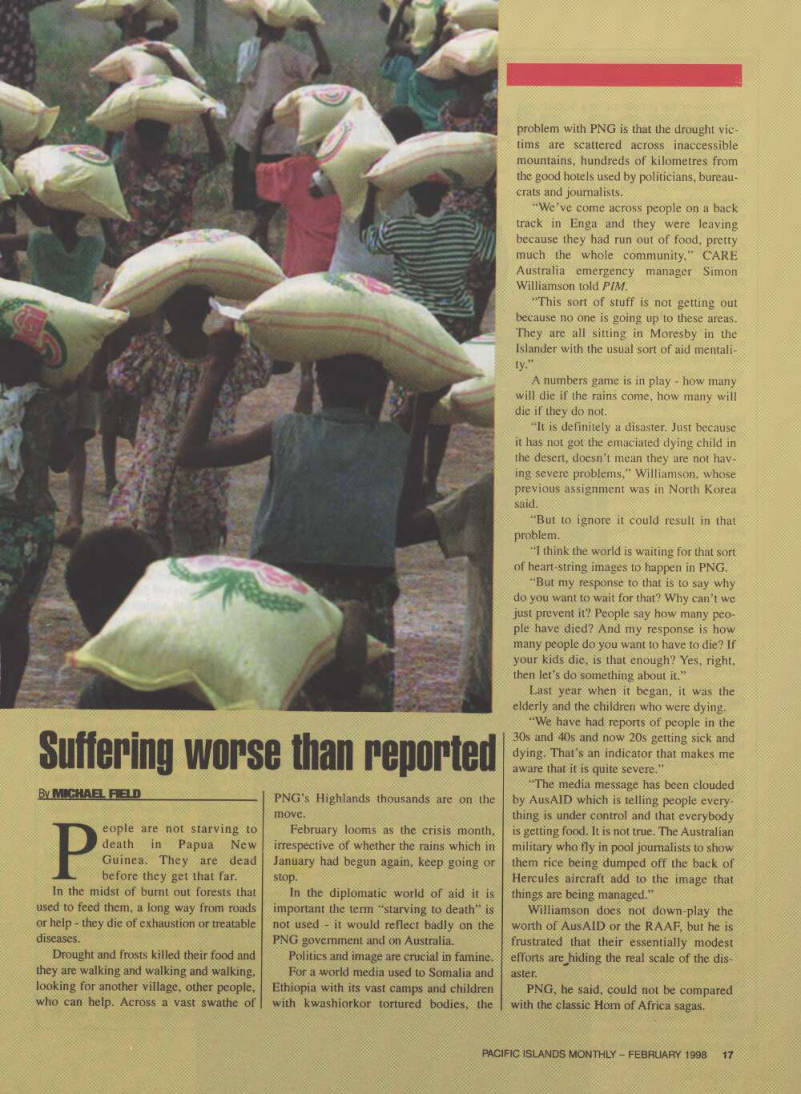
Drought and frosts killed their food and they are walking and walking and walking, looking for another village, other people, who can help. Across a vast swathe of
PNG’s Highlands thousands are on the move.
February looms as the crisis month, irrespective of whether the rains which in January had begun again, keep going or stop.
In the diplomatic world of aid it is important the term “starving to death” is not used - it would reflect badly on the PNG government and on Australia.
Politics and image are crucial in famine.
For a world media used to Somalia and Ethiopia with its vast camps and children with kwashiorkor tortured bodies, the
problem with PNG is that the drought vic tims are scattered across inaccessible mountains, hundreds of kilometres from the good hotels used by politicians, bureau crats and journalists.
“We’ve come across people on a back track in Enga and they were leaving because they had run out of food, pretty much the whole community,” CARE Australia emergency manager Simon Williamson told PIM.
“This sort of stuff is not getting out because no one is going upko these areas.
They are all sitting in Moresby in the Islander with the usual sort of aid mentali ty.”
A numbers game is in play - how many will die if the rains come, how many will die if they do not.
“It is definitely a disaster. Just because it has not got the emaciated dying child in the desert, doesn’t mean they are not hav ing severe problems,” Williamson, whose previous assignment was in North Korea said.
“But to ignore it could result in that
problem.
“I think the world is waiting for that sort of heart-string images to happen in PNG.
“But my response to that is to say why do you want to wait for that? Why can’t we just prevent it? People say how many peo ple have died? And my response is how many people do you want to have to die? If your kids die, is that enough? Yes, right, then let’s do something about it.”
Last year when it began, it was the elderly and the children who were dying.
“We have had reports of people in the 30s and 40s and now 20s getting sick and dying. That’s an indicator that makes me aware that it is quite severe.”
“The media message has been clouded by AusAlD which is telling people every thing is under control and that everybody is getting food. It is not true. The Australian military who fly in pool journalists to show them rice being dumped off the back of Hercules aircraft add to the image that
things are being managed.”
Williamson does not down-play the worth of AusAID or the RAAF, but he is frustrated that their essentially modest efforts arejiiding the real scale of the dis aster.
PNG, he said, could not be compared with the classic Horn of Africa sagas.
“Some of the people are in a Somalian type state but it is not the collective type thing where you could walk across the desert and see people tumbling down en masse with starvation,” he told PIM.
“There are probably people dying of starvation but no one has seen that because they are dying of other things first.
“They are in isolated areas and very dif ficult to get to. The more isolated they are, the more in need they are, the less likely people are going to get to them with any type of assistance.”
It is not helped by the 700 dif- J ferent ethnic groups, the lack of m roads and the way whole vil- JH lages have been “self evacuat ed” by people leaving for jS
food. F
In Africa, people in famine congregated, in PNG they disperse.
“It is much more of a hidden disaster.”
Great swamps have gone and rivers have dried up, leaving foul pools of water for
mosquitoes.
Malaria is steeply up in some areas, typhoid is claiming many.
“You see whole swaths of land that have just been burnt, whole valleys have been burnt out. The ground is cracked with great fis sures,” Williamson says.
The wildlife has gone, including that which the
Highlanders ate.
Some rain returned in
early January, ending the
plight of people forced to drink contaminated water.
Some kaukau or sweet potato has come back onto the markets but it is “miserable stuff’ of little value - and great expense.
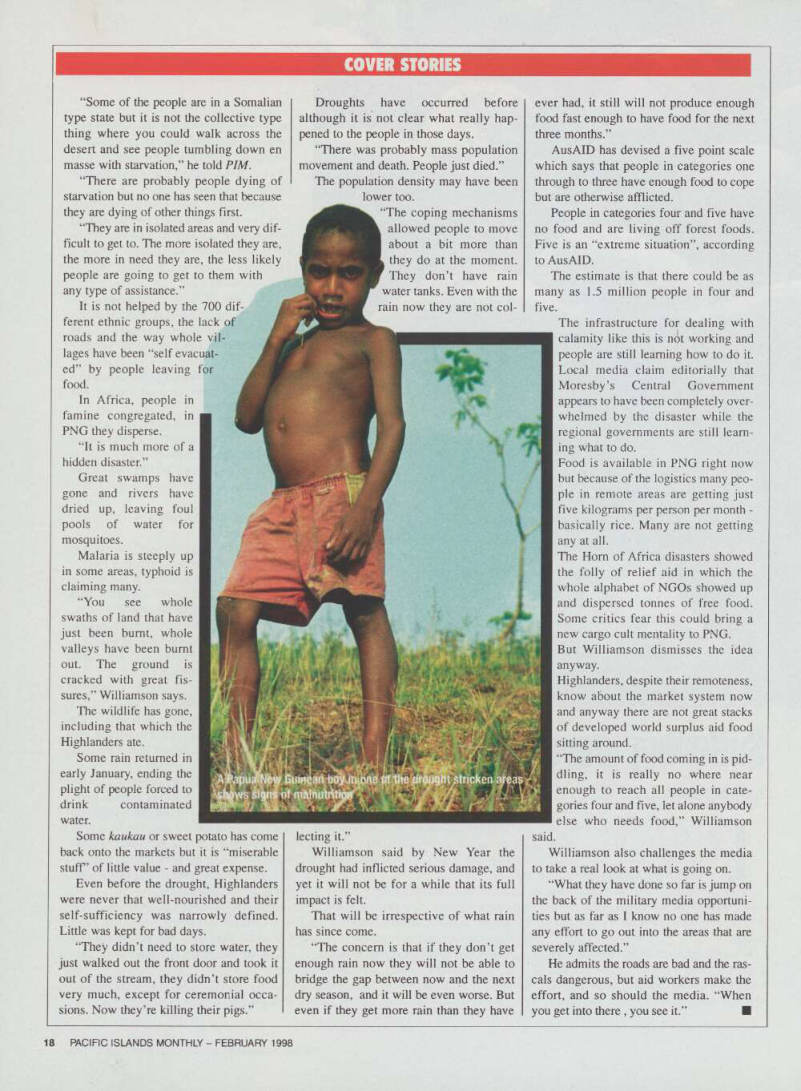
Even before the drought, Highlanders were never that well-nourished and their self-sufficiency was narrowly defined.
Little was kept for bad days.
“They didn’t need to store water, they just walked out the front door and took it out of the stream, they didn’t store food very much, except for ceremonial occa
sions. Now they’re killing their pigs.”
Droughts have occurred before although it is not clear what really hap pened to the people in those days.
“There was probably mass population movement and death. People just died.”
The population density may have been lower too.
“The coping mechanisms allowed people to move 1 a bout a bit more than they do at the moment.
They don’t have rain water tanks. Even with the rain now they are not col-
lecting it.”
Williamson said by New Year the drought had inflicted serious damage, and yet it will not be for a while that its full impact is felt.
That will be irrespective of what rain has since come.
“The concern is that if they don’t get enough rain now they will not be able to bridge the gap between now and the next dry season, and it will be even worse. But even if they get more rain than they have
ever had, it still will not produce enough food fast enough to have food for the next three months.”
AusAID has devised a five point scale which says that people in categories one through to three have enough food to cope but are otherwise afflicted.
People in categories four and five have no food and are living off forest foods.
Five is an “extreme situation”, according to AusAID.
The estimate is that there could be as many as 1.5 million people in four and five.
The infrastructure for dealing with calamity like this is not working and people are still learning how to do it.
Local media claim editorially that Moresby’s Central Government appears to have been completely over whelmed by the disaster while the regional governments are still learn ing what to do.
Food is available in PNG right now but because of the logistics many peo ple in remote areas are getting just five kilograms per person per month basically rice. Many are not getting any at all.
The Horn of Africa disasters showed the folly of relief aid in which the whole alphabet of NGOs showed up and dispersed tonnes of free food.
Some critics fear this could bring a new cargo cult mentality to PNG.
But Williamson dismisses the idea anyway.
Highlanders, despite their remoteness, know about the market system now and anyway there are not great stacks of developed world surplus aid food
sitting around.
“The amount of food coming in is pid dling, it is really no where near enough to reach all people in cate gories four and five, let alone anybody else who needs food,” Williamson
said.
Williamson also challenges the media to take a real look at what is going on.
“What they have done so far is jump on the back of the military media opportuni ties but as far as I know no one has made any effort to go out into the areas that are
severely affected.”
He admits the roads are bad and the ras cals dangerous, but aid workers make the effort, and so should the media. “When you get into there , you see it.” ■
A Papua New Guinean boy in one of the drought stricken areas shows signs of malnutrition