Drought in
pp. 14-17 · Read in the full issue
Cover Stories
Png
worsens
By Sam Vulum
While the world celebrated Christmas and New Year, Papua New Guineans, took stock of what had been a troublesome 1997 and braced themselves for what looks to be another difficult year.
The government, which is still struggling to come out from deep political crisis, appears to be more concerned about staying in power than delivering much needed ser vices to the people.
The credibility of the government, dragged into great disrepute by former Prime Minister Sir Julius Chan’s regime through the Sandline Crisis and other controver sial deals, was given more whipping through the Mujo Sefa videotapes scandal involving Prime Minister Bill Skate.
While some positive developments towards peace have been achieved on Bougainville, the country’s other woes seem to have either remained stagnant or have taken a downward slide. The endemic law and order problem, falling commodity prices, a confused public service resulting from government’s surprise and drastic decisions, and a fluctuating economy are some of the
pressing problems at hand.
However, the devastating impacts of the El Nino related drought appears to be the most worrying. It has so far claimed some 500 lives. The deaths were a result of starvation and drought related diseases.
Expert estimates have it that up to 695,000 people entered 1998 at risk of starvation with some areas possi ble missing out on drought aid completely.
A leading Australian aid agency CARE Australia’s field worker Daryl Ainsworth told the Australian Associated Press that the Aziana Mission, south of Goroka town in Eastern Highlands province, had received no aid when he visited the area on Christmas Eve.
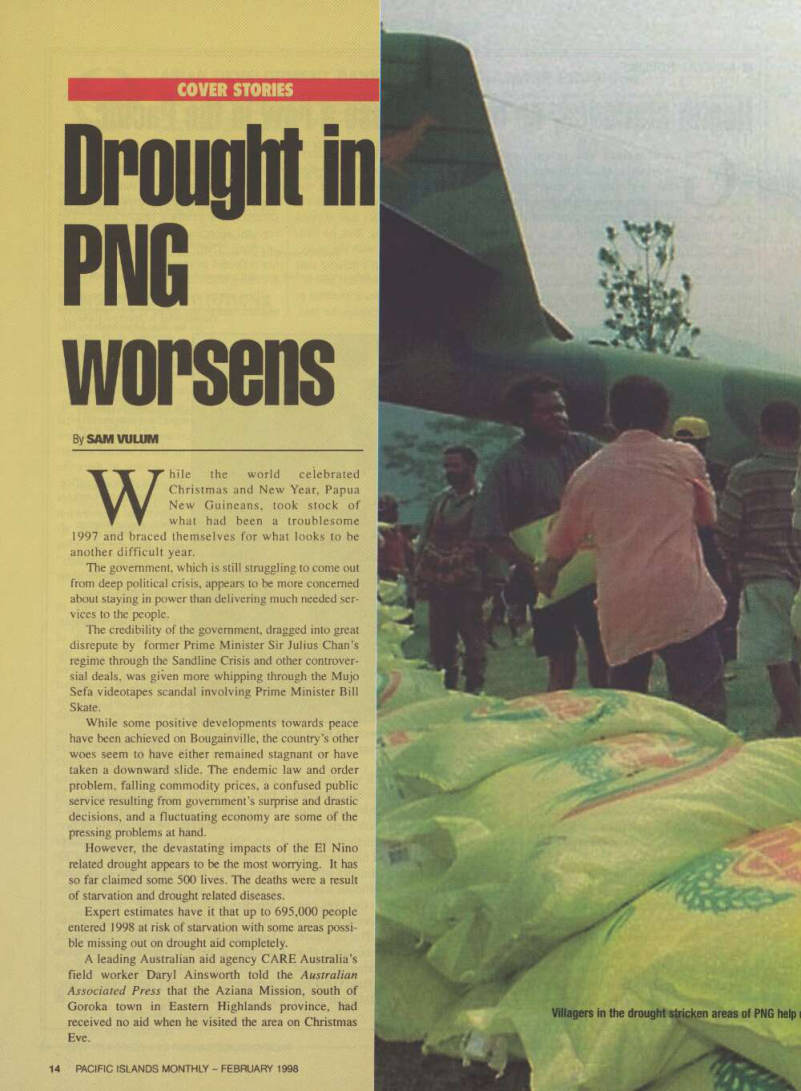
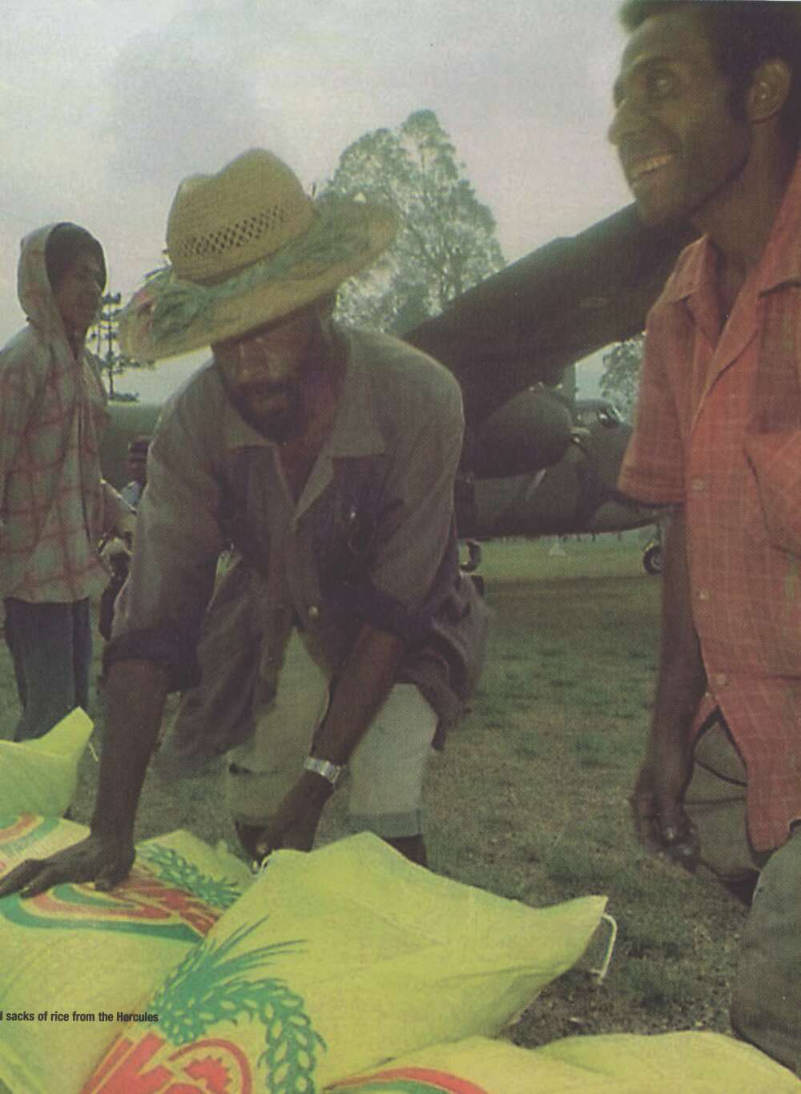
Villagers in the drought stricken areas of PNG help [?]
[?] sacks of rice from the Hercules
According to CARE Australia’s emer gencies manager Simon Williamson, who is based in PNG, typhoid is endemic in the country and in one area 15 children were reported to have died of dysentery.
A severe typhoid outbreak was also responsible for the death of five people at Sairope village in Kokoda area of Oro province - three children and two adults between December 23 and 27 last year.
Conflicting reports also surround the “mysterious” deaths of up to 30 people in the Yapsei area of the Telefomin district, West Sepik province. The Baptist Church’s health services in Telefomin reported that the people died of illnesses known to the area. However, Drought Relief Committee coordinator Peter Barter said that the cause of the deaths remains mysterious. A gov ernment investigating team has yet to establish the cause of deaths. Although there was some relief with rain being expe rienced in the Christmas and New Year period, weather experts have warned that this did not mean an end to the El Nino episode.
The drought has imposed a strain on the country’s acute financial resources and has also severely affected the economy.
Bank of PNG’s governor Koiari Tarata has warned that PNG faces a tough 1998 unless commodity prices improve.
Tarata said there had been an increase in economic activity in the private sector, excluding the mining and petroleum sector in the first half of 1997. Finance secretary Isaac Lupari said that the severe drought conditions combined with poor prices for minerals and agricultural products will affect the government’s ability to raise rev enue needed to finance the spending pro grammes of the public sector in 1998.
Lupari urged senior public sector managers to recognise the serious economic situation facing the country by adopting sound bud get management techniques which would allow them to contain expenditure outlays within the limits set by his department.
A Brisbane-based firm of economic con sultants reported in December that recent government decisions, including measures announced in a Supply Bill handed down in November, sent worrying signals about its ability to manage the economy.
Excerpts of the report titled Insights Papua New Guinea, notes that both as a result of government action or inaction and pervading circumstances beyond its control
- the economy appears to weaken further in early 1998; the Kina is likely to drop fur ther against the US dollar and its volatility is likely to remain in the short term; both lending and deposits are likely to rise; even with the rain, economic prospects have deteriorated dramatically and isolated com munities still face hardships and crime remains the biggest impediment to invest ment, distorting incentives of the labour force, increasing costs and dislocating mar kets. The report said there had been a com bination of factors including a deteriorating balance of payments, the effects the drought has had on the economy, crime and the rippling effects of the problems with the Asian economies upon other emerging mar kets. The government remains committed to the drought relief efforts. Recently it reorganised the functions and responsibili ties of various departments and committees to prevent delays in disbursing funds to help relief efforts. The government’s drought trust account balance stands at K 14,520,108 (sUS7million). These monies are from the government as well as donors.
Provincial Affairs Minister Simon Kaumi said that he would demand that the govern ment honour its KlO million (SUSS mil lion) commitment it made to the account.
The minister was concerned about delays in the past in delivering relief supplies to drought victims. During the festive period, many supplies were left sitting in distribu tion points when Australian Defence Force personnel involved in airlifting supplies took time off. Supplies for Western, Gulf, Milne Bay and West Sepik provinces were stuck in Port Moresby or other distribution points because there was no way of getting them into these areas. These provinces are being serviced through the AusAID relief mission, the Australian Defence Force and the Royal Australian Air Force.
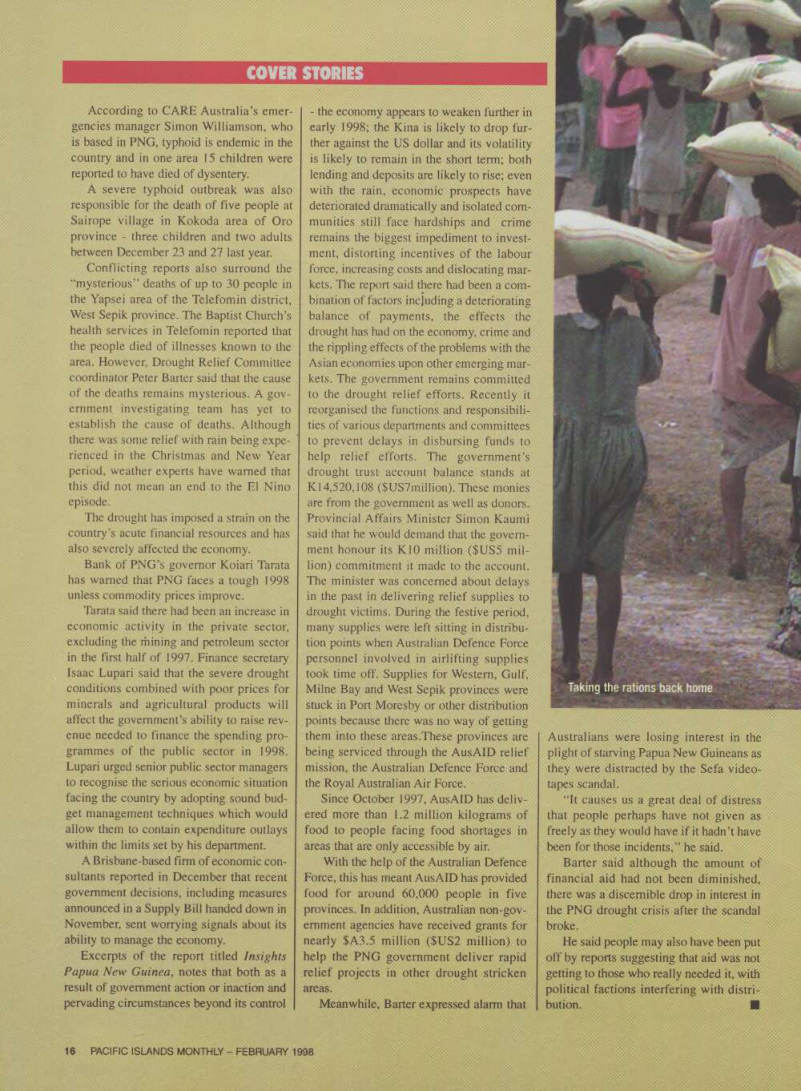
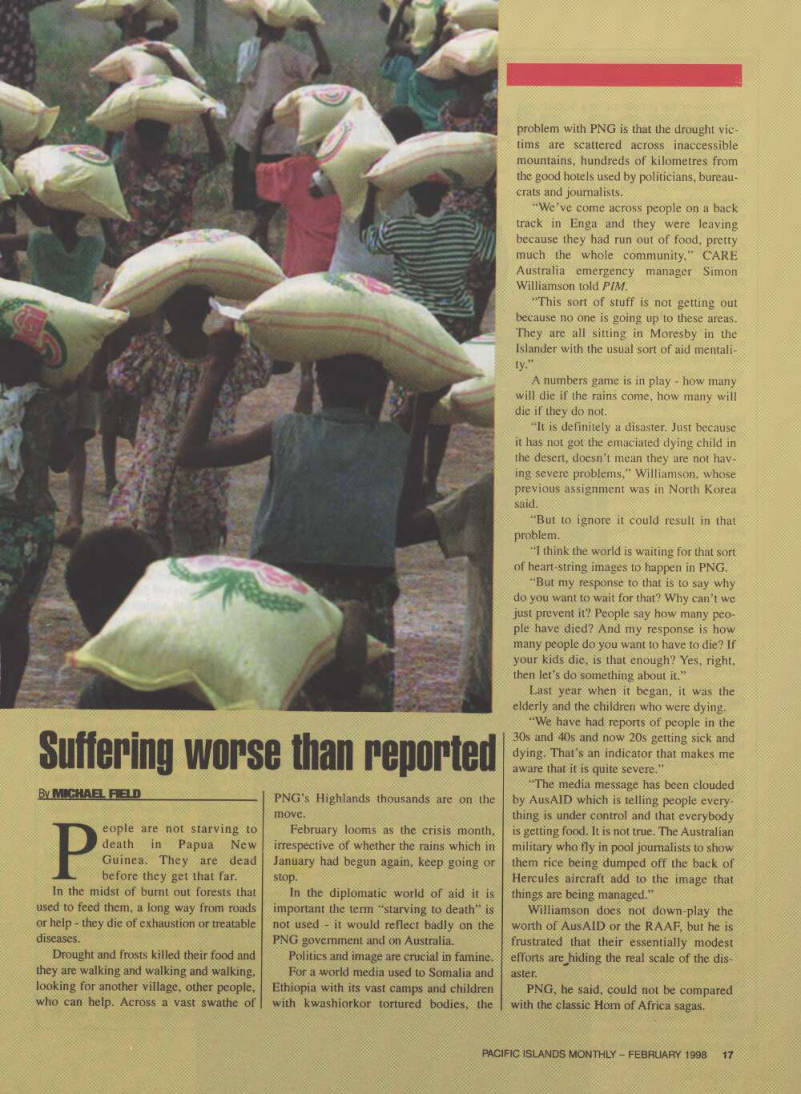
Since October 1997, AusAID has deliv ered more than 1.2 million kilograms of food to people facing food shortages in areas that are only accessible by air.
With the help of the Australian Defence Force, this has meant AusAID has provided food for around 60,000 people in five provinces. In addition, Australian non-gov ernment agencies have received grants for nearly $A3.5 million (SUS 2 million) to help the PNG government deliver rapid relief projects in other drought stricken areas.
Meanwhile, Barter expressed alarm that
Australians were losing interest in the plight of starving Papua New Guineans as they were distracted by the Sefa video tapes scandal.
“It causes us a great deal of distress that people perhaps have not given as freely as they would have if it hadn’t have been for those incidents,” he said.
Barter said although the amount of financial aid had not been diminished, there was a discernible drop in interest in the PNG drought crisis after the scandal broke.
He said people may also have been put off by reports suggesting that aid was not getting to those who really needed it, with political factions interfering with distri bution. ■
Taking the rations back home