Health statistics, or how to cause a row hi the Pacific
p. 13 · Read in the full issue
Growth rates and infant mortality tend towards the extreme in many island countries. After 10 or more years of primary health care promotion in most islands, how ever, and with the support of regional
agencies, improvements are being
made in many key health areas. Infant mortality, for example, though still taking the life of 33 children each day,
has gone down in every country with the apparent exception of Papua New Guinea and Tuvalu (but the numbers in Tuvalu are so small - just several each year - that one or two extra baby deaths and the rate increases 50 per cent over
night).
But when you start citing some of the most dire stats, you run the risk of drawing the ire of local health officials.
That’s because the statis tics themselves can cause their share of commotion.
The Marshall Islands has had, and still has, some of the most sobering statistics in the region (like an eight percent annual urban growth rate, more than twice the birth rate, and an average of just under six children per
mother). But in certain areas, major improvements have been made. Often, however, old statistics continue to be quot
ed, particularly by regional agencies, even
when there has been a dramatic turnaround. It irks island health workers making legitimate efforts to improve health conditions to hear regional agencies using their countries as examples of the “worst.”
The infant mortality rate (IMR) in the Marshall Islands, for example, is now hotly disputed. In the early 1980 s, the infant mortality rate in the Marshall Islands was an astronomical 68 per thousand (behind
only Kiribati, PNG and Vanuatu in a “com petition” no one wants to lead). According to one local health worker, however, the 1988 census data actually showed that the infant mortality rate (IMR) had dipped substantially, to the mid-50s. But, he said, regional agencies assisting with the analy sis of the data simply didn’t believe that the IMR could have improved this much.
That condescending attitude resulted in the IMR being listed at 68 again, he said.
By 1996, however, the IMR was reported by the Ministry of Health to have dropped to 27 per thousand, a number that some regional agencies view with scepticism.
The 1988 census showed a definite decline in the IMR, and the trend has continued into the mid-19905, the Ministry official said. If regional agency officials had not dismissed the IMR data in the 1988 cen sus, there would be little question about the downward trend, he said. But in figures released by the Pacific Community (for merly the South Pacific Commission) and United Nations Population Fund (UNFPA) in December, the Marshall IMR rate is still
more than 60 per thousand.
“It’s very frustrating when they (the regional agencies) use old statistics,” said Justina Langidrik, the Marshalls assistant secretary for primary health care. “The regional agencies act like we’re not doing anything. There’s a lot going on, but it’s not reflected in some of the statistics that are being distributed worldwide.”
Ten years ago, it was hard to get a statistic worth the paper it was written on
in the Marshalls. But since the early 19905, the Ministry of Health in the Marshalls - like many of its counterparts in the region - has devel oped a competent vital statistics office that now produces annual statisti cal reports, as does the national planning office.
So island health workers believe that they are not just blowing hot air when they contest what the regional “experts” broadcast about their key health indicators.
A UNICEF report in 1996 is another example.
It said that the rate of immunisation in the Marshalls had dropped substantially in almost all categories. But the Ministry of Health statistics show some increases or only slight decreases between 1992
and 1994. Measles coverage improved from 53 percent of the population to 59 percent, while polio coverage showed a small decline from 66 percent to 62 per cent. Oddly, say health officials, a number of statistics included in the UNICEF report, such as the death rate of children under five, are not even kept by Ministry. Langidrik doesn’t want to min imise the health problems facing Marshall Islanders. But she’d like the island health workers to get some credit for the areas that have seen improvement. “We’re not just sitting behind our desks reading nov els,” she said. ■
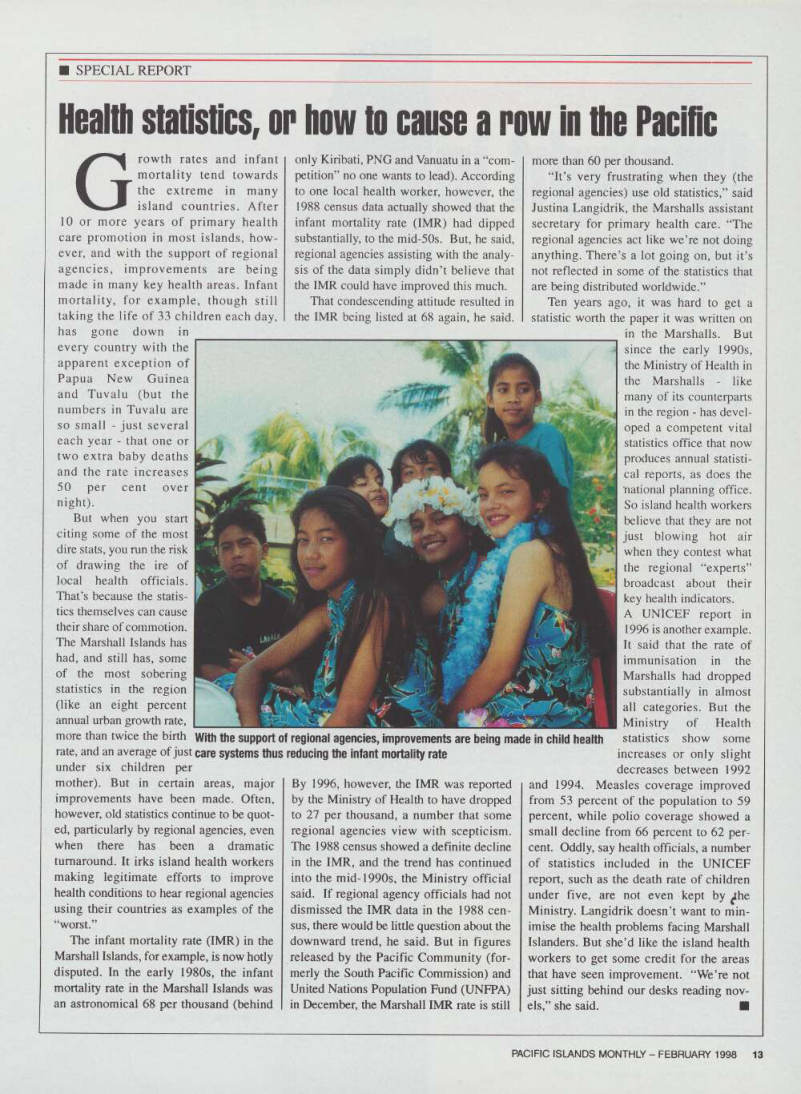
With the support of regional agencies, improvements are being made in child health care systems thus reducing the infant mortality rate