Decline in Marshall Islands teen
p. 11 · Read in the full issue
birth rate credited to youth program
A big decline in the rate of teenage pregnancy in the Marshall Islands is being credited to a youth peer education program that has
led an aggressive family planning pro
motion campaign aimed at teens.
The rate of teen births in the Marshalls
dropped more than 37 percent between 1991 and 1996, according to a report prepared jointly by the Queen’s Health Systems in Hawaii and the Ministry of Health in Majuro.
It’s an impor tant development that shows “the message is get ting out to young people,” said Just i n a Langidrik, the assistant secre tary for primary health care at the ministry. During the 1980 s, the Marshall Islands
had one of the world’s highest growth rates at 4.24 per cent annually. That has declined into the high three per cent range, accord ing to the Ministry of Health. The number of births to teenage mothers has rapidly declined since 1991, when it was 124 per 1000 teens. In 1996, the number of births dropped to 78 per thousand, according to Queen’s official Mele Look and Bureau of Health and Statistics staff Ibrahim Nasiru.
Look was brought in by the ministry to independently review the work of the non governmental organisation Youth to Youth
in Health, which has sponsored health edu cation programs and training for young Marshall Islanders since 1986. Look cred ited Youth to Youth in Health and the min istry’s family planning program with stim ulating the decline in teen births. “Youth to Youth in Health has been the primary, and almost exclusive, health education effort
targeting the teen population,” Look saidf/ “Their work can be credited with a sig nificant proportion of this dramatic decline.” She pointed out Youth to Youth in health promotion was able to achieve this success “through close collaboration
with the Ministry of family plan
ning clinics.” The youth program com bines music, dance and theatre in its health promotion and training program, activities that Look said are key reasons the program has been effective in communicating with island teens. She suggested that using
island culture and oral traditions, “particu larly songs and theatre, is an important component of the success factor.” Look highly commended the youth program, saying “it will be important for the Marshalls to share its accomplishment with this health educatioh model with other Pacific Island nations.”
While the over all population rate also declined during the six year peri od, it only went down by 9.4 per cent. After a big drop from 1991 to 1992 (from 131 to 117 births per 1000 women), the overall birth rate has ranged from 118-122 per 1000 women since then.
Langidrik said that one particu
larly positive
development of
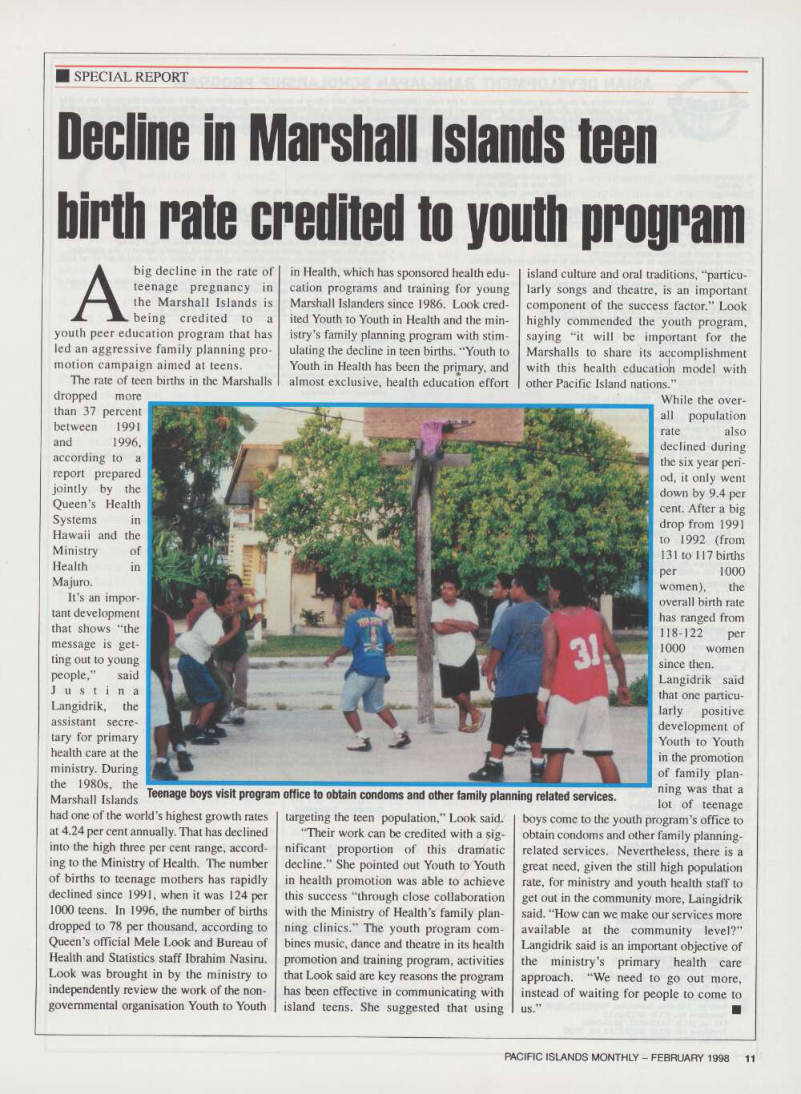
Youth to Youth in the promotion of family plan ning was that a lot of teenage
boys come to the youth program’s office to obtain condoms and other family planning related services. Nevertheless, there is a great need, given the still high population rate, for ministry and youth health staff to get out in the community more, Laingidrik said. “How can we make our services more available at the community level?”
Langidrik said is an important objective of the ministry’s primary health care approach. “We need to go out more, instead of waiting for people to come to us.” ■
Teenage boys visit program office to obtain condoms and other family planning related services.