The worse Is yet to come
pp. 19-20 · Read in the full issue
By Sam Vulum
A father hacked his son to death in the Enga
province after the boy
dug up the sweet potato which his father was saving for the whole family while in the Madang province, a child was killed and his mother was severely burnt in a bush fire.
Two examples of the many tragic sto
ries coming out from the devastating impacts of the prolonged El Nino drought being felt throughout Papua New Guinea since July 1997. For the 1.5 million people affected, as cited by the Australian Agency for International Development (AusAID) January assess ment report, the core of the their livelihood - their gar dens - have been reduced to nothing but barren, dry and withering landscapes and their drinking water has completely dried up.
Raging bush fires contin ue to sweep through many areas causing massive destruction to the environ ment as well as food gar dens and houses.
About 500 people have died so far either from star vation or drought related diseases. The death rate would have been worse had it not been for relief support.
The AusAID report said the number of people badly affected by the drought dou bled from 500,000 three months earlier.
One of the authors of the report said the figure will rise again in the next few months, with the worst con ditions expected in February and March.
“The worst is about to
happen,” Australian National University
agronomist Mike Bourke said.
“These numbers will continue to grow with each passing month. “Even if widespread heavy rain falls soon, the num bers will grow because of the delay between planting and harvesting food gar dens.”
The scale of the problems that require urgent attention are several times greater than those which occurred following widespread frost and drought in 1972-
1973. Most stories about people suffering
and struggling against the drought and
frost were reported in the worst affected areas of Southern Highlands, Western Highlands, Enga and Eastern Highland
provinces.
In these areas, most families had noth ing to eat and were surviving on ferns and other wild plants before help came. In the coastal areas, people live on famine food mainly fruit trees and sea food.
Those who can afford to store food, had
to live with very high prices.
In the Highlands, young women, previously one of the priced asset of any fam ily, have become valueless.
They are being used as means of survival - given away to men without any form of bride price pay ment. In the Marian area of the Enga province, two women were paid for (as bride price) with 10 bags of 25 kilogram rice.
Pigs, another highly regarded wealth in the region, were traded well below their normal price value. A community leader from Lakalap in the Enga province, Kepas Kiplan said he sold a KBOO (SUS4OO) pig for Kl5O
(Sus7S).
“My family’s lives are
more important than that of a pig,” Kiplan. “Prices for trade store goods are very high, therefore, any little money we find is used to buy rice for the evening meal.”
In the Margarima area of Enga, people were reported to be using what little money they had to buy wheat meal flour. And this was being mixed into a dough and roasted with hot stones because people
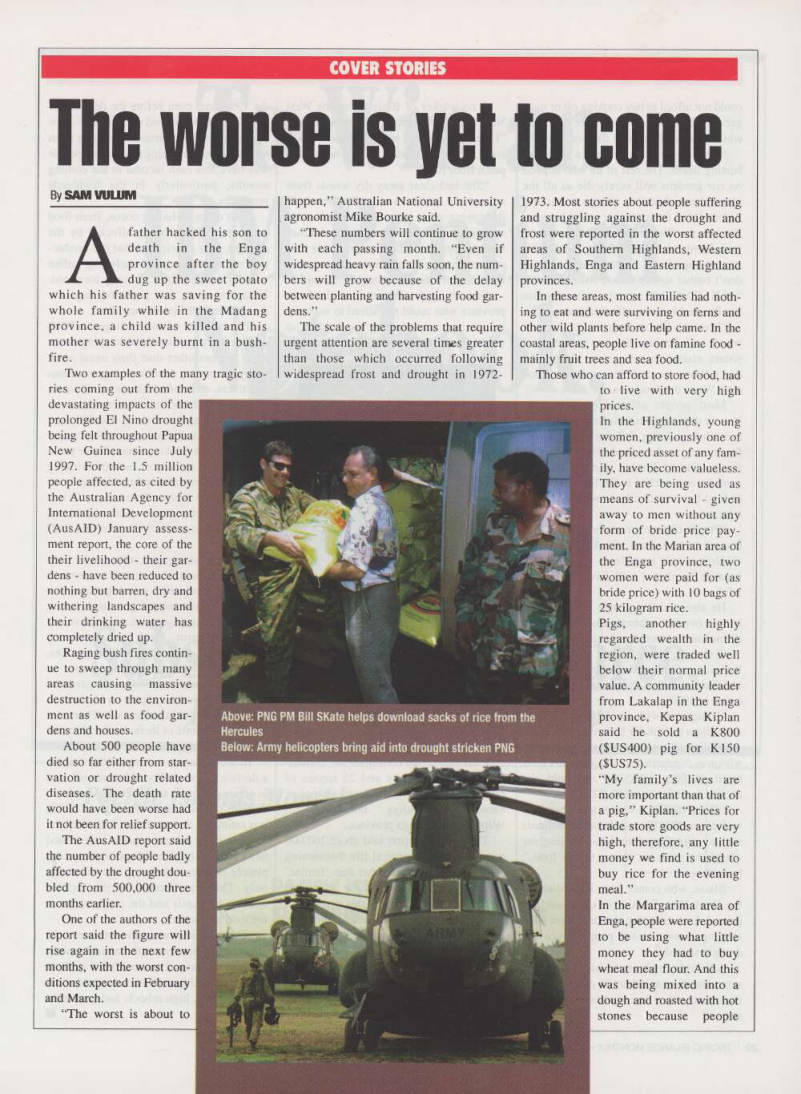
Above: PNG PM Bill Skate helps download sacks of rice from the Hercules
Below: Army helicopters bring aid into drought stricken PNG
could not afford to buy cooking oil or mar garine. Those with money were fortunate while chose without were the worst hit.
“Only the money men stand a chance of beating death. The rest of us who depend on our gardens will surely die as all the plants have died,” a village councillor Kaima Dend from another worst hit area, Tambul, the Western Highlands province, said. Dend, who was half way through his second bag of rice for his family said: “I don’t bother to buy tinned fish,” he said.
“At K 1.70 (US 85 cents) ... after my rice has finished I cannot afford anymore.
“It sounds like an exaggeration because we all look healthy. But our brothers and sisters elsewhere see green leaves. We don’t. When the green leaves die, our food dies. When our food dies, we die.”
Most people affected have become heavily depended on their family members and relatives living and working in towns for money to buy food. Health worker Saniyo Oki of Tambul said the little he earned was stretched to the limit as he had to feed his own family as well as distant relatives.
“People like me are really wasting their reserve money. I am afraid many of my children won’t be able to go to school because by then I will have no money left.”
He also said that people lived on wild lettuce, overripe cabbage leaves and pieces of kaukau that were barely palatable.
Sixty-year old Susana Clara, from Kerepia in Tambul, described the drought and frost as worse than what she experi enced in 1972.
“I migrated with my family to Mendi and Lalibu to look for bananas,” she said.
William Korekola was another father who was compelled to slaughter his boar worth KlOOO (US$5OO) and sold the cooked meat for just K5O (SUS2S).
“These days it is harder to gather food to feed my family and domestic animals such as pigs. Therefore, I had to slaughter one pig to get some money to buy food,” he said.
Blaise, who comes from Bali Island in the West New Britain province said, “I guess I don’t have any choice. I have been sending money to my people since the
drought started.”
Although people on the island are in the same situation as others in other parts of the country, they have not been receiving any aid.
A co-worker of Blaise with the West New Britain provincial government said, “I shed tears when I was told about my kid sister, braving all odds to save her potato patch from fire.
“She had clear away dry weeds from around the patch to stop the fire from destroying what was her family’s only remaining garden. I’ve made a commit ment to support my family during this time of crisis and will continue to do so until they recover from the drought,” he said.
Some hungry villagers from the Enga province who could not afford to wait any longer, resorted to looting and holding up trucks along the Okuk Highway to get their
share of supplies. However, this forced trucking companies to stop their cartage of relief supplies into Enga province and Tari in the Southern Highlands province.
Transport company Pagini Transwest Joint Venture suspended all its trucks from transporting relief supplied into the two affected areas. Two consignments, consist ing 25 tonnes of rice and 25 tonnes of cooking oil were stolen despite a police escort in Waliya boomgate in
Wapenamanda, Enga province.
The AusAID report said about 260,000 people were in a critical life threatening situation, with no food other than ‘famine’ foods or bush foods available and about 980,000 were approaching this situation.
“The food that is available is probably less than half of that normally produced and is of poor quality,” said the report.
Villagers are spending their cash reserves, selling assets and changing spending patterns to buy imported food.
Rice sales in 1997 ran at 25 percent above
the 1996 rate, even before the delivery of significant food aid had commenced. Now that the main coffee season is coming to an end and assets are being sold, many people will have less cash income in the coming months, particularly in the highlands
provinces.
Cash crops including cocoa, fresh food and betel nut are being affected by the drought. It is anticipated that the produc tion of most cash crops including coffee will be reduced soon in many locations.
Villagers report that pigs and dogs are dying because of insufficient food.
The majority of rural villages in PNG
are currently getting their drinking water
from sources other than their usual ones.
Many are getting them from larger streams and rivers, some of which are heavily con taminated with human and animal waste.
It is estimated that about 130,000 rural villagers are currently experiencing critical problems with drinking water. These prob lems include an almost lack of drinking water or access to only brackish water or contaminated water. There is sufficient water to process sago in some locations, particularly in parts if Western and Gulf provinces.
Fires are widespread, with smoke haze so severe at times that aircraft movements are being restricted - even at major air ports. Extensive area of grassland, forest, economic trees, sago palm and nipa stands have been burnt. Field teams recorded many reports of damage to food gardens, dwelling as well as to some tree crops.
In many parts of PNG, villagers and local health workers report an increase in diarrhoea and skin infections. There are also many reports of increases in other dis eases, including pneumonia and malaria.
In some places, nursing mothers report a decline in the quality of breast milk and in others, villagers are attributing deaths to drought related causes. Throughout PNG, it is estimated that more than half of all the community or primary schools were closed before the school holidays, either com
pletely or operated during the mornings
only. This was because of the lack of stamina by pupils and the need to search for food and water.
Other institutions in the most severely affected locations were threatened mainly because of lack of water. These include hospitals, health centres, sub-health cen tres, aid posts, high schools and corrective institutes. ■
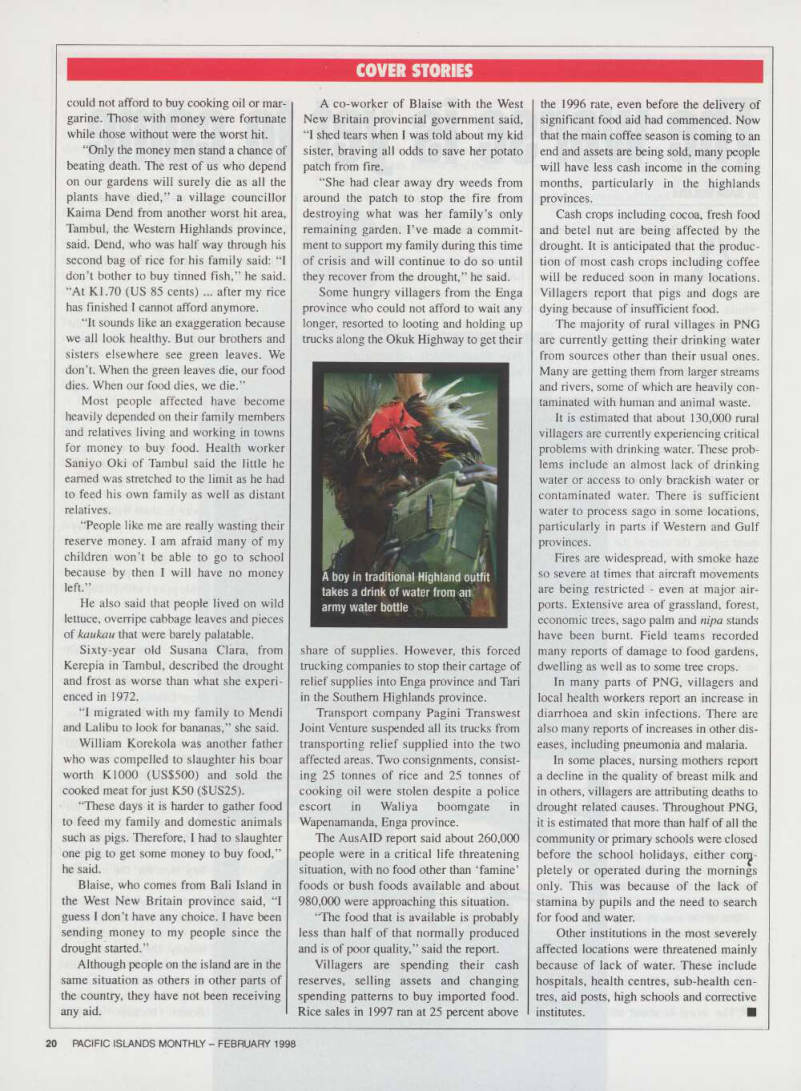
A boy in traditional Highland outfit takes a drink of water from an army water bottle