The growing
pp. 37-38 · Read in the full issue
industries
Despite Samoa’s geo graphically isolated position, a diversified industrial base made up of several local and overseas ventures
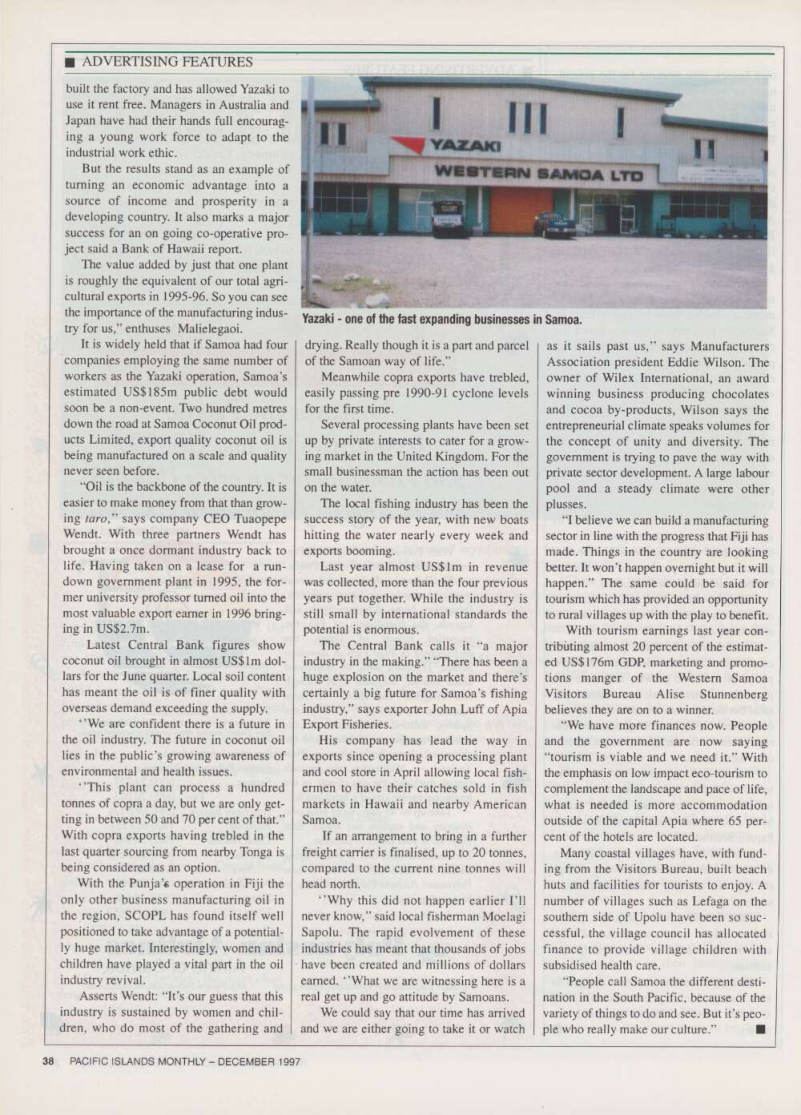
are turning up trumps for the Islands new economic direction. The biggest of these is the arrival of Japanese company Yazaki in 1991 to produce wire harnesses for cars.
Yazaki employs some 2000 people, mostly female in a labour intensive opera tion. By relocating from Australia the com pany has made a significant contribution to local incomes and the trade balance. Tax holidays anddr costs were two incentives offered by the government, which also
built the factory and has allowed Yazaki to use it rent free. Managers in Australia and Japan have had their hands full encourag ing a young work force to adapt to the industrial work ethic.
But the results stand as an example of turning an economic advantage into a source of income and prosperity in a developing country. It also marks a major success for an on going co-operative pro ject said a Bank of Hawaii report.
The value added by just that one plant is roughly the equivalent of our total agri cultural exports in 1995-96. So you can see the importance of the manufacturing indus try for us,” enthuses Malielegaoi.
It is widely held that if Samoa had four companies employing the same number of workers as the Yazaki operation, Samoa’s estimated USslBsm public debt would soon be a non-event. Two hundred metres down the road at Samoa Coconut Oil prod ucts Limited, export quality coconut oil is being manufactured on a scale and quality never seen before.
“Oil is the backbone of the country. It is easier to make money from that than grow ing taro,” says company CEO Tuaopepe Wendt. With three partners Wendt has brought a once dormant industry back to life. Having taken on a lease for a run down government plant in 1995, the for mer university professor turned oil into the most valuable export earner in 1996 bring ing in USs2.7m.
Latest Central Bank figures show coconut oil brought in almost US$l m dol lars for the June quarter. Local soil content has meant the oil is of finer quality with overseas demand exceeding the supply. ‘’We are confident there is a future in the oil industry. The future in coconut oil lies in the public’s growing awareness of environmental and health issues. ‘This plant can process a hundred tonnes of copra a day, but we are only get ting in between 50 and 70 per cent of that.”
With copra exports having trebled in the last quarter sourcing from nearby Tonga is being considered as an option.
With the Punjab operation in Fiji the only other business manufacturing oil in the region, SCOPE has found itself well positioned to take advantage of a potential ly huge market. Interestingly, women and children have played a vital part in the oil industry revival.
Asserts Wendt: “It’s our guess that this industry is sustained by women and chil dren, who do most of the gathering and
drying. Really though it is a part and parcel of the Samoan way of life.”
Meanwhile copra exports have trebled, easily passing pre 1990-91 cyclone levels for the first time.
Several processing plants have been set up by private interests to cater for a grow ing market in the United Kingdom. For the small businessman the action has been out on the water.
The local fishing industry has been the success story of the year, with new boats hitting the water nearly every week and
exports booming.
Last year almost US$l m in revenue was collected, more than the four previous years put together. While the industry is still small by international standards the potential is enormous.
The Central Bank calls it “a major industry in the making.” “There has been a huge explosion on the market and there’s certainly a big future for Samoa’s fishing industry,” says exporter John Luff of Apia Export Fisheries.
His company has lead the way in exports since opening a processing plant and cool store in April allowing local fish ermen to have their catches sold in fish markets in Hawaii and nearby American Samoa.
If an arrangement to bring in a further freight carrier is finalised, up to 20 tonnes, compared to the current nine tonnes will head north. ‘’Why this did not happen earlier I’ll never know,” said local fisherman Moelagi Sapolu. The rapid evolvement of these industries has meant that thousands of jobs have been created and millions of dollars earned. ‘’What we are witnessing here is a real get up and go attitude by Samoans.
We could say that our time has arrived and we are either going to take it or watch
as it sails past us,” says Manufacturers Association president Eddie Wilson. The owner of Wilex International, an award
winning business producing chocolates
and cocoa by-products, Wilson says the entrepreneurial climate speaks volumes for the concept of unity and diversity. The government is trying to pave the way with private sector development. A large labour pool and a steady climate were other plusses.
“I believe we can build a manufacturing sector in line with the progress that Fiji has made. Things in the country are looking better. It won’t happen overnight but it will happen.” The same could be said for tourism which has provided an opportunity to rural villages up with the play to benefit.
With tourism earnings last year con tributing almost 20 percent of the estimat ed USsl76m GDP, marketing and promo tions manger of the Western Samoa Visitors Bureau Alise Stunnenberg believes they are on to a winner.
“We have more finances now. People and the government are now saying “tourism is viable and we need it.” With the emphasis on low impact eco-tourism to complement the landscape and pace of life, what is needed is more accommodation outside of the capital Apia where 65 per cent of the hotels are located.
Many coastal villages have, with fund ing from the Visitors Bureau, built beach huts and facilities for tourists to enjoy. A number of villages such as Lefaga on the southern side of Upolu have been so suc cessful, the village council has allocated finance to provide village children with subsidised health care.
“People call Samoa the different desti nation in the South Pacific, because of the variety of things to do and see. But it’s peo ple who really make our culture.” ■
Yazaki-one of the fast expanding businesses in Samoa.