Samoa's economic recovery
pp. 36-37 · Read in the full issue
Advertising Features
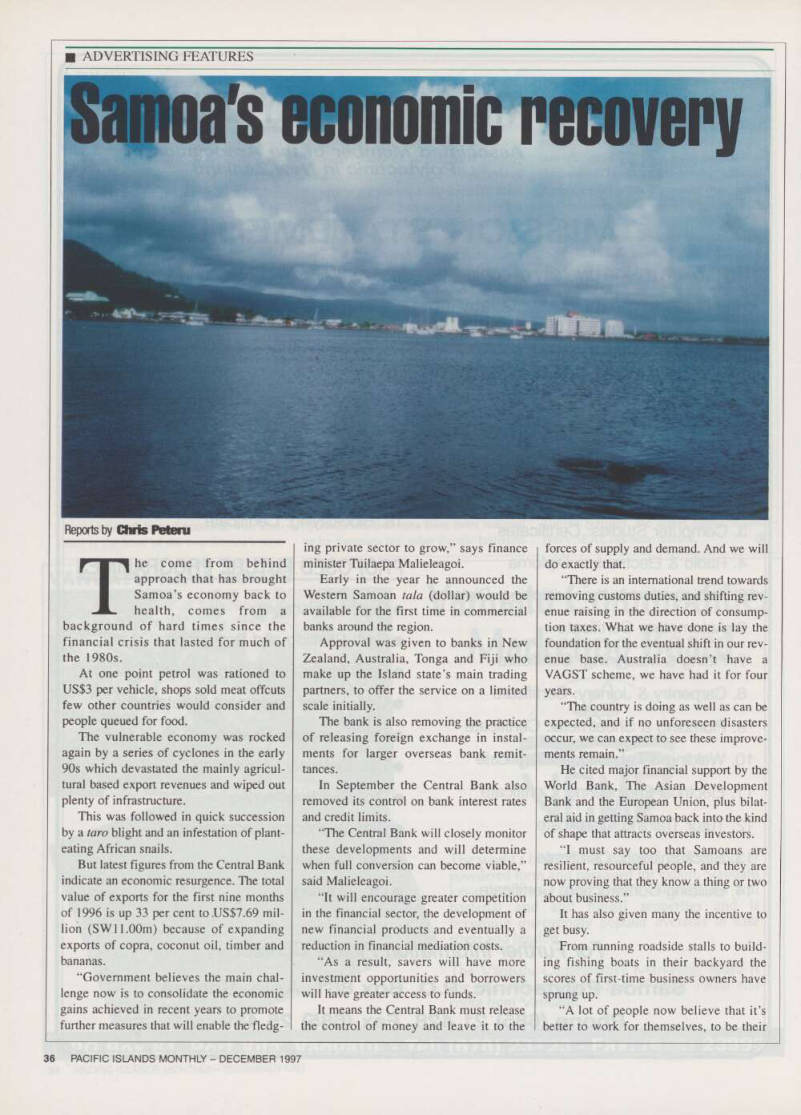
The come from behind approach that has brought Samoa’s economy back to health, comes from a background of hard times since the financial crisis that lasted for much of the 1980 s.
At one point petrol was rationed to US$3 per vehicle, shops sold meat offcuts few other countries would consider and people queued for food.
The vulnerable economy was rocked again by a series of cyclones in the early 90s which devastated the mainly agricul tural based export revenues and wiped out plenty of infrastructure.
This was followed in quick succession by a taro blight and an infestation of plant eating African snails.
But latest figures from the Central Bank indicate an economic resurgence. The total value of exports for the first nine months of 1996 is up 33 per cent to U 557.69 mil lion (SW 11.00 m) because of expanding exports of copra, coconut oil, timber and bananas.
“Government believes the main chal lenge now is to consolidate the economic gains achieved in recent years to promote further measures that will enable the fledg
ing private sector to grow,” says finance minister Tuilaepa Malieleagoi.
Early in the year he announced the Western Samoan tala (dollar) would be available for the first time in commercial banks around the region.
Approval was given to banks in New Zealand, Australia, Tonga and Fiji who make up the Island state’s main trading partners, to offer the service on a limited scale initially.
The bank is also removing the practice of releasing foreign exchange in instal ments for larger overseas bank remit tances.
In September the Central Bank also removed its control on bank interest rates and credit limits.
“The Central Bank will closely monitor these developments and will determine when full conversion can become viable,” said Malieleagoi.
“It will encourage greater competition in the financial sector, the development of new financial products and eventually a reduction in financial mediation costs.
“As a result, savers will have more investment opportunities and borrowers will have greater access to funds.
It means the Central Bank must release the control of money and leave it to the
forces of supply and demand. And we will do exactly that.
“There is an international trend towards removing customs duties, and shifting rev enue raising in the direction of consump tion taxes. What we have done is lay the foundation for the eventual shift in our rev enue base. Australia doesn’t have a VAGST scheme, we have had it for four years.
“The country is doing as well as can be expected, and if no unforeseen disasters occur, we can expect to see these improve ments remain.”
He cited major financial support by the World Bank, The Asian Development Bank and the European Union, plus bilat eral aid in getting Samoa back into the kind of shape that attracts overseas investors.
“I must say too that Samoans are resilient, resourceful people, and they are now proving that they know a thing or two about business.”
It has also given many the incentive to get busy.
From running roadside stalls to build ing fishing boats in their backyard the scores of first-time business owners have sprung up.
“A lot of people now believe that it’s better to work for themselves, to be their
Reports by Chris Peteru
own bosses, than working for the govern ment or whoever. The difference now is that people are willing to take a risk, now everyone wants in,” says store owner Pat Bentley.
“People now know that if they apply sound business practices, and are thor oughly prepared there is every chance things will happen for them,” says Audrey Aumua formerly a consultant at the Small Business Centre, a hands-on training facil ity initially set up by the New Zealand government.
In a rapidly changing world tiny devel oping states in the region have often had to move at double time to stay afloat. In Samoa the government has positioned the country to become more market driven promising a gradual deregulation in the economy and more opportunities for those with drive and initiative to prosper.
The government has already signalled its intention to lead the way in freeing up the market, with the sale in the last 24 months of government shares in the national bank, now ANZ owned, and the post office banking division to private local interests.
While importance is still attached to agriculture, the latest development being a budding beef industry, diversification and producing quality products in any market has become today’s new standard.
“We believe that the economic future of our country lies more in tourism and in manufacturing.”
The moves show the government’s confidence that the economy is entering a period of sustained growth. To ensure fair play, the Central Bank has warned the local business community that it will come down hard on those selling acquired for eign currency on the black market instead of to local banks.
“We are getting reports now from the banks about how much firms are cashing in. There is a very small amount going back into banks,” said bank Governor
Papalii Scanlan.
A senior bank official says that using the black market and illegal money chang ers cost the country “hundreds of thou sands of dollars a year.”
If the situation did not improve, public notices and the on-site inspection of busi ness houses would be carried out, said Scanlan.
Businesses and hotels were obliged to trade foreign exchange at bank rates, and to make sure the banks received the money. ■