Home discomforts
pp. 23-24 · Read in the full issue
Rent on state housing goes up causing concern among NZ’s Pacific Islands community
By Atama Raganivatu
Sir Winston Churchill once claimed “There are three kinds of lies - lies, damn lies and statistics.”
Thankfully, official statistics have become far more reliable and gained greater credence since Churchill’s
days and the follow ing statistics ade quately explain why
Wellington’s policy
of introducing mar ket rents for state housing is causing immense concern among members of the New Zealand Pacific Islands com
munity.
The statistics show that 35.6 percent of Pacific Island people in
New Zealand reside in state houses; 70 percent of the Pacific Islands community live in the greater Auckland area; the aver age rent for a two bedroom state house in the greater Auckland area is approximately $US114 per week, compared to the aver age for houses outside Auckland of approximately $NZ76 per week and the overall cost of living in Auckland is approximately 10 percent higher than the rest of New Zealand.
Wages in the Queen City reflect his dif ference, however welfare benefits (and a large proportion of state housing tenants are beneficiaries) do not.
State housing in New Zealand began with the country’s first Labour govern ment, which was in power between 1935 and 1949. During this time 32,000 dwellings were built with the purpose of providing affordable accommodation for low income families. Initially, the jobs cre ated by their construction also helped New
Zealand emerge from the great depression.
Since 1949, the conservative National Party has formed the government more often than not, however the original princi pal of fixing state housing rents at levels required to recover costs rather than make a profit was maintained until 1991.
Then, the National administration announced it would gradually increase state house rents until they reflected those in the private sector.
During the past six years, numerous horror stories have been recounted about the deteriorating housing situation in New
Zealand. The media regularly chronicles case of families living in cars, garages and squalid, cramped buildings obviously unfit for human accommodation. Opposition politicians claim that these instances are all the direct consequence of state houses being unaffordable for a significant num ber of people. Of course, New Zealand is not alone in suffering from a shortage of adequate housing and, even today, the homeless there are not as conspicuous as their unfortunate counterparts in the United States and Britain.
But, what makes the circumstances in New Zealand particularly poignant is that previous generations of Kiwis regarded access to suitable accommodation almost as a birthright.
In the run up to the 1996 general elec tion every major opposition party pledged to introduce income-related rents for state houses if becoming government.
When the election produced a stale
mate each party represented in parliament agreed to a rent freeze. But, upon National and New Zealand First cobbling together a coalition agreement early this year, the pre
vious government’s policy prevailed and
the freeze ended on July 1.
At the same time, the coalition govern ment boosted the accommodation supple ment, a benefit available through the Ministry of Social Welfare to low income families in both the public and private housing sectors.
However, the supplement in most cases, did little other than partially alleviate the
rent increases.
In Auckland, the aver age state house rent (covering all building sizes) is approximately SUSSISS a week and the average supple ment of approximately SUSS44 a week.
“The housing picture is far from satisfactory and administration of the accommodation supplement is ques tionable,” Arthur Anae,
National’s single Pacific Island member of parliament acknowledges. “Every one is looking at solutions to it.”
Not surprisingly, Taito Phillip Field, the Labour Party’s spokesman on Pacific Island affairs is less measured in his criti cism: “Many people in state houses have known for a long time that state housing is unaffordable.
This has resulted in overcrowding and there are several other problems which are
repercussions of the government’s policy,
including health, education failures in the Pacific Islands community and escalating crime.
Housing New Zealand (the government organisation which administers state hous ing) made a profit of $U566,000,000 last year.
That profit was at the expense of low income people and the most vulnerable, including the old and children. The only fair means to access state rents is to make
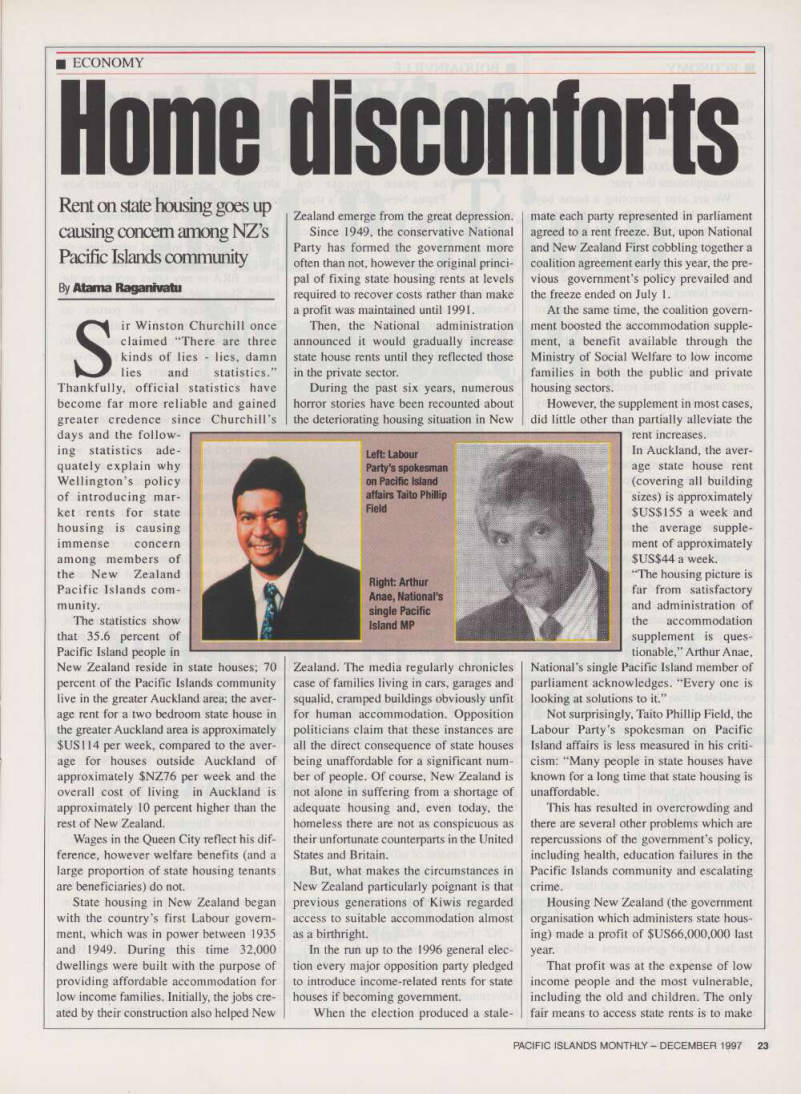
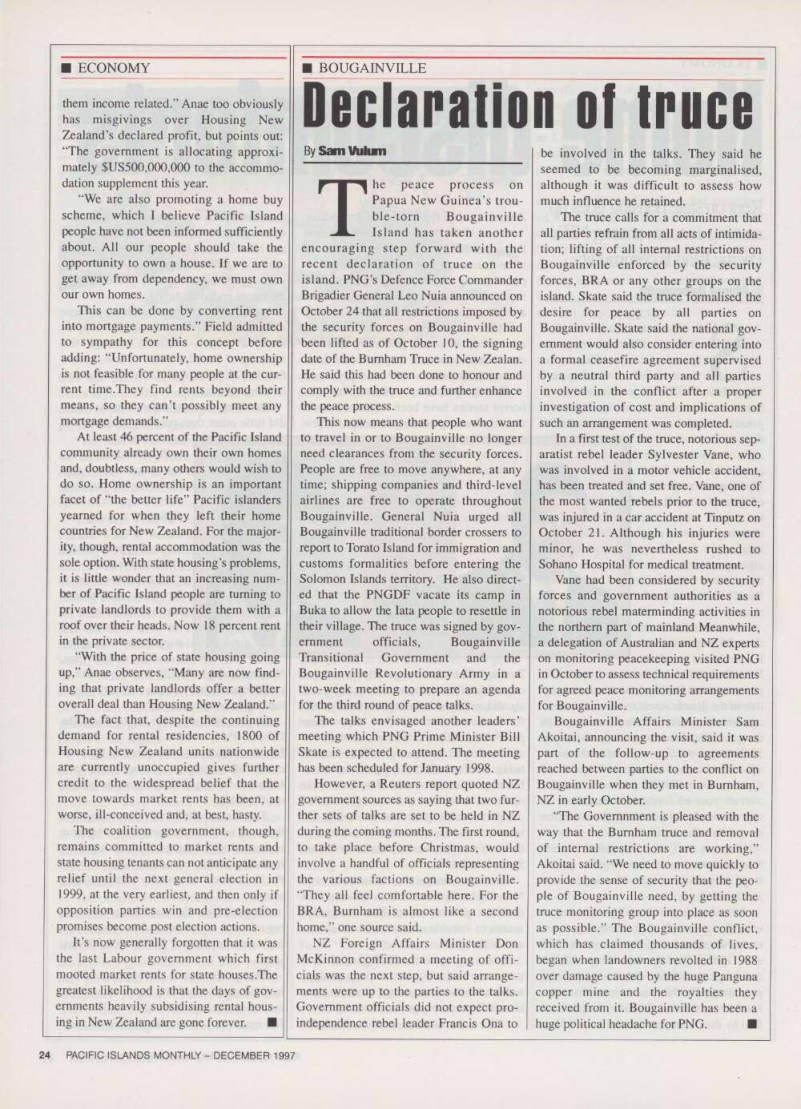
Left: Labour Party's spokesman on Pacific Island affairs Taito Phillip Field
Right: Arthur Anae, National’s single Pacific Island MR
them income related.” Anae too obviously has misgivings over Housing New Zealand’s declared profit, but points out: “The government is allocating approxi mately $U5500,000,000 to the accommo dation supplement this year.
“We are also promoting a home buy scheme, which I believe Pacific Island people have not been informed sufficiently about. All our people should take the opportunity to own a house. If we are to get away from dependency, we must own our own homes.
This can be done by converting rent into mortgage payments.” Field admitted to sympathy for this concept before adding: “Unfortunately, home ownership is not feasible for many people at the cur rent time. They find rents beyond their means, so they can’t possibly meet any mortgage demands.”
At least 46 percent of the Pacific Island community already own their own homes and, doubtless, many others would wish to do so. Home ownership is an important facet of “the better life” Pacific islanders yearned for when they left their home countries for New Zealand. For the major ity, though, rental accommodation was the sole option. With state housing’s problems, it is little wonder that an increasing num ber of Pacific Island people are turning to private landlords to provide them with a roof over their heads. Now 18 percent rent in the private sector.
“With the price of state housing going up,” Anae observes, “Many are now find ing that private landlords offer a better overall deal than Housing New Zealand.”
The fact that, despite the continuing demand for rental residencies, 1800 of Housing New Zealand units nationwide are currently unoccupied gives further credit to the widespread belief that the move towards market rents has been, at worse, ill-conceived and, at best, hasty.
The coalition government, though, remains committed to market rents and state housing tenants can not anticipate any relief until the next general election in 1999, at the very earliest, and then only if opposition parties win and pre-election promises become post election actions.
It’s now generally forgotten that it was the last Labour government which first mooted market rents for state houses. The greatest likelihood is that the days of gov ernments heavily subsidising rental hous ing in New Zealand are gone forever. ■