Women and fisheries
pp. 21-22 · Read in the full issue
Economy
By Kalinga Seneviratne
The small island nations of the South Pacific may not have abundant natural resources, but one thing they have in plenty is seafood. For generations, both men and women have played a key role in the subsis tence fisheries economy which has provided plenty of nutrition for its people.
Today, with economic restructuring the buzzword in the region and fish-export income its priority, women are being
marginalised from this industry as foreign
aid-driven development schemes focus on training the men for deep-sea fishing and other technology-driven fish-processing skills. Estimates from the Honiara-based Forum Fisheries Agency (FFA) show the South Pacific supplies half the world’s canned tuna and between 30 to 40 per cent of the fresh tuna imported into Japan -a catch estimated in 1995 to be worth about SUSI7OO million. Foreign fishing vessels, however, paid only SUS6O million in licensing fees to Pacific Island nations to fish in their 200-mile exclusive economic zones during the same year. That, accord ing to the FFA, is a mere 3.52 percent of the value of the catch.
If you take into account the income Pacific Island countries get from port calls by foreign fishing vessels, the income earned by locals - mostly women - work ing in foreign-owned canneries in coun tries such as Papua New Guinea, Fiji, Western Samoa and Solomon Islands, the total export income from fisheries for the South Pacific could be around SUSIOO million a year.
While this income is important for the cash-strapped economies of the Pacific, there’s very little attention paid to the development of subsistence fisheries as an important protein source for its people, as well its role in saving precious foreign income, which would otherwise be allocat ed for food imports.
Subsistence fisheries still provides the main source of protein foods for the coastal communities of the Pacific Islands. Studies commissioned by the Noumea-based South Pacific Commission (SPC) have shown
declining fish catches by these subsistence fishing activities. In many countries, this is blamed on commercial over-exploitation of particular species, sometimes by
licensed foreign fishing vessels.
In a book published by SPC on women’s role in Pacific development, Claire Slatter, a University of the South Pacific lecturer and a founding member of the Women in Fisheries network based in Suva, noted Pacific governments were try ing to maximise export income not only from deep-sea tuna fisheries, but also from inshore fisheries.
“Instead of supporting or shoring up the inshore fishery, thereby protecting this vital resource base which is sustaining thousands of Pacific people who are pri marily dependent on semi-subsistence livelihood, governments have been unwit tingly encouraging intensified exploitation of existing inshore commercial species,” she said.
Slatter pointed out that while numerous studies had highlighted the central role women played in providing protein to the communities from subsistence fisheries, had not resulted in official recognition of it and support for women’s fisheries activi ties. This view is shared by Patricia Tuara, the women’s fisheries development officer at the SPC. A former head of the fisheries management section of the Ministry of Marine Resources in the Cook Islands, she says the women’s fisheries development programme was set up at the SPC after many studies found that, although women were involved in fisheries in many ways, they were not given the necessary support by governments.
“The type of fishing a woman does is that which will not take her away from home for a long period of time because of domestic responsibilities,” she explained to PIM.
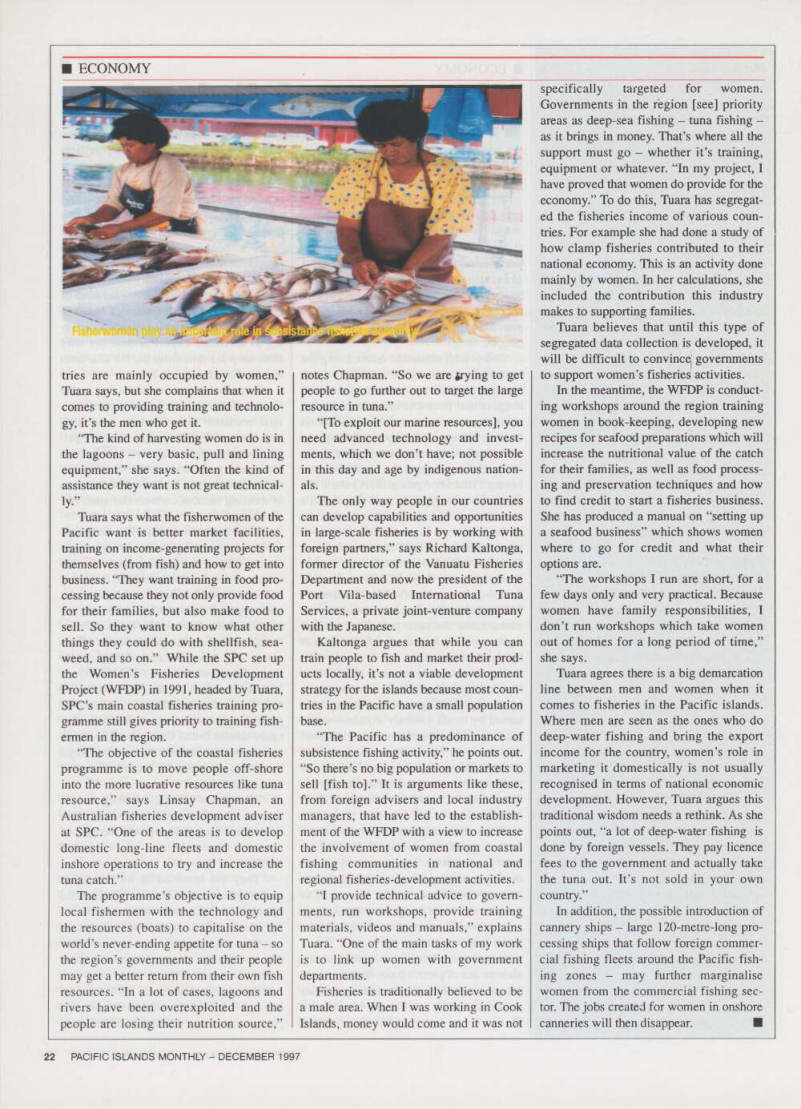
“They are involved in harvesting as well as processing. Once its [fish] landed by men, a lot of processing is carried out by women,” Tuara notes, adding that, in countries such as Fiji, even the new can neries set up by foreign companies employ
mainly women.
However, she points out, it’s in the mar keting of fish domestically that women play a major role. “Markets in all the coun-
tries are mainly occupied by women,”
Tuara says, but she complains that when it comes to providing training and technolo gy, it’s the men who get it.
“The kind of harvesting women do is in the lagoons - very basic, pull and lining equipment,” she says. “Often the kind of assistance they want is not great technical ly-”
Tuara says what the fisherwomen of the Pacific want is better market facilities, training on income-generating projects for themselves (from fish) and how to get into business. “They want training in food pro cessing because they not only provide food for their families, but also make food to sell. So they want to know what other things they could do with shellfish, sea weed, and so on.” While the SPC set up the Women’s Fisheries Development Project (WFDP) in 1991, headed by Tuara, SPC’s main coastal fisheries training pro gramme still gives priority to training fish ermen in the region.
“The objective of the coastal fisheries programme is to move people off-shore into the more lucrative resources like tuna resource,” says Linsay Chapman, an Australian fisheries development adviser at SPC. “One of the areas is to develop domestic long-line fleets and domestic inshore operations to try and increase the tuna catch.”
The programme’s objective is to equip local fishermen with the technology and the resources (boats) to capitalise on the world’s never-ending appetite for tuna - so the region’s governments and their people may get a better return from their own fish resources. “In a lot of cases, lagoons and rivers have been overexploited and the people are losing their nutrition source,”
notes Chapman. “So we are trying to get people to go further out to target the large resource in tuna.”
“[To exploit our marine resources], you need advanced technology and invest ments, which we don’t have; not possible in this day and age by indigenous nation als.
The only way people in our countries can develop capabilities and opportunities in large-scale fisheries is by working with foreign partners,” says Richard Kaltonga, former director of the Vanuatu Fisheries Department and now the president of the Port Vila-based International Tuna Services, a private joint-venture company with the Japanese.
Kaltonga argues that while you can train people to fish and market their prod ucts locally, it’s not a viable development strategy for the islands because most coun tries in the Pacific have a small population base.
“The Pacific has a predominance of subsistence fishing activity,” he points out.
“So there’s no big population or markets to sell [fish to].” It is arguments like these, from foreign advisers and local industry managers, that have led to the establish ment of the WFDP with a view to increase the involvement of women from coastal fishing communities in national and regional fisheries-development activities.
“I provide technical advice to govern ments, run workshops, provide training materials, videos and manuals,” explains Tuara. “One of the main tasks of my work is to link up women with government departments.
Fisheries is traditionally believed to be a male area. When I was working in Cook Islands, money would come and it was not
specifically targeted for women.
Governments in the region [see] priority areas as deep-sea fishing - tuna fishing as it brings in money. That’s where all the support must go - whether it’s training, equipment or whatever. “In my project, I have proved that women do provide for the economy.” To do this, Tuara has segregat ed the fisheries income of various coun tries. For example she had done a study of how clamp fisheries contributed to their national economy. This is an activity done mainly by women. In her calculations, she included the contribution this industry makes to supporting families.
Tuara believes that until this type of segregated data collection is developed, it will be difficult to governments to support women’s fisheries activities.
In the meantime, the WFDP is conduct
ing workshops around the region training
women in book-keeping, developing new recipes for seafood preparations which will increase the nutritional value of the catch for their families, as well as food process ing and preservation techniques and how to find credit to start a fisheries business.
She has produced a manual on “setting up a seafood business” which shows women where to go for credit and what their options are.
“The workshops I run are short, for a few days only and very practical. Because women have family responsibilities, I don’t run workshops which take women out of homes for a long period of time,” she says.
Tuara agrees there is a big demarcation line between men and women when it comes to fisheries in the Pacific islands.
Where men are seen as the ones who do deep-water fishing and bring the export income for the country, women’s role in marketing it domestically is not usually recognised in terms of national economic development. However, Tuara argues this traditional wisdom needs a rethink. As she points out, “a lot of deep-water fishing is done by foreign vessels. They pay licence fees to the government and actually take the tuna out. It’s not sold in your own
country.”
In addition, the possible introduction of cannery ships - large 120-metre-long pro cessing ships that follow foreign commer cial fishing fleets around the Pacific fish ing zones - may further marginalise women from the commercial fishing sec tor. The jobs created for women in onshore canneries will then disappear. ■