Not many Cooks can still
pp. 37-38 · Read in the full issue
United Nations
Not many Cooks can still flavour the broth
By Lan Williams
In one of the odder twists of geopolitics, the not-so-big Cook Islands have just replaced oh-so-big China on the governing council of the World Health Organisation, just as the battle to elect a new director-general heats up.
Last time, the Japanese incumbent Dr Hiroshi Nakajima fought off accusations of nepotism, cronyism and incompetence to win a second five-year term. The gov erning council is composed of 32 members who are supposed to be elected for their own personal medical excellence and to be independent of their governments.
And some of them might be.
This time one of the leading contenders is Pakistani Nafis Sadik, for the past 10 years the head of UNFPA, the UN’s family planning wing or “Fund for Population Activities”, and on October 10 she was
scheduled to go to the newly strategic Cook Islands, for obvious reasons. “They are on the WHO council,” she told PIM briskly, when interviewed in her New York office.
Her claims to the office are her experi ence in overseeing a global, health-related organisation with a staff of 900 and a bud get of SUS3OO million. Being non- European, a woman and a doctor as well, all helps of course. Her strongest opponent is undoubtedly former Norwegian Prime Minister Gro Bruntland Harlem, whom
Australia is supposed to favour. Of course, what Canberra wants cuts little copra in the islands lately, and she goes to the Cooks at their invitation.
However, she hastens to point out that her visit is more than just a canvassing trip.
“We have quite an important programme in the Pacific,” she says. “They have high population growth rates, high maternal
mortality, and high infant mortality, and
some of the countries just can’t cope with their populations. There’s a lot of emigra tion.” She points out that the islands in
some ways get better treatment from UNFPA, since "the cost of the programmes per capita is often much higher than main land countries’ because of things like trans port costs - and because the countries are so much smaller.
“So I’m quite interested to see what Cook Islands is doing in this field and in health generally, but particularly with women’s health, because indicators there are not so good.”
Dr Sadik recalled the Small Islands Conference in Barbados four years ago, and shares the general feeling that its deci sions have not been too assiduously imple mented.
“We have been discussing with the Caribbean countries some kind of a follow up to that in the population field. We were thinking of linking it to the ID-5 - Cairo plus five - conference to link it to environ ment - in the sense of rising sea levels, but also environment in the sense of health.”
The five-year review of the Cairo popu lation conference would indeed provide a forum for AOSIS members to vent their dissatisfaction at the neglect of their needs since Barbados, not least since rising sea levels and rising populations clearly rein force unsustainable population densities.
"That’s a connection we would be interest ed in, demographics - so obviously there is a link to the Kyoto conference on emis sions control - not least for the Pacific Islands.”
Elaborating on her plans if elected, she says; "I think WHO could be the lead in providing the format, the framework.
"In the system the problem is that each organ tries to get its own resources and then sticks to its own thing.
"That’s what Kofi Annan is trying to change with his reform proposals.” ■
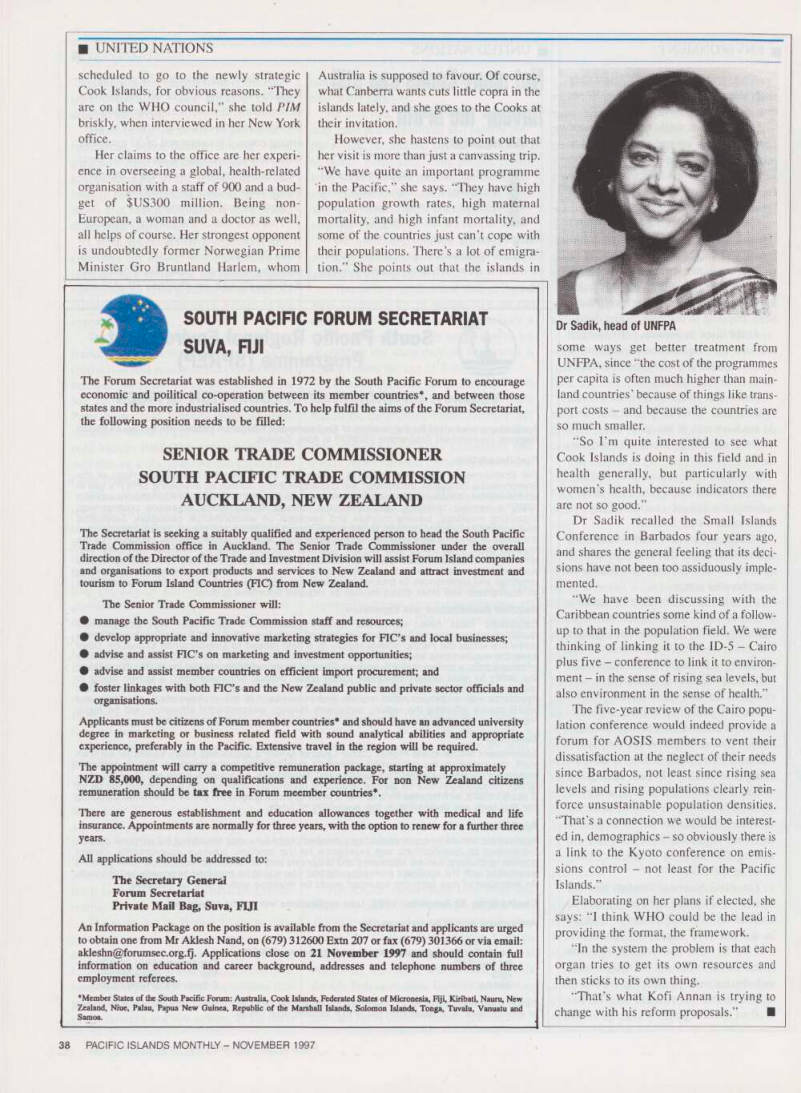
Dr Sadik, head of UNFPA