The drought
pp. 34-37 · Read in the full issue
Environment
By Sam Vulum
Papua New Guinea has seen some bad natural disasters in recent times but none as critical as the disturbing
impacts of the prolonged El Nino related drought currently wreaking havoc throughout the country and claimed to be the worst in 50 years.
The dreadful El Nino, the weather pat tern blamed for spreading crippling drought throughout the eastern states, has descended on PNG since June and is fore
cast to continue into next year. It claimed 73 lives, as of September 22, and the num ber was expected to rise if the relief sup plies were slow in coming. More than
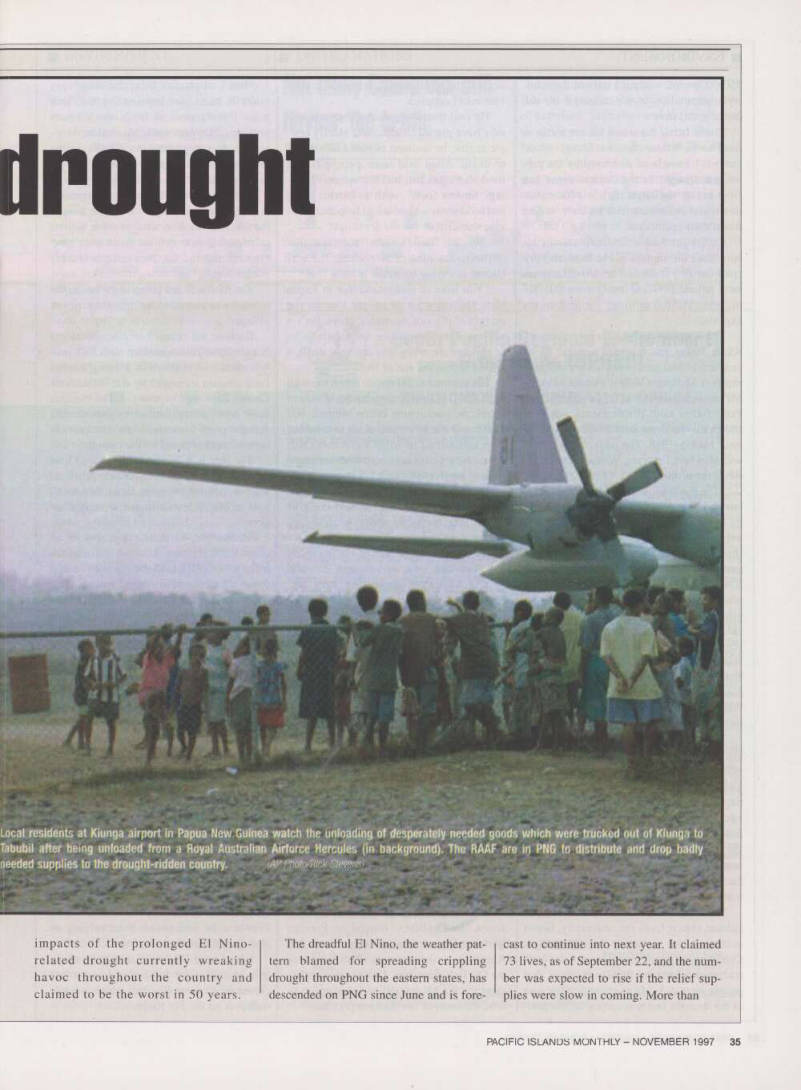
Local residents at Kiurtga airport in Papua New Guinea watch the unloading of desperately needed goods which were trucked out of Kiunga to Tabubil after being unloaded from a Royal Australian Airforce Hercules (In background). The RAAF are in PNG to distribute and drop badly needed supplies to the drought-ridden country, (AP Photo/Rick Stevens)
750,000 people - about a sixth of the coun try’s population - are affected by the drought and frost.
Those being the worst hit are those in rural areas, whose main livelihood - food gardens - have been destroyed by the pro longed drought in the coastal areas and frost in the highlands. Schools have shut down and health institutions have scaled down their operations.
Coffee producers have expressed con cern over the impact of the frost and dry spell on their fruits and tea manufacturers have reported PNG is losing more than K 1 million (SUSO.6 million) a month in tea exports.
The country’s only sugar manufacturer, Ramu Sugar, has reported a threat on its production and severe impact on its cattle ranch at Markham Valley. Former Madang MP and disaster relief agency chairman Peter Barter said: “Professional judgment indicated the drought will be with PNG until March, 1988. The odds are that 1988 will also be a dry year. We can expect dif ficult times ahead.
"The medium-to-long-term prognosis is not good for all our people.” Barter’s agen cy was established by the government to oversee and facilitate relief operations throughout the country. The four-month drought has so far attracted K 34,155 mil lion ($U521.68 million) from the PNG government for relief operations. The gov ernment has already spent K 1.2 million (SUSO.76 million) from the amount on var ious provinces in amounts ranging from K 200,000 (SUS 127,000) in Enga and Southern Highlands to K 20,000 each in New Ireland and Oro provinces. The other funds were to be distributed to the people through their MPs.
The Australian government pledged to provide an initial $A500,000
($U5370,000) drought assistance package
and has been delivering supplies since September 22. While announcing the pack age on September 15, Australian Federal Foreign Minister Alexander Downer said the Australian National University would assess the situation immediately and report back to the PNG and Australian govern ments.
The team, led by Bryant Allan, an agri culture expert from the university, began assessing the situation in 10 groups.
Commenting on the assessment, Allan con tradicted reports by PNG authorities that people were dying from starvation because of the drought and was critical of the deci
sion by the Australian government to pro vide relief supplies.
He said that while the harsh conditions may have placed children and elderly peo ple at risk, he doubted anyone had starved to death. Allan said some people facing food shortages still had the option of eat ing “famine food” such as banana roots and wild yams which would help them sur vive the crisis.
"We are frankly rather sceptical that anybody has died of starvation,” he was quoted as saying by AAP.
"You have to understand that in Papua New Guinea a lot of people live on the margin - it’s not Australia, there isn't a welfare state. People live tough here, a lot of children die when they are very small, a lot die before the age of five.”
His comments did not go down too well with PNG’s opposition leader Bernard Narokobi, questioning Prime Minister Bill Skate and his government as to whether they subscribed to Allan’s comment that Papua New Guineans could live on famine food to survive the crisis.
He told parliament, "Here is an expert who tells us we actually should not give money and food to our people because they are not dying of starvation.”
Skate deferred answering the questions to a later date.
The Australian government was also reportedly under attack for allowing all food deliveries into PNG to be made to one town which has close connections to min ing giant BHP Cos Ltd.
The accusation levelled at the govern ment was that more than 50,000 kg of food being flown in by the air force was being delivered to the remote mining town of Tabubil, close to the Ok Tedi mine in which BHP is a major shareholder, ABC radio reported.
Frank Willet, who operates a supermar ket in nearby Kiunga, said he could not get any assistance from the air force. “We can’t get any assistance from the Royal Australian Air Force plane - it’s like those guys in Kiunga don’t exist,” Willet said on ABC radio.
An RAAF spokesman said food had been included on training flights into Tabubil because the opportunity had arisen. In Canberra, Australian Foreign Minister Downer denied suggestions that Australian assistance was slanted towards the Ok Tedi mine area. Downer told parlia ment the RAAF was delivering supplies to affected areas of the Western province.
"But I emphasise these are arecas very much in need, not because the 0)K Tedi mine just happens to be in the Western province,” Downer said. "Australiarn coop eration was requested by PNG’s prime minister for provincial- and local-level governments.
"To suggest the Australian government is somehow focusing on the area around the Ok Tedi mine because of some sinister relationship between the Australian gov ernment and the Ok Tedi mine is frankly misleading.”
The food was not going to the towns but to stores in surrounding drought-stricken villages.
Back on the home front, local business houses have committed up to K 2.41 mil lion (SUS 1.53 million) in a drought-relief fund account managed by the Papua New Guinea Banking Corporation. The Westpac bank went a step further by introducing drought relief for some of its customers in certain areas affected by the drought.
The help is in the form of deferred loan repayments or a moratorium on principal loan reductions for up to three months. It will be available to customers on applica tion.
Meanwhile, Barter has appealed for an extra K3OO million (SUSI9O million) for relief efforts. He said the cost of feeding those affected would exceed several hun dred million kina. The committee has already met international donor countries and agencies to seek help in managing the crisis.
Provincial Affairs and Local Level Governments minister Simon Kaumi told parliament on September 25 initial statis tics compiled from the provinces so far indicated K 750,000 ($U5476,000) per day was required for food alone. While pre senting the first drought report to parlia ment, Kaumi said the nation could not afford the high cost. He confirmed media reports that 200,000 people from Kandeep in the Enga Province were directly affected in the worst-hit areas of Enga, Southern Highlands and Western Highlands provinces.
He said these people began moving to clans and traditional friends in the lower lying areas. In the Upper Fly of Western Province, he said people were relying on store-bought food.
Kaumi said; "While cash may be avail able to buy store food, the drought has closed off their supply line, which is barge transport up the Fly River.
“Food and fuel stocks are desperately short and prices have risen up to 30 per cent as some stores fly in supplies.”
He said in the atolls and small island communities in several provinces yet to recover from Cyclone Justin earlier this year, the drought has affected water and food supplies and this was compounded by increased health problems.
It’s not only the village that have been affected. Residents in major towns throughout the country are also suffering from acute water shortages. Almost all major centres, including Port Moresby, have reported that water levels have been dropping in catchments and dams.
Authorities in Manus, for example, fear that the situation could turn into a serious disaster if the dry spell continues for another few months.
Provincial water supervisor, John Rokam, said: "I would predict that if we do not have rain in the next four or five months, we will be faced with a disas ter.”
To prepare for any outbreak of dis eases, the health department has already submitted a list of essential drugs to donor agencies for funding.
Health authorities have cautioned against food-bome diseases if people are not careful in handling food and used contaminated water.
Already reports indicate an increase in miscarriages. Authorities said diar rhoea, dysentery, malnutrition, coughs and other respiratory problems were spreading through the highlands.
Individual reports of deaths have also emerged. In one such report in the Western Highlands province, two chil dren who fled the frost-ravaged Tambul district died at Waghi where they reset tled with their families. They died from eating poisonous wild beans after going without a meal for a day. The number of deaths is increasing. Also in Tambul, the area most affected by the frost, people have been reportedly saying that they are waiting for death as crops have been killed by the frost.
The PNG National Weather Service reported that the dry spell is expected to continue unless there are major changes in the pressure anomalies associated with the El Nino phenomenon this side of the world is facing. Although mon soonal rains were expected by the end of last month but this will not be sufficient to offset the drought. ■