United we stand
pp. 30-31 · Read in the full issue
Polynesian Economic Community proposed as cure for ailing economies
By Florence Syme-Buhchanan
Atop Pacific academic has advised seven regional leaders that it’s time Polynesian nations stopped acting separately and united to form a Polynesian Economic Community, enabling freer social, cul tural and economic exchange.
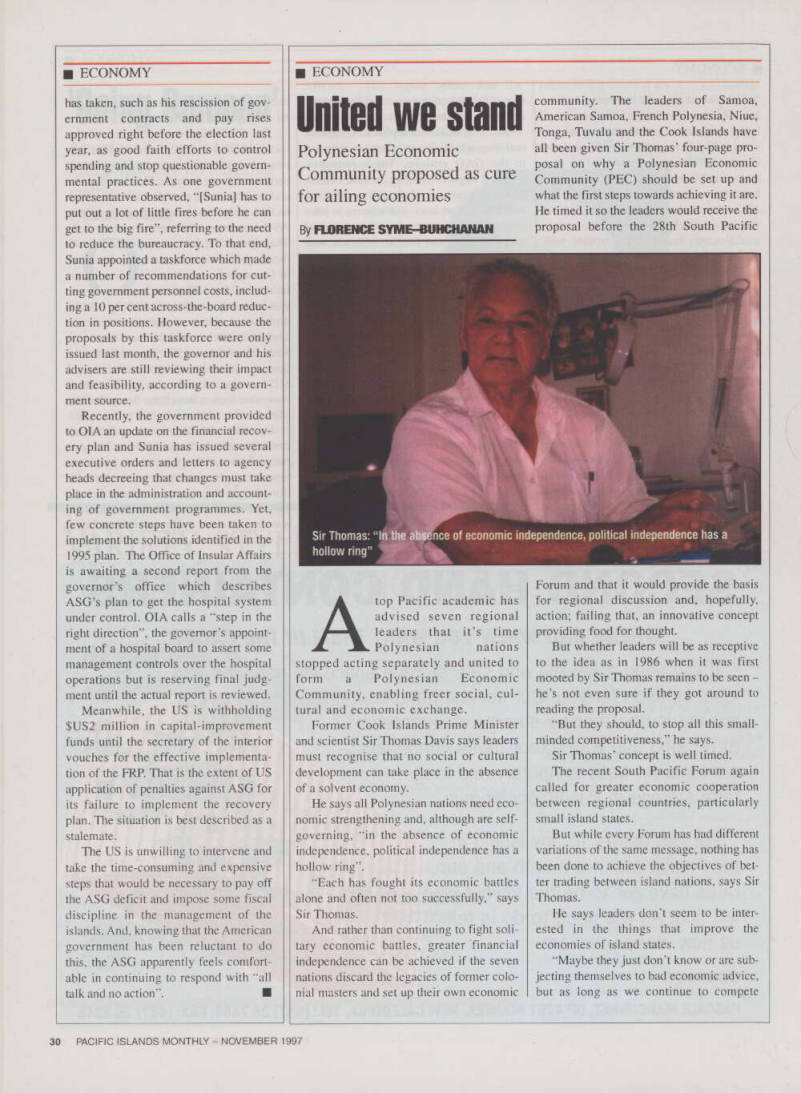
Former Cook Islands Prime Minister and scientist Sir Thomas Davis says leaders must recognise that no social or cultural development can take place in the absence of a solvent economy.
He says all Polynesian nations need eco nomic strengthening and, although are self governing, “in the absence of economic independence, political independence has a hollow ring”.
"Each has fought its economic battles alone and often not too successfully,” says Sir Thomas.
And rather than continuing to fight soli tary economic battles, greater financial independence can be achieved if the seven nations discard the legacies of former colo nial masters and set up their own economic
community. The leaders of Samoa, American Samoa, French Polynesia, Niue, Tonga, Tuvalu and the Cook Islands have all been given Sir Thomas’ four-page pro posal on why a Polynesian Economic Community (PEC) should be set up and what the first steps towards achieving it are.
He timed it so the leaders would receive the proposal before the 28th South Pacific
Forum and that it would provide the basis for regional discussion and, hopefully, action; failing that, an innovative concept providing food for thought.
But whether leaders will be as receptive to the idea as in 1986 when it was first mooted by Sir Thomas remains to be seen he’s not even sure if they got around to reading the proposal.
“But they should, to stop all this small minded competitiveness,” he says.
Sir Thomas’ concept is well timed.
The recent South Pacific Forum again called for greater economic cooperation between regional countries, particularly small island states.
But while every Forum has had different variations of the same message, nothing has been done to achieve the objectives of bet ter trading between island nations, says Sir Thomas.
He says leaders don’t seem to be inter ested in the things that improve the economies of island states.
“Maybe they just don’t know or are sub jecting themselves to bad economic advice, but as long as we continue to compete
Sir Thomas: “In the abfence of economic independence, political independence has a hollow ring”
against each other, the region will stay this way for another 100 years.”
Sir Thomas points to dependency on foreign aid as one of the reasons succes sive leaders fail to establish vibrant economies. But that in itself is another story. (See side bar) In his proposal, the former prime minis ter states, “Because of limited development in colonial times and failure to maintain the exclusive nature of markets for the products developed by rulers of that time, there has always been a need for Polynesian island states to exploit and mar ket whatever resources each may have and, where possible, to share them with one another.”
“The tourism industry, for instance, might be greatly enhanced for all member states if it were developed, promoted and marketed regionally rather than individual ly. The recent AUSTEO report has validity in many respects, but the former rulers have not been helpful in making its mar kets freely and preferentially accessible to whatever products island states may devel op, especially if the products compete with their own. They have jealously protected their markets from invasion of our goods, but have freely exploited and burgeoned their exports to the island states. From the point of view of Pacific island states, SPARTECA is a failure.”
Sir Thomas says island states have been influenced into dealing only with former colonial masters, regardless of the disad vantages.
His proposal adds, “In independence arrangements, some disincentives were built into the new system to discourage countries from developing new markets for imports and exports.”
“Exporting has become more and more difficult while imports have flourished at high cost to island countries. Export mar kets we once had no longer exist because former masters went elsewhere for what used to be exclusive to us,” he says citing fruit and vegetable exports to New Zealand, which have steadily declined over the years.
Sir Thomas says island states have been let down in many ways by past colonial rulers who should have remained their partners.
"But we have also let ourselves down by continuing with the heritage of obsolete social and economic methods the former rulers left island countries to follow. They
have also sapped motivation for develop ment and self-reliance - with not always well directed aid.
“The economy of a country is just like the economy of a home - when your coun try is at stake, your home is at stake and the only way to earn for your home is to use the skills you have and sell it outside,”
Sir Thomas says.
“You do all the things that earn you money, you sell your skills, but you don’t sell it to your husband or your kids,” is the parallel he uses for Polynesian countries selling goods to each other without tax breaks.
In his proposal, Sir Thomas said the
Polynesian community would gain
strength by uniting and become an eco nomic and social force of its own in its dealings within the region, Pacific rim countries and beyond.
“At this time we might not see clearly what goods or services we can trade with one another or with the outside world. But have we looked in depth and with creative thinking?”
The simple examples he gives are American Samoa’s cheap American imports, Tonga’s access to high-quality housing at attractive prices, Samoan and Tongan beer, Cook Islands oranges, “and the list goes on”.
While there are difficulties such as transportation and transfer of agricultural products. Sir Thomas believes these can be overcome easily if the seven countries work at it together.
"The aim of a united community is to wash away valueless hindrances to com mercial development while maintaining each of our political autonomies and valu able economic and cultural differences,”
Sir Thomas told Polynesian leaders.
First steps that need to be taken to establish a PEC are; • abolishing visas between member countries with passports the only require ment; • removing all protective tariffs and other disincentives on goods and services traded between member countries; • facilitating the movement of goods and services between member countries; • ensuring trading between member states is performed freely by the private sectors of each country with incentives as needed; • ensuring trading between member states and to the outside world protects the
economic survival of its members; and • ensuring the development of efficient communication and transportation systems between member states and the outside world.
He reminded leaders that Polynesians “are one people with the same heritage”.
Because of this, he says, “it should not be difficult for us to combine our forces for our mutual benefit, survival and the suste nance of a good life for our people”.
Sir Thomas was PM between 1978 and 1987, with the exception of about three months in 1983. During his tenure, Sir Thomas applied his own economic medicine to the ailing, aid-dependent Cook Islands economy. His prescription resulted in the Cook Islands experiencing unprece dented economic growth of 12 per cent per annum, rated as one of the highest in the world. ■