'Going Samoan'
pp. 28-30 · Read in the full issue
American Samoa’s fiscal irresponsibility no laughing matter
By Susan Prokop
On a crisp September evening at the New
Zealand embassy’s
Pacific Islands night, a group of people talked about those occasions when their personal finances become unbalanced.
Laughed one official with the US Interior Department, ‘"I call it going Samoan.”
Part of the explanation for American Samoa as the butt of jokes about fiscal irre sponsibility can be found in the most recent State of the Islands, the report issued each year by Interior’s Office of Insular
Affairs. The report notes that the American Samoa government [ASG] has a cumulative operating deficit "in excess of SUS3O million”, which amounts to about half of its annual operating budget.
Last year, the ASG took in SUS6O.6 million but spent SUS6B.3 million.
American Samoa receives consid erable sums from the US. Over one-third of its
operating budget
is the SUS 23million direct subsidy ASG receives from Uncle Sam. The
US sends another SUS 6-10 million each year in capital improvement funds to the islands and many millions more in federal grant programme monies. Despite this
influx of US taxpayer dollars, ASG contin ues to be unable to finance its way out of its growing debt. The government has no borrowing authority nor is there any entity to whom it could turn to pay off its debt.
ASG just accu mulates an ongoing short fall each year and, to deal with its deficit, simply doesn’t pay its bills to vendors, to tax payers owed refunds or on accounts owed to the US.
Stories in the local media paint an ongo
ing picture of mismanagement and inap propriate use of public funds. As reported in the Samoa News, the governor’s office recently paid SUSBB,OOO for non-competi tive contracts to refurbish the executive mansion with custom-made furniture. No money had been included in the ASG bud get for the renovation. However, after a conversation between Governor Tauese Sunia and head of the American Samoan Power Authority (ASPA), funds were transferred from ASPA into the ASG gen eral fund - the fund with the SUS3Om deficit - from which came the money for the redecorating.
At a July hearing conducted by the Appropriations Committee of the Samoan legislature, a government official admitted the ASG had been selling off surplus vehi cles in need of repair for SUSSO, without the required public notice and auction.
Because some of the vehicles only needed modest repairs to be in working order once again, the government was losing out on a significant source of potential revenue.
That same month, the American Samoan Farmers Cooperative revealed the government had been buying Western Samoan bananas for its school lunch pro gramme at SUSI.SO per pound. Even US mainlanders, thousands of miles from the source of this tropical fruit, don't have to shell out that kind of money for bananas, paying on average about 59 cents per pound. Meanwhile, American Samoan farmers, on the rare occasion when they were able to sell bananas to their own gov ernment, were paid only 80 cents per pound.
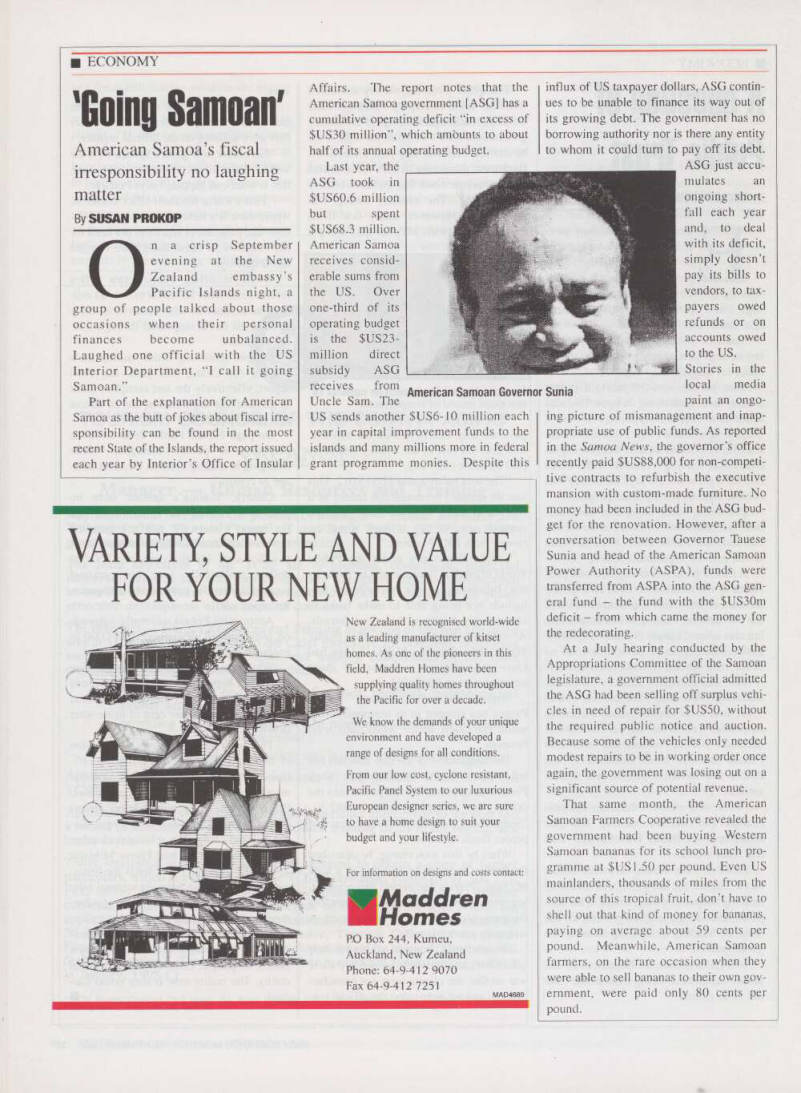
American Samoan Governor Sunia
Poor accounting and business practices by ASG have jeopardised the ability of island residents to obtain local hospital ser vices. The US Department of Health and Human Services has threatened to stop honouring Medicare and Medicaid charges from the territory’s sole hospital after the ASG submitted a poorly written plan for clearing up problems in its health care sys tem. Not only has HHS had trouble with the island health department, some suppli ers of pharmaceuticals have refused to send medicine to the hospital because of the notoriously long time it takes ASG to pay its bills. At the same time, American Samoans’ ability to obtain off-island care may be uncertain. Millions of dollars are owed by ASG to hospitals in Hawaii and the mainland, making it one of the larger medical care deadbeats in the US health system. American Samoa’s troubles are documented at least as far back as 1992 when an audit by the US General Accounting Office [GAO] cited poor fiscal management and inadequate budget disci pline as reasons for the poor condition of the government’s finances. These prob lems have been compounded, the OIA sug gests, by a rapidly increasing population,
recent natural calamities, and “a limited economic and tax base”.
In 1993, ASG sent a plan to Congress outlining actions it would take to respond to the GAO critique. These measures included improvements in revenue collec tion, enforcement of American Samoan balanced budget laws, and reforms in pro curement and contracting. A working group of ASG and Interior officials was appointed the next year to clarify specific objectives to implement the plan of action set out in 1993. In 1995, working with a consultant from OIA, the ASG put togeth er a Financial Recovery Plan [FRP] to complement the efforts of the working group. This recovery plan identified a number of corrective actions that required only an executive order, not lengthy leg islative deliberations, to be put into effect.
For example, one of the FRP recom mendations was that ASG reduce what all agree is an oversized workforce. Yet, a hir ing freeze for the government that was in place at the time of the FRP has been large ly ignored. According to sources at OIA, bimonthly payroll costs rose from SUS 2.2 million in 1995 to SUS 2.6 million in 1997.
The SUS6O million the ASG is spending
each year on personnel represents almost all of its general fund revenues.
The FRP also recommended slight increases in local government fees for court, hospital, telephone, hotel and other services to bring in some SUS 3 million in additional revenue to ASG. In the words of an OIA budget analyst, the response of the ASG has been: “We need to study that.
They [the ASG] have managed to put off the tough decisions because they have yet to face any dire consequences from their failure to do so. What we have is a nega tive recovery going on.” Calling ASG’s problems a matter of “misplaced priori ties”, this official cited the fact that many Samoan schools are in dilapidated condi tion, at a time when the government spent SUSI million to build a playing field when American Samoa hosted the South Pacific Mini Games.
Defenders of the American Samoan government insist Sunia, who was inaugu rated in January this year, has to be given time to straighten out the mess he inherited from the previous governor, [even though this somewhat overlooks the fact that he was the lieutenant governor in that admin istration]. Officials point to actions Sunia
has taken, such as his rescission of gov ernment contracts and pay rises approved right before the election last year, as good faith efforts to control spending and stop questionable govern mental practices. As one government representative observed, “[SuniaJ has to put out a lot of little fires before he can get to the big fire”, referring to the need to reduce the bureaucracy. To that end, Sunia appointed a taskforce which made a number of recommendations for cut ting government personnel costs, includ ing a 10 per cent across-the-board reduc tion in positions. However, because the proposals by this taskforce were only issued last month, the governor and his advisers are still reviewing their impact and feasibility, according to a govern ment source.
Recently, the government provided to OIA an update on the financial recov ery plan and Sunia has issued several executive orders and letters to agency heads decreeing that changes must take place in the administration and account ing of government programmes. Yet, few concrete steps have been taken to implement the solutions identified in the 1995 plan. The Office of Insular Affairs is awaiting a second report from the governor’s office which describes ASG’s plan to get the hospital system under control. OIA calls a “step in the right direction”, the governor’s appoint ment of a hospital board to assert some management controls over the hospital operations but is reserving final judg ment until the actual report is reviewed.
Meanwhile, the US is withholding SUS 2 million in capital-improvement funds until the secretary of the interior vouches for the effective implementa tion of the FRR That is the extent of US application of penalties against ASG for its failure to implement the recovery plan. The situation is best described as a stalemate.
The US is unwilling to intervene and take the time-consuming and expensive steps that would be necessary to pay off the ASG deficit and impose some fiscal discipline in the management of the islands. And, knowing that the American government has been reluctant to do this, the ASG apparently feels comfort able in continuing to respond with "all talk and no action”. ■