Letters To The Editor
Come and see: the IDS response
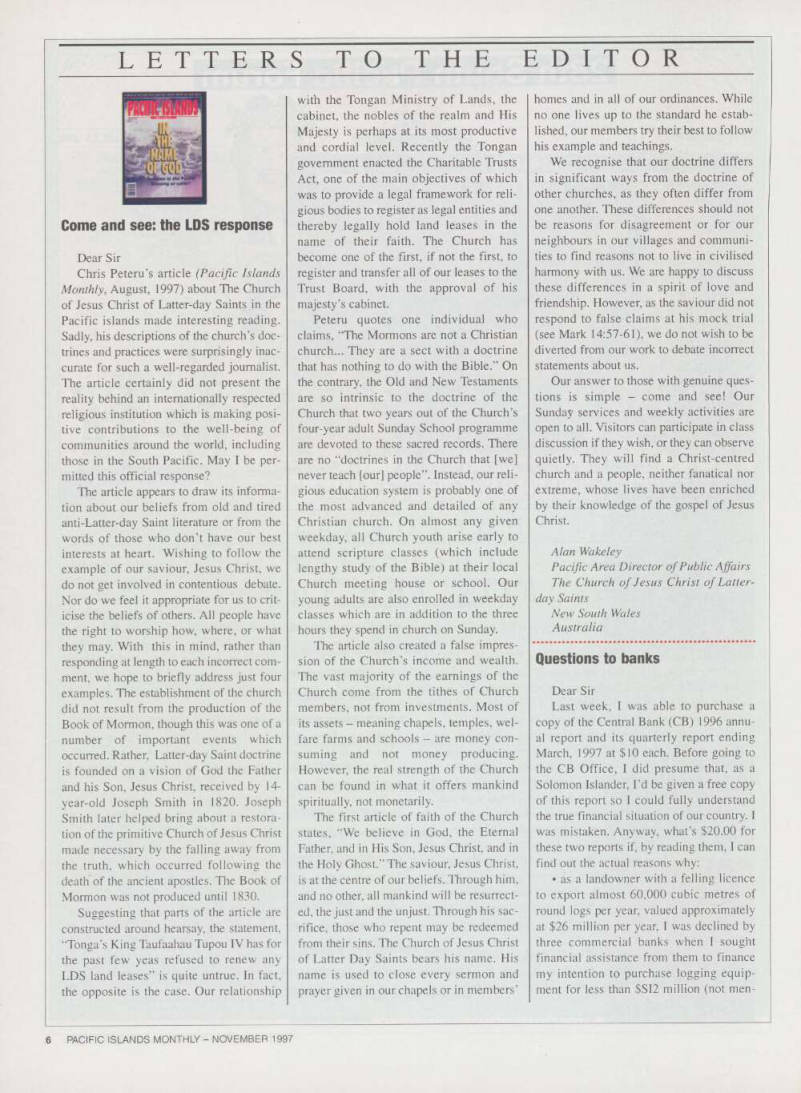
Dear Sir Chris Peteru’s article (Pacific Islands Monthly, August, 1997) about The Church of Jesus Christ of Latter-day Saints in the Pacific islands made interesting reading.
Sadly, his descriptions of the church’s doc trines and practices were surprisingly inac curate for such a well-regarded journalist.
The article certainly did not present the reality behind an internationally respected religious institution which is making posi tive contributions to the well-being of communities around the world, including those in the South Pacific. May I be per mitted this official response?
The article appears to draw its informa tion about our beliefs from old and tired anti-Latter-day Saint literature or from the words of those who don’t have our best interests at heart. Wishing to follow the example of our saviour, Jesus Christ, we do not get involved in contentious debate.
Nor do we feel it appropriate for us to crit icise the beliefs of others. All people have the right to worship how, where, or what they may. With this in mind, rather than responding at length to each incorrect com ment, we hope to briefly address just four examples. The establishment of the church did not result from the production of the Book of Mormon, though this was one of a number of important events which occurred. Rather, Latter-day Saint doctrine is founded on a vision of God the Father and his Son, Jesus Christ, received by 14year-old Joseph Smith in 1820. Joseph Smith later helped bring about a restora tion of the primitive Church of Jesus Christ made necessary by the falling away from the truth, which occurred following the death of the ancient apostles. The Book of Mormon was not produced until 1830.
Suggesting that parts of the article are constructed around hearsay, the statement, "Tonga's King Taufaahau Tupou IV has for the past few yeas refused to renew any LDS land leases” is quite untrue. In fact, the opposite is the case. Our relationship
with the Tongan Ministry of Lands, the cabinet, the nobles of the realm and His Majesty is perhaps at its most productive and cordial level. Recently the Tongan government enacted the Charitable Trusts Act, one of the main objectives of which was to provide a legal framework for reli gious bodies to register as legal entities and thereby legally hold land leases in the name of their faith. The Church has become one of the first, if not the first, to register and transfer all of our leases to the Trust Board, with the approval of his
majesty’s cabinet.
Peteru quotes one individual who claims, “The Mormons are not a Christian church... They are a sect with a doctrine that has nothing to do with the Bible.” On the contrary, the Old and New Testaments are so intrinsic to the doctrine of the Church that two years out of the Church’s four-year adult Sunday School programme are devoted to these sacred records. There are no “doctrines in the Church that [we] never teach [our] people”. Instead, our reli gious education system is probably one of the most advanced and detailed of any Christian church. On almost any given weekday, all Church youth arise early to attend scripture classes (which include lengthy study of the Bible) at their local Church meeting house or school. Our young adults are also enrolled in weekday classes which are in addition to the three hours they spend in church on Sunday.
The article also created a false impres sion of the Church’s income and wealth.
The vast majority of the earnings of the Church come from the tithes of Church members, not from investments. Most of its assets - meaning chapels, temples, wel fare farms and schools - are money con suming and not money producing.
However, the real strength of the Church can be found in what it offers mankind spiritually, not monetarily.
The first article of faith of the Church states, "We believe in God, the Eternal Father, and in His Son, Jesus Christ, and in the Holy Ghost.” The saviour, Jesus Christ, is at the centre of our beliefs. Through him, and no other, all mankind will be resurrect ed, the just and the unjust. Through his sac rifice, those who repent may be redeemed from their sins. The Church of Jesus Christ of Latter Day Saints bears his name. His name is used to close every sermon and prayer given in our chapels or in members’
homes and in all of our ordinances. While no one lives up to the standard he estab lished, our members try their best to follow his example and teachings.
We recognise that our doctrine differs in significant ways from the doctrine of other churches, as they often differ from one another. These differences should not be reasons for disagreement or for our neighbours in our villages and communi ties to find reasons not to live in civilised harmony with us. We are happy to discuss these differences in a spirit of love and friendship. However, as the saviour did not respond to false claims at his mock trial (see Mark 14:57-61), we do not wish to be diverted from our work to debate incorrect statements about us.
Our answer to those with genuine ques tions is simple - come and see! Our Sunday services and weekly activities are open to all. Visitors can participate in class discussion if they wish, or they can observe quietly. They will find a Christ-centred church and a people, neither fanatical nor extreme, whose lives have been enriched by their knowledge of the gospel of Jesus Christ.
Alan Wakeley
Pacific Area Director of Public Affairs The Church of Jesus Christ of Latter day Saints New South Wales Australia