Australia
Editorial
Australia calls the tune
After the ‘release’ in July of the
Aus T E O
reports -
Australia’s very candid and highly confidential briefing papers on Pacific leaders - John Howard’s personal appearance at this year’s South Pacific Forum was seen as vital for Australian damage control. Howard’s absence from the Rarotonga meeting, so speculation had it, would not be the right tonic to wash down the bitter pill island leaders were already having trouble swallowing.
But by the end of the Rarotonga meeting, Australians them selves must be wondering whether their prime minister didn’t, in fact, do more damage to Australia’s international relations.
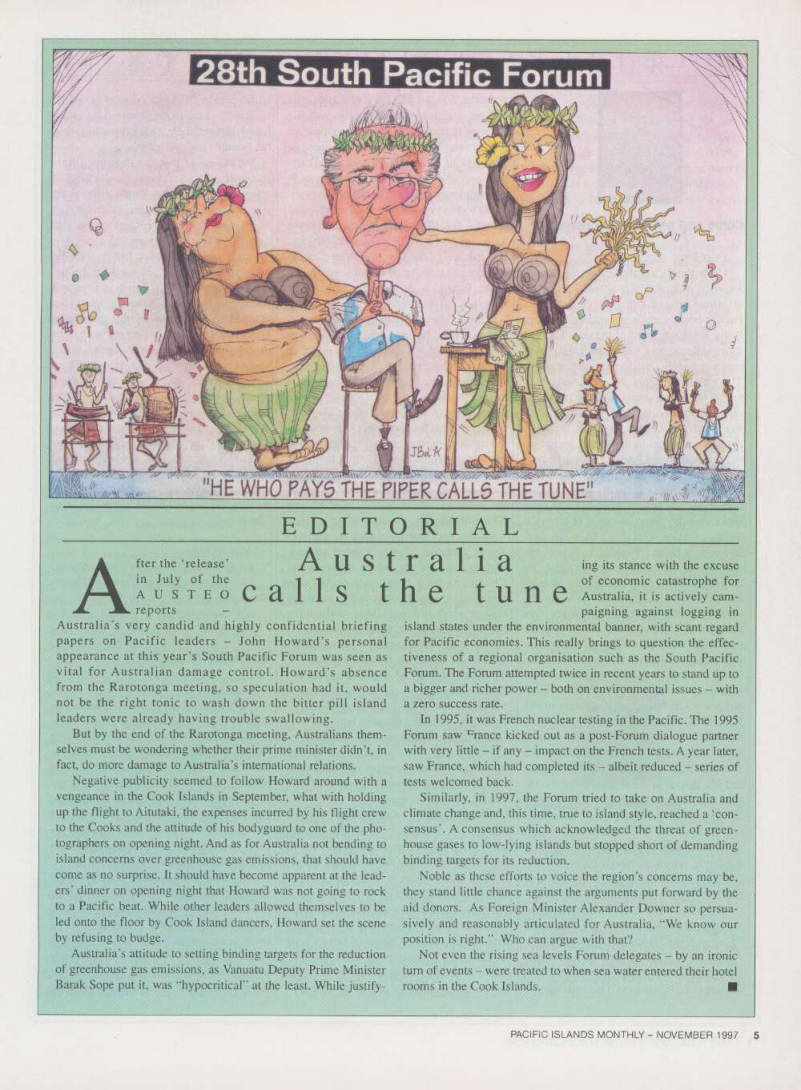
Negative publicity seemed to follow Howard around with a vengeance in the Cook Islands in September, what with holding up the flight to Aitutaki, the expenses incurred by his flight crew to the Cooks and the attitude of his bodyguard to one of the pho tographers on opening night. And as for Australia not bending to island concerns over greenhouse gas emissions, that should have come as no surprise. It should have become apparent at the lead ers’ dinner on opening night that Howard was not going to rock to a Pacific beat. While other leaders allowed themselves to be led onto the floor by Cook Island dancers, Howard set the scene by refusing to budge.
Australia’s attitude to setting binding targets for the reduction of greenhouse gas emissions, as Vanuatu Deputy Prime Minister Barak Sope put it, was "hypocritical” at the least. While justify
ing its stance with the excuse of economic catastrophe for Australia, it is actively cam paigning against logging in
island states under the environmental banner, with scant regard for Pacific economies. This really brings to question the effec tiveness of a regional organisation such as the South Pacific Forum. The Forum attempted twice in recent years to stand up to a bigger and richer power - both on environmental issues - with a zero success rate.
In 1995, it was French nuclear testing in the Pacific. The 1995 Forum saw kicked out as a post-Forum dialogue partner with very little - if any - impact on the French tests. A year later, saw France, which had completed its - albeit reduced - series of tests welcomed back.
Similarly, in 1997, the Forum tried to take on Australia and climate change and, this time, true to island style, reached a ‘con sensus’. A consensus which acknowledged the threat of green house gases to low-lying islands but stopped short of demanding binding targets for its reduction.
Noble as these efforts to voice the region’s concerns may be, they stand little chance against the arguments put forward by the aid donors. As Foreign Minister Alexander Downer so persua sively and reasonably articulated for Australia, “We know our position is right.” Who can argue with that?
Not even the rising sea levels Forum delegates - by an ironic turn of events - were treated to when sea water entered their hotel rooms in the Cook Islands. ■