Oceanic portraits on display
p. 51 · Read in the full issue
Literature
By Nicolas
Rothwell
HOW poignantly they stare out at us, these faces from a vanished Oceania - the fading islands of memory, already far removed from us in time.
The handsomely-produced “Portraits of Oceania” brings together some 120 evocative photographs of 19th century Australia, New Zealand, Samoa, Tonga and Fiji.
These images are currently on display in a landmark exhibition, showing at the Art Gallery of NSW, Sydney, until October 26.
As “Portraits” form part of the Festival of the Dreaming, the first of Sydney’s four Olympic arts festivals, the emphasis on photographic representations of Aboriginal
life is understandable; yet the Pacific images here are of startling vividness.
They record a world in transition, and societies gaining awareness of the photographic gaze staring at them, recording them.
They evoke the phase of contact, knowledge, intercultural penetration,
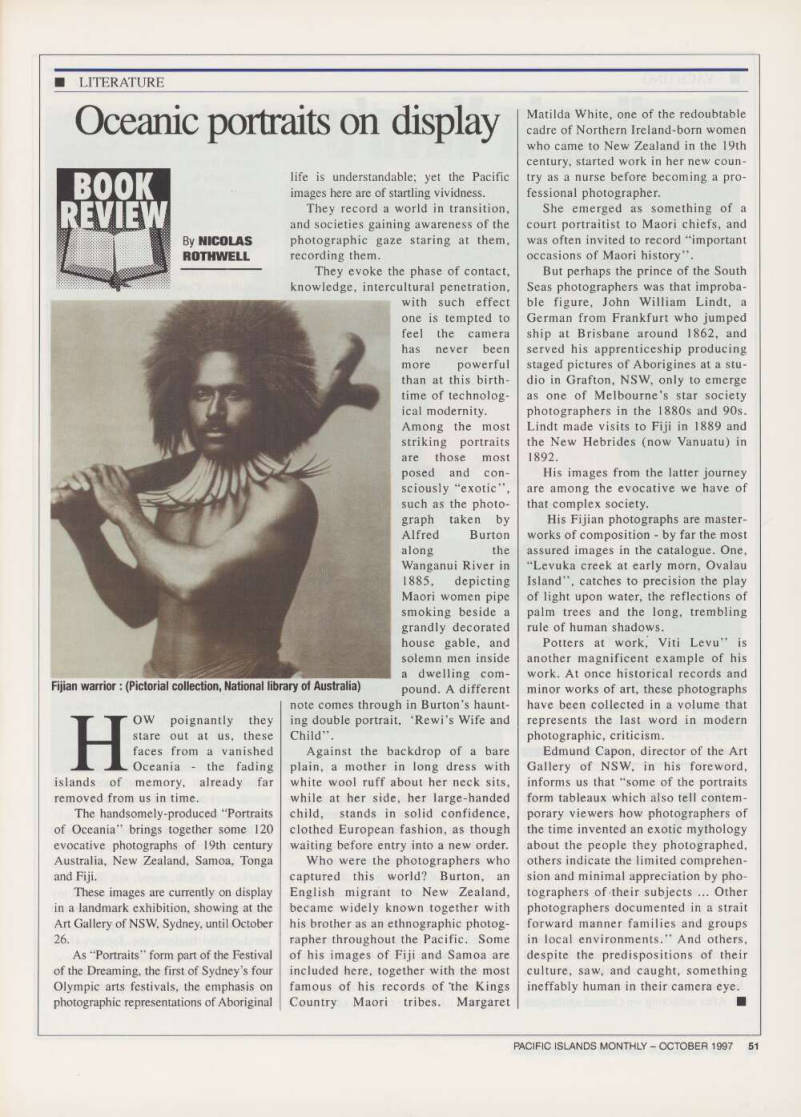
with such effect one is tempted to feel the camera has never been more powerful than at this birth time of technolog ical modernity.
Among the most striking portraits are those most posed and con
sciously “exotic”,
such as the photo graph taken by Alfred Burton along the Wanganui River in
1885, depicting
Maori women pipe smoking beside a grandly decorated house gable, and solemn men inside a dwelling com pound. A different
note comes through in Burton’s haunt ing double portrait, ‘Rewi’s Wife and Child”.
Against the backdrop of a bare plain, a mother in long dress with white wool ruff about her neck sits, while at her side, her large-handed child, stands in solid confidence, clothed European fashion, as though waiting before entry into a new order.
Who were the photographers who captured this world? Burton, an English migrant to New Zealand, became widely known together with his brother as an ethnographic photog rapher throughout the Pacific. Some of his images of Fiji and Samoa are included here, together with the most famous of his records of 'the Kings Country Maori tribes. Margaret
Matilda White, one of the redoubtable cadre of Northern Ireland-born women who came to New Zealand in the 19th century, started work in her new coun try as a nurse before becoming a pro
fessional photographer.
She emerged as something of a court portraitist to Maori chiefs, and was often invited to record “important occasions of Maori history”.
But perhaps the prince of the South Seas photographers was that improba ble figure, John William Lindt, a German from Frankfurt who jumped ship at Brisbane around 1862, and
served his apprenticeship producing
staged pictures of Aborigines at a stu dio in Grafton, NSW, only to emerge as one of Melbourne’s star society photographers in the 1880 s and 90s.
Lindt made visits to Fiji in 1889 and the New Hebrides (now Vanuatu) in 1892.
His images from the latter journey are among the evocative we have of that complex society.
His Fijian photographs are master works of composition - by far the most assured images in the catalogue. One, “Levuka creek at early morn, Ovalau Island”, catches to precision the play of light upon water, the reflections of palm trees and the long, trembling rule of human shadows.
Potters at work, Viti Levu” is another magnificent example of his work. At once historical records and minor works of art, these photographs have been collected in a volume that represents the last word in modern
photographic, criticism.
Edmund Capon, director of the Art Gallery of NSW, in his foreword, informs us that “some of the portraits form tableaux which also tell contem porary viewers how photographers of the time invented an exotic mythology about the people they photographed, others indicate the limited comprehen
sion and minimal appreciation by pho
tographers of their subjects ... Other photographers documented in a strait forward manner families and groups in local environments.” And others, despite the predispositions of their culture, saw, and caught, something ineffably human in their camera eye. ■
Fijian warrior: (Pictorial collection, National library of Australia)