Trading in Vava'u
pp. 52-53 · Read in the full issue
Yachting
Story and photography by SALLY ANDREW
We navigated carefully between the off lying islets and reefs of the Vava’u group of islands in northern Tonga. The night had been black and squally, the motion violent, the seas pyramidal. By first light, sea conditions had moder ated and we caught a beautiful big waloo. But landing the fish created a big mess! Fish blood everywhere: all over our legs, the cockpit, fenders, buckets, winches, dodger.
After anchoring we cleaned up the gore
and shared our bounty with the other yachts. Local entrepreneur Dfdi paddled out in a yellow inflatable dinghy filled with tapa, shells, carvings, bananas, paw paw, limes. The fresh fruit was welcomed and so was the rain later that evening. We topped up our water tanks, did a mountain of laundry and still had water to spare.
Cruising the islands of the Vava’u group is an easy, pleasant, peaceful experi ence where one wakes to the rustle of the breeze or the gentle slapping of wavelets on the hull. But in Neiafu, the administra tive centre where we had to go to check in with the officials, one wakes to the sound of roosters crowing, dogs barking, pigs fighting, babies crying, fishermen
whistling, church bells ringing, lalis beat ing, choirs singing. It’s incredible!
The Bounty Bar in the centre of town is a yachtie hangout and has an open-air view of the harbour. A Tongan Burger with a plunger pot of local Royal Tongan coffee hits the spot, though watch out if Lucky the dog is around. This dogged canine kept trying to bite my burger.
The cheapest burger and beer in town are at the Viking Bar, run by a young Danish lady, Caroline. Here we met Klaus, another local businessman, gossiping and drinking a beer. His Sunset Cafe, located on the water in a big green house kitty cor ner to St. Joseph’s Church, had just opened and boasted Neiafu’s only cappuccino machine. The outdoor patjo faces the set ting sun and overlooks Neiafu harbour.
The Cafe’s in-the-water dinghy dock is convenient for international yachtsmen.
Going to a Tongan feast is on the agen da of every tourist. In Vava’u there are sev eral to choose from at different locations throughout the week. Aisea’s weekly feast at Lisa Beach begins with a kava hour at 5 o’clock, followed by food at six and tradi tional dancing afterwards. Matoto’s feast (at Ano Beach twice each week) features traditional cooking, with lobster, crab, and chicken. On Sundays, the Royal Tongan Resort, Club Hunga and Popao Village offer all-you-can-eat barbecues. One thing’s for sure, you don’t go hungry in Vava’u.
Humpback whales frequent the cruising grounds around Vava’u during the winter months. Patty Vogan from Dolphin Pacific Diving has been working with a research team from Auckland University - doing sound and visual recordings of whales in Vava’u from the deck of the Dolphin Diver, the catamaran Phoenix, operated by Whale Watch Vava’u, operates whale watch tours out of the Paradise and Tongan Beach resorts.
In Neiafu, Vosa (Fa Sea Jewellery) carves interesting artefacts out of black coral, bone, ivory whale tooth, big tusks, sharks, sea shells, wood, etc. Bone fish pendants and tiny carved pigs suited my budget, but I lusted after a large carved whale bone with a four-digit price tag. For hand-crafted baskets, the Tongan Hand Craft Co-op has the best selection.
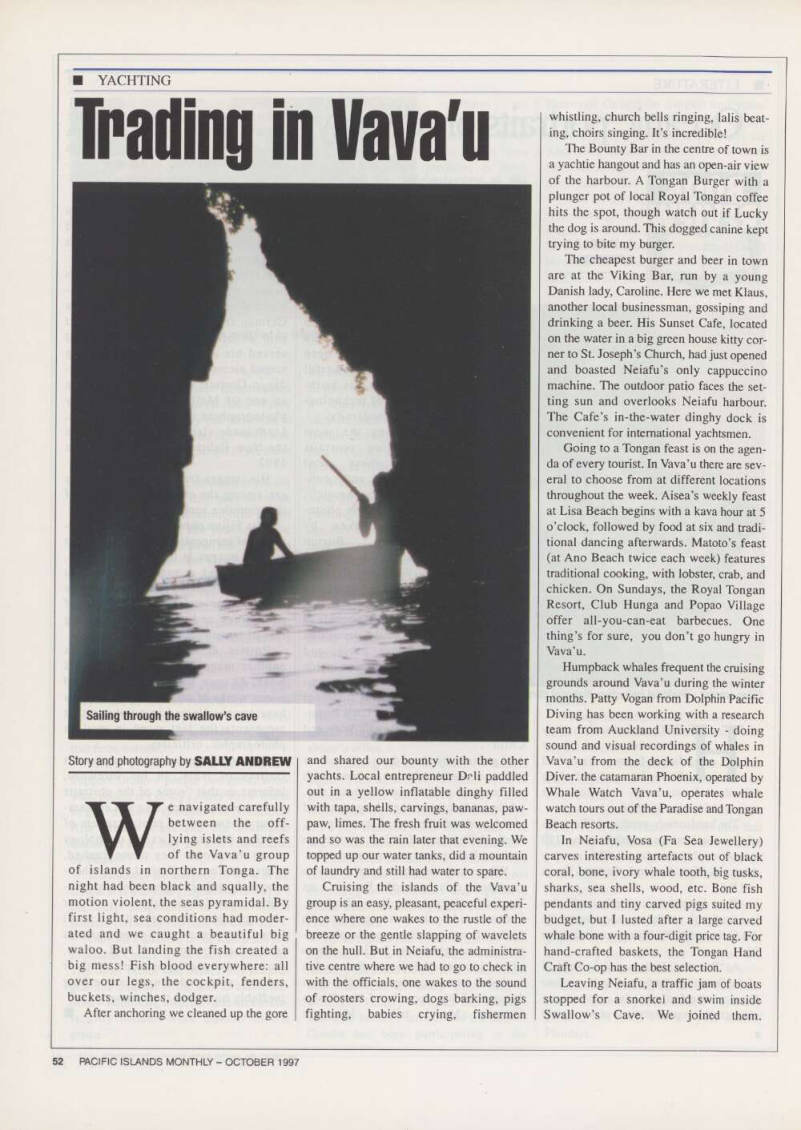
Leaving Neiafu, a traffic jam of boats stopped for a snorkel and swim inside Swallow’s Cave. We joined them.
Sailing through the swallow’s cave
Afterwards we sailed past tiny Ava and Nuku Islands and east through the pass to Kenutu Island, dodging coral heads all the way. We anchored in 24 feet. Turtles cruised through the anchorage which was filled with Kiwi regatta boats.
Ashore at Kenutu we met Joanna and Moses, proprietors of the Berlin Bar.
Fancy being able to purchase a cold drink on an uninhabited island! Behind the beach, a track leads over to the windward side where casuarina trees cling to lime stone cliffs. It is absolutely lovely.
The passage out of Kenutu is
unmarked, so Foster shimmied up the mast and I stayed at the helm, following his instructions. Once clear, we headed to the island of Vakaeitu. On the beach by the northern point, near the coral Gardens, a group of adventure tourists had set up camp after a day of Friendly Island kayak ing.
From the small floating dock, a path leads up through the bush and along a rough jeep trail. At the top is Popao Backpackers Resort and the Lighthouse Cafe, a great place for breakfast or lunch.
Master baker, Joe, has a well-equipped
clean kitchen with a wood-fired oven. Joe bakes breads and cakes and serves coffee, tea and cold drinks. He gave us a guided tour of the resort which recreates an old style Tongan village. A few canoes are parked on the beach, available for anyone who wants to try paddling. Two-person swings hang from trees in front of the cafe and face out to a spectacular seaview. We enjoyed his delicious Viennese pastries.
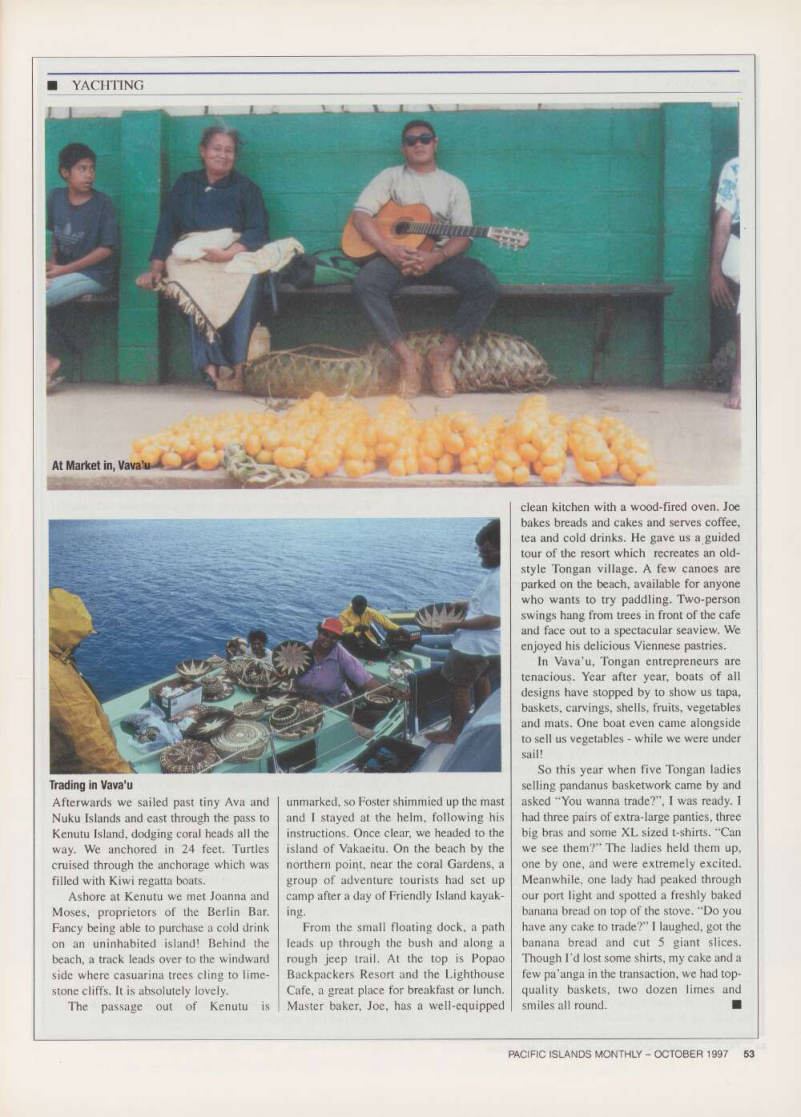
In Vava’u, Tongan entrepreneurs are tenacious. Year after year, boats of all designs have stopped by to show us tapa, baskets, carvings, shells, fruits, vegetables and mats. One boat even came alongside to sell us vegetables - while we were under sail!
So this year when five Tongan ladies selling pandanus basketwork came by and asked “You wanna trade?”, I was ready. I had three pairs of extra-large panties, three big bras and some XL sized t-shirts. “Can we see them?” The ladies held them up, one by one, and were extremely excited.
Meanwhile, one lady had peaked through our port light and spotted a freshly baked banana bread on top of the stove. “Do you have any cake to trade?” I laughed, got the banana bread and cut 5 giant slices.
Though I’d lost some shirts, my cake and a few pa’anga in the transaction, we had top quality baskets, two dozen limes and smiles all round. ■
At Market in, Vava’u
Trading in Vava’u