Escapism
pp. 49-50 · Read in the full issue
Art
Escaping prison through art
By Lili Tuwai
“...and it was lonesome time again I had no books, I had no pens waiting 16 hours just to hear that big bell ring Long Bay Jail you’re cruel and bad you have made sane men go mad some have even taken their life at dif ferent times but you won’t do that to me I’ll still be sane when they set me free and I’ll pray to god to help me keep my mind’’ - Malabar Mansion, sung by the late Aboriginal musician, Mac Silva
Aboriginal inmates at Sydney’s Long Bay
Jail - the Malabar Mansion - are discover ing ways of letting off steam through art.
Many famous Aboriginal artists have done some time and art work in prison. Art is often their only release and it’s ironic that for many of them, prison is the place they first access and develop their creative skills.
A report issued by the Human Rights an Equal opportunity Commission in November, 1996 found the rate at which Aborigines were jailed increased by 61 per cent since 1988 and the death rate of indigenous inmates risen sharply.
At Long Bay, four Aboriginals are among 10 inmates enrolled in a full-time vocational arts course.
Their work has appeared on another Long Bay product - The Aboriginal and Torres Strait Islander Inmate Handbook for prisoners edited by - Aboriginal inmate, Todd Gordon.
The handbook is a guide to jail life for
Aboriginal prisoners. “The booklet pro vides Koori (Aboriginal) prisoners with a support network inside the Bay and it helps them survive their incarceration,” says 24year-old Gordon. Gordon was 19 when he first went to jail. Reflecting on his past behaviour, he says, “I was in trouble all the time, I had fights just about every day.”
Acting heavy and fighting other
inmates in order not to get picked on, land ed Gordon in constant strife during the first 18 months of his sentence at Sydney’s Parklea Jail.
As a result, he was transferred to the maximum security section of Long Bay Jail, a move which Gordon believes worked to turn his life around. “When I got tipped (transferred) from Parklea to Long Bay, it was the first time I went to education. I think the experience enabled me to change - I’ve gone from one person to another”.
The teaching skills and commitment to inmates’ education was the driving force of the education staff at that time, reasons Gordon. “They used to come to us and ask us what did we want to do, instead of telling us what to do all.”
It was this approach that led Gordon to take an interest in education. As a conse quence, he became the inmates’ Aboriginal coordinator at the education unit and began helping establish appropriate programmes for them.
The daily reality and realisation of Gordon’s own incarceration has led him to want to help make things a little easier for his Koori brothers by producing the hand book. “I come across guys feeling suicidal or twho want to themselves for any num ber of reasons. I know how just being in jail can get on top of you and when some external problem occurs and you feel pow erless to do anything about it.
“Being able to ring an Aboriginal staff member when these things happen can help solve these problems, I stress to peo ple to get involved with stuff in gaol because it’s not good to sit around. If you get involved, you start seeing that when problems come up you are a bit stronger land can tackle them,”
The Aboriginal and Torres Strait Inmate Handbook has been described by staff and inmates alike as a tool of empow erment for Aboriginals in jail.
Often inmates new to the jail system
have no understanding regarding arranging
professional help or assistance. The hand-
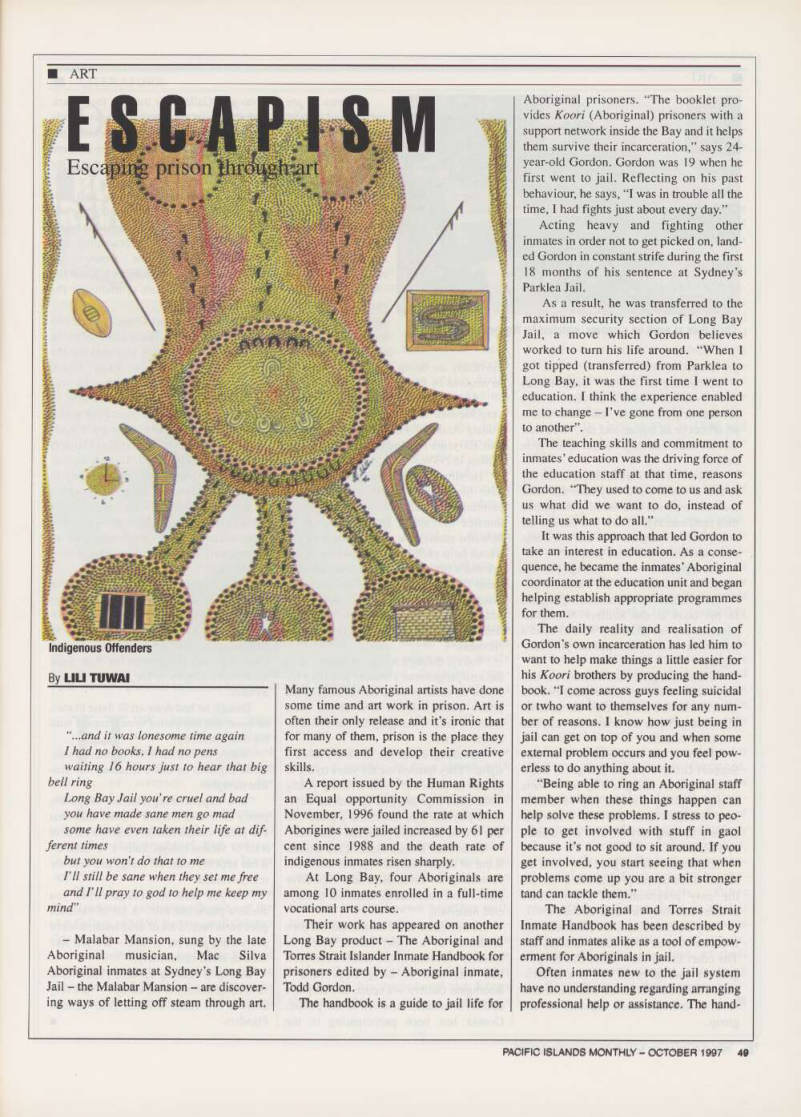
Indigenous Offenders
get an appointment.
According to Gordon: “Some blokes don’t even know how to do that - if they see that in the book they can show that to an officer or an inmate and say, ‘Well how do I do that?’ and they can get to see these people.
“A lot of Kooris are ashamed or too shy to talk to others but if they have this book they can seek out and identify the person they need and say, “‘I saw you there in the book, can you help me with this?’ It works as an icebreaker for some people.”
Photographic work throughout the handbook was taken by Sue Pauli, the art An example of information highlighted in the book is the Redfern Aboriginal Medical Service (RAMS). RAMS send a doctor out to the metropolitan jails fort nightly.
"Blokes can go to the clinic and say that they want to see the Aboriginal doctors from this service and put their names down to see them. There are several services like that from outside.
“There is the Children of Prisoners Support Group - people just get to know what people are doing so they know where to go,” explains Gordon. The Vocational Arts Studies class and the Boomgate Gallery at Long Bay are also coordinated by Pauli.
Ten inmates are assigned to work in the studio. It is a unique programme in that it’s the only programme in NSW where inmates can study full time on their art.
They are classified to the Reception and Induction Centre specifically to study art.
The other factor that makes this art pro gramme unusual is the mix of classifica tions - minimum, medium- and maximum security inmates work together in one group.
Inmates are encouraged to take initiative in devel oping their own projects. A quick glance around the room reveals
inmates busily
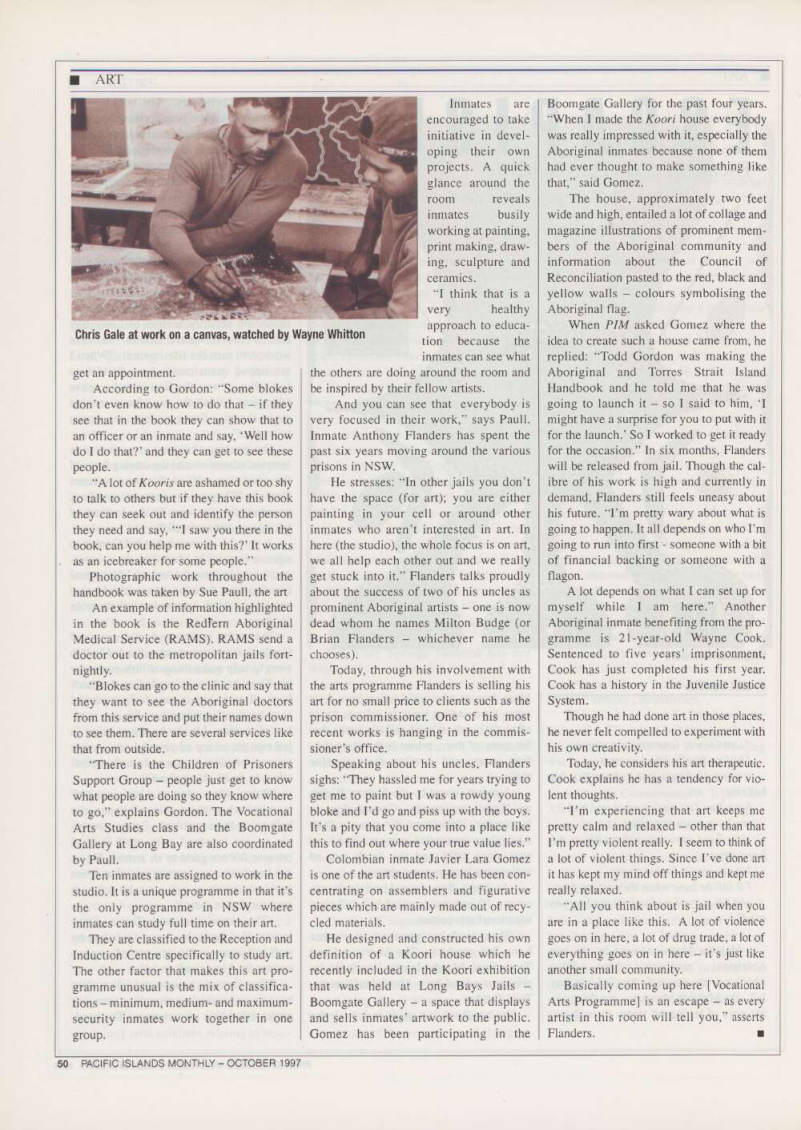
working at painting,
print making, draw ing, sculpture and ceramics.
“I think that is a very healthy approach to educa tion because the inmates can see what
the others are doing around the room and be inspired by their fellow artists.
And you can see that everybody is very focused in their work,” says Pauli.
Inmate Anthony Flanders has spent the past six years moving around the various prisons in NSW.
He stresses: “In other jails you don’t have the space (for art); you are either painting in your cell or around other inmates who aren’t interested in art. In here (the studio), the whole focus is on art, we all help each other out and we really get stuck into it.” Flanders talks proudly about the success of two of his uncles as prominent Aboriginal artists - one is now dead whom he names Milton Budge (or Brian Flanders - whichever name he chooses).
Today, through his involvement with the arts programme Flanders is selling his art for no small price to clients such as the prison commissioner. One of his most recent works is hanging in the commis sioner’s office.
Speaking about his uncles, Flanders sighs; "They hassled me for years trying to get me to paint but I was a rowdy young bloke and I’d go and piss up with the boys.
It’s a pity that you come into a place like this to find out where your true value lies.”
Colombian inmate Javier Lara Gomez is one of the art students. He has been con centrating on assemblers and figurative pieces which are mainly made out of recy cled materials.
He designed and constructed his own definition of a Koori house which he recently included in the Koori exhibition that was held at Long Bays Jails - Boomgate Gallery - a space that displays and sells inmates’ artwork to the public.
Gomez has been participating in the
Boomgate Gallery for the past four years.
"When I made the Koori house everybody was really impressed with it, especially the Aboriginal inmates because none of them had ever thought to make something like that,” said Gomez.
The house, approximately two feet wide and high, entailed a lot of collage and magazine illustrations of prominent mem bers of the Aboriginal community and information about the Council of Reconciliation pasted to the red, black and yellow walls - colours symbolising the Aboriginal flag.
When PIM asked Gomez where the idea to create such a house came from, he replied: “Todd Gordon was making the Aboriginal and Torres Strait Island Handbook and he told me that he was going to launch it - so I said to him, T might have a surprise for you to put with it for the launch.’ So I worked to get it ready for the occasion.” In six months, Flanders will be released from jail. Though the cal ibre of his work is high and currently in demand, Flanders still feels uneasy about his future. “I’m pretty wary about what is going to happen. It all depends on who I’m going to run into first - someone with a bit of financial backing or someone with a
flagon.
A lot depends on what I can set up for myself while I am here.” Another Aboriginal inmate benefiting from the pro gramme is 21-year-old Wayne Cook.
Sentenced to five years’ imprisonment, Cook has just completed his first year.
Cook has a history in the Juvenile Justice
System.
Though he had done art in those places, he never felt compelled to experiment with his own creativity.
Today, he considers his art therapeutic.
Cook explains he has a tendency for vio lent thoughts.
"I’m experiencing that art keeps me pretty calm and relaxed - other than that I’m pretty violent really. I seem to think of a lot of violent things. Since I’ve done art it has kept my mind off things and kept me really relaxed.
"All you think about is jail when you are in a place like this. A lot of violence goes on in here, a lot of drug trade, a lot of everything goes on in here - it’s just like another small community.
Basically coming up here [Vocational Arts Programme] is an escape - as every artist in this room will tell you,” asserts Flanders. ■
Chris Gale at work on a canvas, watched by Wayne Whitton