A unique birthing centre
pp. 47-48 · Read in the full issue
Culture
By Liz Thompson
The process of giving birth for women all over the world has changed dra matically over the last few centuries. From the domain of women who relied on emotional sup port and encouragement and the use of herbal medicines and remedies it became the territory of men. From the mid-wives who assisted in home births using knowledge and wisdom passed from woman to woman, the birth experience moved into a sterile medical environment dominated by male obstetricians. For indigenous women all over the world, this pattern has been repeated with the impact of colonialism and the influence of west ern culture. For Aboriginal women in Australia, this had a serious impact on
their traditional birthing practices.
Control and intervention form the basis of the western medical approach, a general philosophy which under mines the role of traditional Aboriginal birth attendants and their methods of birthing. Western medical
systems have criticised traditional practices as unhygenic and con demned them for being unable to cope with emergency situations. According to a report produced by the Central Australian Aboriginal Congress (CAAC) in Alice Springs -’Horning: Pmere Laltyeke Anwerne Ampe Mpwareteke’ - ‘ We want to have babies in our traditional country’ very few medical practitioners have bothered to find out what exactly takes place at a traditional birth. As on so many occasions, traditional knowledge has been dismissed by white imperialistic atti tude as no longer relevant in the face of supposedly more ‘sophisticated’ knowl edge. These attitudes have shown little understanding or respect for difference and the thousands of years of practical experi ence which make up traditional birthing practices for Aboriginal women. The report was produced as part of an effort to establish Alukura, a birthing centre in Alice Springs designed specifically for Aboriginal women. Alukura nurtures the co-existence of traditional approaches to birth alongside aspects of western medicine. Alukura came into existence in response to the rapidly growing awareness that Aboriginal women were not happy with the hospital experience they were
being subjected to and needed a more cul turally appropriate environment in which to have their children, one based on the guidelines of ‘grandmothers law’.
Traditionally, the process of birthing is part of Aboriginal Law. It is sacred business for women, nothing to do with men. When the time comes near for a woman to give birth, those women who attend to her, usually grandmothers and aunts, go off into the bush far from the main camp. There they build an Alukura, a traditional place for birthing, sheltered with a windbreak. The women who attend births are not taught delivery skills formally, but like all aspects of Aboriginal education, leam through observation and direct experience. Women are not prepared for birth or told what will
happen, they discover during their own
labour what traditional practices are and this way they leam for the future, for the times in which they will assist their grand daughters or nieces. It is considered essen tial to both mother and child’s well-being that a number of traditional practices are observed during and directly after birth.
Once the baby is born, both it and the mother are rubbed with sand which has been warmed over hot coals, a method used to relieve pain. A medicinal leaf is placed on the ground and a fire built over it, the smoke from this fire has special qualities and both mother and baby are placed over the ashes in order that they draw up these properties. This practice is believed to make them both strong. The placenta is buried in the ground onto which the child is bom, a very important practice believed to link the spirit of the child, the mother and country. The place in which a child is bom will be of great significance throughout its life. It is believed that the ‘spirit child’ comes from the ancestors who are associated with particular parts of the country. These ancestors are part of the Tjukurpa, a rich body of knowledge com monly referred to as ‘the dreaming’. The Tjukurpa contains the creation stories which tell of ancestral spirits who emerged from a featureless landscape and during their travels brought the earth and all the animals that live upon it into existence.
The ‘spirit child’ comes from these ances
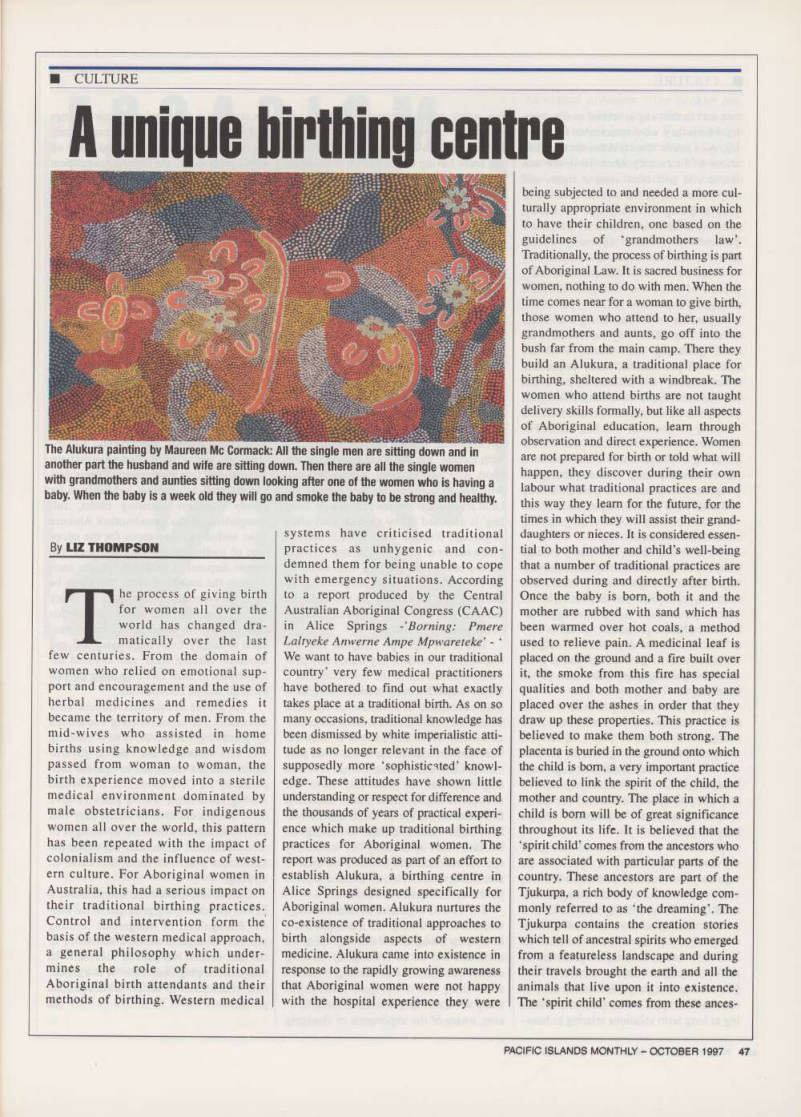
The Alukura painting by Maureen Me Cormack: All the single men are sitting down and in another part the husband and wife are sitting down. Then there are all the single women with grandmothers and aunties sitting down looking after one of the women who is having a baby. When the baby is a week old they will go and smoke the baby to be strong and healthy.
tors and in this way is related to the coun try which they were responsible for creat ing. As a result “the child has strong affili ations to the country where he or she was found and will later assume rights and responsibilities for the law, the land and its people. Being bom is related to country, kin and the dreamtime stories which are particularly relevant” (Earning: Pmere Laity eke Anwerne Ampe Mpwaretyeke).
Since the arrival of Europeans, so many aspects of traditional Aboriginal life have changed. People have settled in permanent communities rather than living a nomadic existence in which they survived off the land, gathering bush tucker. With the arrival of pastoralists, many permanent water sources were polluted by cattle and the numerous bores were sunk. Aboriginal people settled around stations and missions working as labourers building roads. For this they were paid with rations - white flour, tea and sugar. Since then, store food has formed the basis of most Aboriginal peoples diet. Stores sell predominantly ‘rubbish food’, flour, sugar, tea, canned foods and biscuits all completely lacking in terms of nutrition.
As a result there has been a huge increase in the incidence of diabetes, kid ney problems, high blood pressure and alcohol. A frequent use of pain relievers such as panadol and aspirin have aggravat ed some of these problems. All this is very different to the old days when Aboriginal women were fit and strong eating good food and walking many miles each day in search of it.
“Long time, old people used to check after the mother and baby with bush food like goanna, kangaroo and wild berries.
Before when she was pregnant, for her kids she ate a lot of bush tucker like sugarbag, wild potatoes, witchetties and yams. That’s why she had healthy children." (Earning: Pmere Laltyeke Anwerne Ampe
Mpwaretyeke).
In addition to problems of diet, girls, are also having children at a younger age than they used to when traditional law was strictly adhered to. All these changes have seen the infant mortality rate rise. As a result, Aboriginal women have been encouraged by the white authorities to have their babies in what are promoted as ‘safe and clean’ hospital environments.
The answer to a rise in infant mortality is seen to be hospital births rather than look ing at long term solutions relating to hous
ing, water, communications, nutrition and so on. In response to these pressures, an increasing number of Aboriginal women are know having their children in hospitals which completely neglect to take into account the sacred law which had sur rounded traditional homing practices. As a result, women are left felling empowered, alienated and often very frightened. Male doctors or obstetricians often attend to the births. This is a cause for great shame and embarrassment. Nurses and medical assis tants are unable *to communicate their thoughts or needs. Hospitals often have an interventionist approach, the use of drugs, drips, epidurals, shaving, monitors and so on are all very unfamiliar.
Caesarean’s are a terrifying intrusion.
Women are not comforted or supported by other women but instead find themselves in a strange and completely unfamiliar environment. Babies are often delivered with forceps, the umbilical cord is cut too short which Aboriginal women believe will lead to sickness. Neither mother nor child are smoked and the placenta or ‘baby bag’ is disposed off by medical staff often in garbage disposal units. This is consid ered a matter of great sadness and very bad for the health and spiritual well being of the baby. Women in hospitals give birth on beds, on their backs, they are allowed little movement and are unable to take up tradi tional birthing postures.
The Alice Springs Hospital has not responded to modem day trends and pro vided alternatives to the restrictions of a labour ward. Birthing centres have now been established in a number of hospitals around the country. Here women are assist ed by mid-wives and there is no medical intervention. Instead the focus is on pain management and making women feel safe and supported so that they have the strength to deliver their babies naturally.
Unfortunately none of these alternatives have been made available to Aboriginal women, the inadequacy of culturally appropriate childbirth facilities led them to take matters into their own hands and press for the establishment of Alukura.
The CAAC organised several meetings where women were given the opportunity to air their thoughts and develop ideas for establishment of an Aboriginal birthing centre. The business of horning is such a secret thing that it was quite difficult for many women to talk about the issues, how ever, aware of the importance of changing
the status quo they spoke of their feelings and experiences. At the final conference the Aboriginal women involved came up with a proposal for the Federal government which outlined their needs. This proposal put forward several important points. It recommended among other things that the Federal government finance the Congress Alukura immediately and permanently; recognise that the Congress Alukura will be a model for Aboriginal communities in the future; the Northern Territory govern ment cooperate in providing a suitable site of at least five acres for this.
There were also a lot of recommenda tions made in relation to mobile bush clin ics designed to attend bush births and the
improvement of hospital environments.
Women asked that the Federal government and the Northern Territory department of health implement a number of services which would make the hospital experi ence, less intimidating. These suggestions included full time interpreters, female doc tors and staff only; access and facilities for family members assisting births, full recognition of the grandmother Alukura Law, including allowances for the adop tion of traditional birthing postures, the proper disposal of afterbirth, proper inci sions to the umbilical cord, that there be signs in Aboriginal languages in Alice Springs Hospital. The women asked that stores in remote communities be encour aged to supply fresh nutritious food and minimal ‘rubbish food’ and stressed the importance of basic facilities being provid ed in all remote communities.
The moves to establish Alukura were successful. The initial building was funded by grant-in-aid schemes. A new building was then funded by the Federal govern ment. Alukura continues to operate sup
ported by the Commonwealth. It provided
Aboriginal women with a place to give birth to their children in which they feel safe, in which they have the advantages of modem medical techniques but where the traditional practices form the basis of
birthing.
Culture is respected and Grandmother’s Law is the underlying principle of the cen
tre. Recognition of indigenous birthing
practices alongside western obstetrics in the past decade has proved successful in many developing countries. It is a model that would seem to beneft all indigenous people. ■