Bernice burns bright
pp. 44-45 · Read in the full issue
By Atama Raganivatu
Pacific Island netballers have brought much credit to our region in recent years. The Cook Islands national selection is currently ranked sixth in the world and Fiji, Vanuatu, Western Samoa and Papua New Guinea also regularly make their pres ence felt at important international tournaments.
More significantly perhaps, Pacific Island players now provide the backbone of the New Zealand national side, the Silver Ferns, who traditionally vie with Australia for the right to be known as
world champions.
Rarotongan Margharet Matenga and Samoa’s Rita Fatialofa (cousin of former
Manu Samoa rugby warhorse Peter Fatialofa), both members of the Kiwi team which dominated the international scene in the mid 1980 s, are still the most revered netballers of Pacific Island inheritance.
However, Bernice Mene may soon find herself included in their illustrious compa ny.
As well as continuing Pacific Island players’ tradition of excellence, Mene is also maintaining a family tradition, for her father, mother and brother have all shone in their chosen sporting fields.
Although her father, Mene Mene, is best known for his feats as an athlete and athletics coach, it was a rugby game which shaped his life. Appearing for the Western Samoan representative XVC in 1965 against the touring New Zealand Maori
side, the 17 year old full back was awestruck by the power and skill of the visitors. Realising that he would have to leave Apia if he too was to fulfil his own sporting potential, Mene moved to Christchurch soon afterwards.
Mene had not been in New Zealand long when he recognised that track and field athletics, not rugby, was really his forte. He won six New Zealand decathlon titles between 1971 and 1978 and repre sented his adopted country at the 1974 Commonwealth Games, before turning his hand to coaching. He attended the two most recent Olympics in his capacity.
His wife, the former Sally Flynn, was also an athletics champion. She competed in both the javelin and discus at two Commonwealth Games and held the New Zealand national javelin record for 21 years.
Inheriting such an impressive pedigree, it is little wonder that Sally and Mene’s children displayed great sporting aptitude.
Their eldest son, Chris, threw the discus for Western Samoa at last year’s Atlanta Olympics. Chris is a very useful winger in
Canterbury is first grade club rugby too and was once a member of the Kiwis bob sleigh squad! Regretfully, he has not been able to devote as much time to sport as he would like due to the demands of his pro fession. A policeman, he is following in the large footsteps of his paternal grandfather, who was once the chief of Apia’s force.
Sally and Mene’s second child, Bernice, initially seemed destined to make her name in athletics as well. While attending Christchurch’s Villa Maria College, she was New Zealand’s 1990 Secondary Schools champion in the high jump, long jump and the shot put. For good measure, she finished third in the 200 metres sprint!
In 1990, the prestigious “North and South" magazine profiled Bernice then 15, in a feature on New Zealand’s most
promising athletes.
Only 10 words were devoted to her prowess on the netball court. Initially, net ball was nothing more than one of several sports Bernice participated in to either keep her fit during the athletics “off sea son” or to provide a relief from the tedium
or normal training. Volleyball, water polo
and basketball also served these purposes.
Upon being drafted into the New
Zealand under 21 netball squad when 15, though, Mene realised that the sport offered her just as many oppor tunities, if not more, than athlet ics.
She persisted with athletics throughout her college days,
eventually concen
trating upon the heptathlon. But, netball became the
major sporting
focus in her life in 1992, when she was chosen for the New Zealand senior side - only a year after winning a place in
the Canterbury
provincial team.
Bernice made her full international debut playing in front of 6000
parochial, excited and screaming school girls at London’s Wembley Arena against England. The experience did not faze her possibly because she was still a schoolgirl herself - and New Zealand won easily.
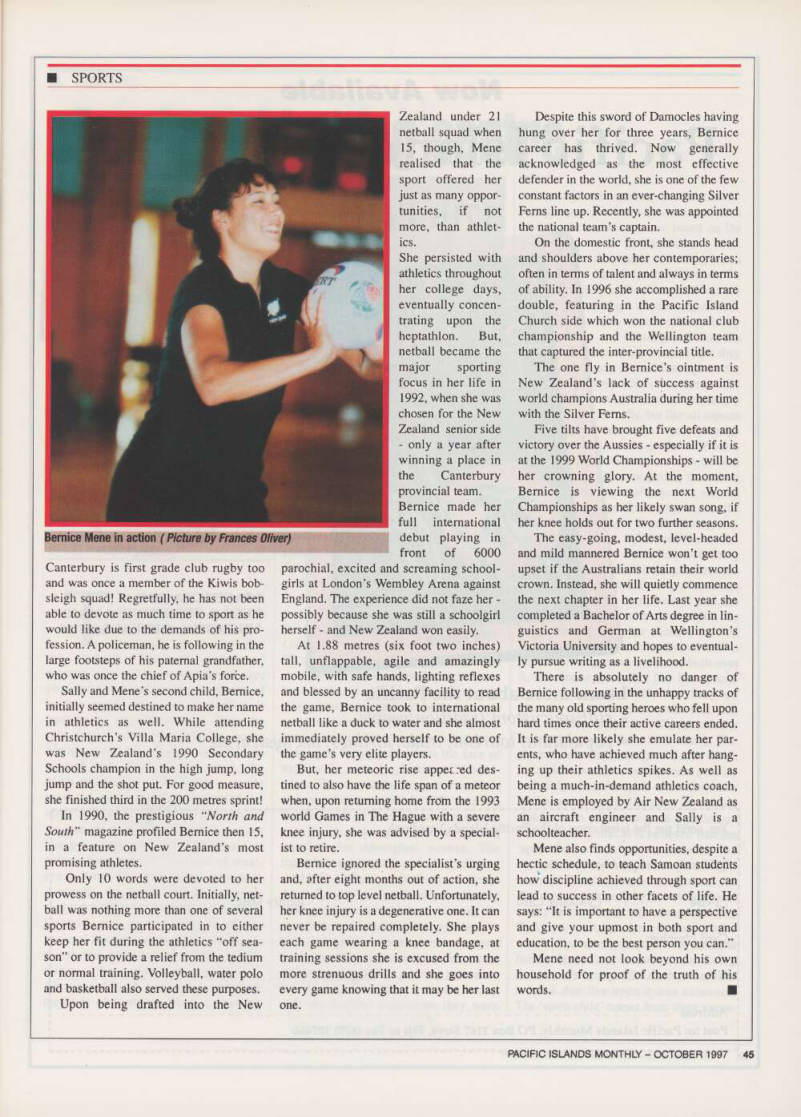
At 1.88 metres (six foot two inches) tall, unflappable, agile and amazingly mobile, with safe hands, lighting reflexes and blessed by an uncanny facility to read the game, Bernice took to international netball like a duck to water and she almost immediately proved herself to be one of the game’s very elite players.
But, her meteoric rise appeared des tined to also have the life span of a meteor when, upon returning home from the 1993 world Games in The Hague with a severe knee injury, she was advised by a special ist to retire.
Bernice ignored the specialist’s urging and, after eight months out of action, she returned to top level netball. Unfortunately, her knee injury is a degenerative one. It can never be repaired completely. She plays each game wearing a knee bandage, at training sessions she is excused from the more strenuous drills and she goes into every game knowing that it may be her last one.
Despite this sword of Damocles having hung over her for three years, Bernice career has thrived. Now generally acknowledged as the most effective defender in the world, she is one of the few constant factors in an ever-changing Silver Ferns line up. Recently, she was appointed the national team’s captain.
On the domestic front, she stands head and shoulders above her contemporaries; often in terms of talent and always in terms of ability. In 1996 she accomplished a rare double, featuring in the Pacific Island Church side which won the national club championship and the Wellington team that captured the inter-provincial title.
The one fly in Bernice’s ointment is New Zealand’s lack of shccess against world champions Australia during her time with the Silver Ferns.
Five tilts have brought five defeats and victory over the Aussies - especially if it is at the 1999 World Championships - will be her crowning glory. At the moment, Bernice is viewing the next World Championships as her likely swan song, if her knee holds out for two further seasons.
The easy-going, modest, level-headed and mild mannered Bernice won’t get too upset if the Australians retain their world crown. Instead, she will quietly commence the next chapter in her life. Last year she completed a Bachelor of Arts degree in lin guistics and German at Wellington’s Victoria University and hopes to eventual ly pursue writing as a livelihood.
There is absolutely no danger of Bernice following in the unhappy tracks of the many old sporting heroes who fell upon hard times once their active careers ended.
It is far more likely she emulate her par ents, who have achieved much after hang ing up their athletics spikes. As well as being a much-in-demand athletics coach, Mene is employed by Air New Zealand as an aircraft engineer and Sally is a schoolteacher.
Mene also finds opportunities, despite a hectic schedule, to teach Samoan students how discipline achieved through sport can lead to success in other facets of life. He says: “It is important to have a perspective and give your upmost in both sport and education, to be the best person you can.”
Mene need not look beyond his own household for proof of the truth of his words. ■
Bernice Mene in action (Picture by Frances Oliver)