All Blacks, only possible
pp. 42-43 · Read in the full issue
choice for Charles
No one can doubt Charles Riechelma nn’s patriotism. His favourite foods are Tongan; he claims Royal Beer to be without peer; nobody could be prouder than him that his grand mother wrote "Po Fananga" , one of Tonga’s finest literary works; com patriot Viliame Ofahengaue is his hero; he believes Fukave Island is blessed with the most awe-inspir ing scenery in the world and wild horses would not prevent him from spending Christmas in the Kingdom.
Yet, Riechelmann wears New Zealand’s black in the international rugby arena not the red jersey of Tonga.
He is just one of the many ambitious Pacific Island
athletes who have reluc tantly come to concede that representing their home country simply is not an option if they are to give themselves a realistic chance of matching the world’s elite.
Limited access to top class coaching, the death of high grade training facili ties and a paucity of inter national competition con spire to make the Pacific Island nations unattractive
propositions for aspiring
rugby stars and there can be little wonder they turn so readily to New Zealand and Australia. Our southern neighbours offer an abun dance of all that is essential to nurture a talented young player and also infinite opportunities for financial reward and glory once his raw talent has been suffi
ciently polished.
Shy by nature, Riechelmann is hesitant to talk about his reasons for choosing New Zealand over Tonga but, when asked to recount his earliest memory of rugby as a child, tells of playing barefeet and without a team strip on an ope., field in Nukualofa which had just one set of goalposts. There can be no dispute that New Zealand, the country where he has lived for almost half his life, can be credited for
Riechelmann’s develop
ment into an exceptional player and that is probably the prime reason for him
pledging allegiance to the
All Blacks.
Riechelmann was 13 when he left Tonga to con tinue his education at Auckland Grammar
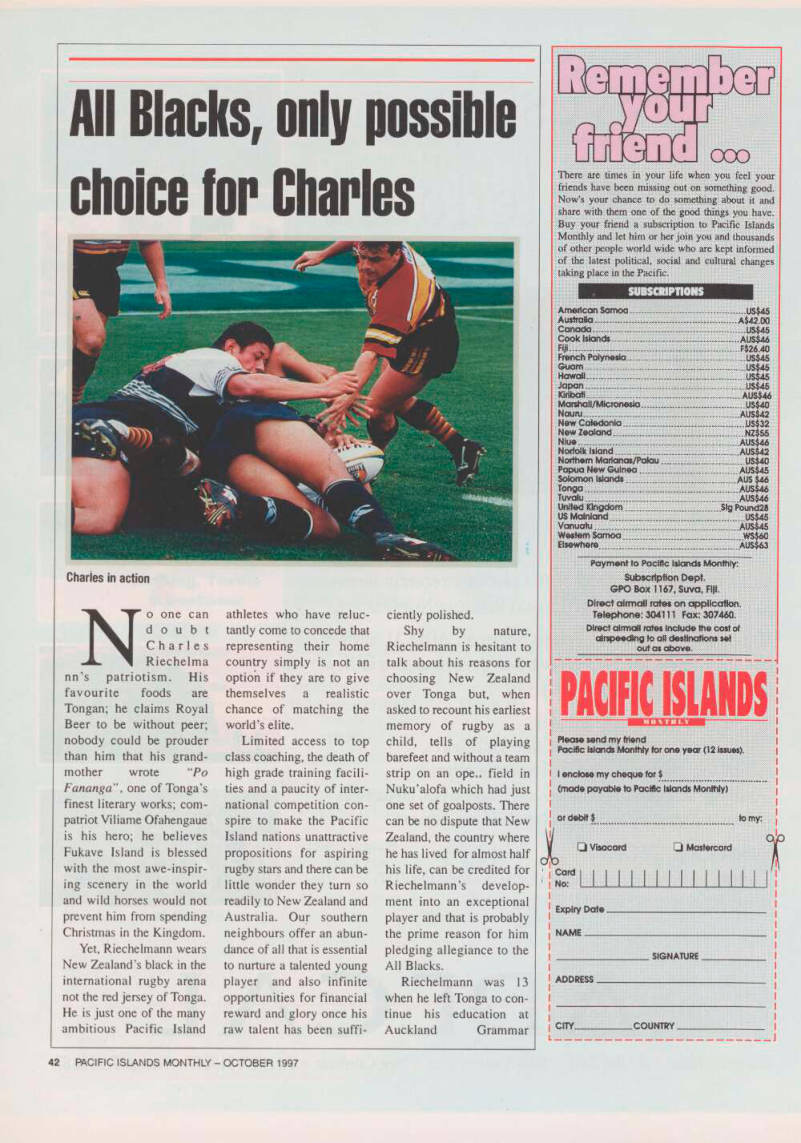
Charles in action
■ Sports
School, one of New Zealand’s most presti gious learning institutions. Auckland Grammar has a proud record on the rugby field as well as in the class room (no sec ondary school has produced more All Blacks) and it soon became apparent that Riechelmann would further enhance its sporting reputation. Also a highly accom plished track athlete and basketballer, he represented the New Zealand Secondary Schools rugby selection between 1989 and 1991; captaining them during the latter season. Only two other players have spent three years in the team. 1991 also saw the first of the shoulder injuries which have haunted Riechelmann’s career. After two disloca tions, he underwent an operation (two screws were inserted) that kept him away from rugby for a whole year and delayed his introduction to the senior level.
In retrospect, the Tongan believes the 12 month break from the game to have been beneficial as it enabled him to enter the ultra tough Auckland club competition completely fresh. Certainly, his debut sea son was an impressive one and he earned places in the Queen City’s Colts XV and sevens combination.
Promotion into Auckland’s awesome senior squad came the following year but, understandably, Riechelmann had to be content with only occasional outings for an
Auks unit chock-a-block with seasoned internationals.
Despite his restricted experience with Auckland, Tonga sought Riechelmann for their 1995 World Cup squad. It was the moment of truth for him. Previously he had, when quizzed about his international loyalties, stated "The subject is irrelevant, as neither Tonga or New Zealand have asked me to play for them.”
After much consideration, he decided against travelling to South Africa and made a call up for the All Blacks his primary goal. When professional rugby was, at long last, legalised, Riechelmann put his studies at the Auckland Institute of Technology, where he was studying for a diploma in marketing, onto hold.
The 1996 Super Twelve Series marked Riechelmann as very much an All Black prospect. He was the tournament’s revela tion; switching regularly from prop to flanker to fill, with equal effectiveness, gaps left by teammates injured, suspended or, in the case of Michael Jones, unavail able for Sunday games due to religious commitments.
A prop throughout his schooldays, Riechelmann found himself, at 1.92 metres tall, straining to match loftier opponents in the lineouts upon graduating into senior fare. Strong, mobile, athletic and-combat ive, he has all the attributes of a first rate
blindside flanker and was named in this position for the shadow test team at the 1996 All Blacks trial.
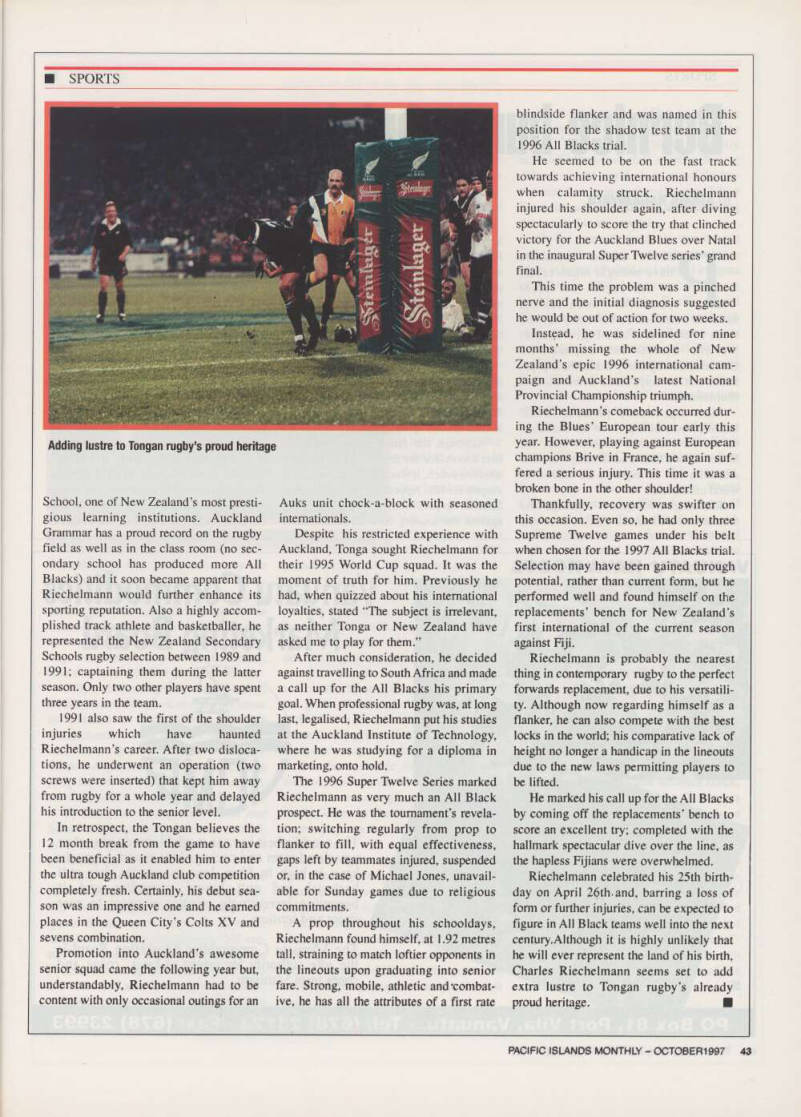
He seemed to be on the fast track towards achieving international honours when calamity struck. Riechelmann injured his shoulder again, after diving spectacularly to score the try that clinched victory for the Auckland Blues over Natal in the inaugural Super Twelve series’ grand final.
This time the problem was a pinched nerve and the initial diagnosis suggested he would be out of action for two weeks.
Instead, he was sidelined for nine months’ missing the whole of New Zealand’s epic 1996 international cam paign and Auckland’s latest National Provincial Championship triumph.
Riechelmann’s comeback occurred dur ing the Blues’ European tour early this year. However, playing against European champions Brive in France, he again suf fered a serious injury. This time it was a broken bone in the other shoulder!
Thankfully, recovery was swifter on this occasion. Even so, he had only three Supreme Twelve games under his belt when chosen for the 1997 All Blacks trial.
Selection may have been gained through potential, rather than current form, but he performed well and found himself on the replacements’ bench for New Zealand’s first international of the current season against Fiji.
Riechelmann is probably the nearest thing in contemporary rugby to the perfect forwards replacement, due to his versatili ty. Although now regarding himself as a flanker, he can also compete with the best locks in the world; his comparative lack of height no longer a handicap in the lineouts due to the new laws permitting players to be lifted.
He marked his call up for the All Blacks by coming off the replacements’ bench to score an excellent try; completed with the hallmark spectacular dive over the line, as the hapless Fijians were overwhelmed.
Riechelmann celebrated his 25th birth day on April 26th. and, barring a loss of form or further injuries, can be expected to figure in All Black teams well into the next century. Although it is highly unlikely that he will ever represent the land of his birth, Charles Riechelmann seems set to add extra lustre to Tongan rugby’s already proud heritage. ■
Adding lustre to Tongan rugby’s proud heritage