PNG looks north
pp. 28-30 · Read in the full issue

Economy
By Kalinga Seneviratne
In 1993, the then Papua New Guinea Prime Minister Paius Wingti launched the Look North policy to develop economic links with Asia. In doing so he said his country needed to leam work ethics and low-cost production techniques from Asia,
if it were going to be successful in interna tional commerce. Last year, his successor and then Prime Minister Sir Julius Chan, during an official visit to Malaysia, told the Malaysian Chamber of Commerce that since they “have already trodden the path we are travelling on”, they should come forward and help PNG do the same.
He invited Malaysian businesses to
invest in his country to create a ‘ ’Northern Gateway’ for Pacific Island countries to Asia. As PNG looks north for inspiration to develop its economic potential, a grow ing Asian business presence is making some people uneasy.
“The Look North foreign policy has been a milestone in PNG’s external rela tions,” says Dr Ray Anere, head of the University of PNG’s department of politi cal studies. Dr H G Mannur, head of the economics department at the university, says the policy’s major aim of integrating with ASEAN (Alliance of South-East Asian Nations) makes economic sense for PNG. This Look North policy has its mer its and bad effects,” says Sir Ebia Olewale, a former deputy prime minister and for eign minister.
“Its merit is that people from Asian countries can come and invest here and develop industries. The bad aspect is that Asian companies who want to put their money here also want to bring in Asian labourers. A good example is in the timber industry, he points out, where Malaysian companies have brought in people to drive tractors, cook food for them, operate bull dozers, big trucks and other logging equip ment. There’s resentment here because when we have our young people finishing technical college with the knowhow to do these things, why bring the Asian labour ers here?” Since Wingti launched the poli cy, Malaysians have slowly but surely built a strong economic presence here.
In the past five years, PNG’s exports to Malaysia have grown almost five-fold to SUS2B.B million and imports from Malaysia have doubled to SUS4O million.
Malaysian investments here are estimated at around US$l. 5 billion.
Most of it, however, have been in the forestry sector - where the activities of
Malaysian logging companies have attract
ed a lot of negative media coverage, espe cially from the Australians. “ Our relation ship with PNG is growing,” says S Ganeson, second secretary of the
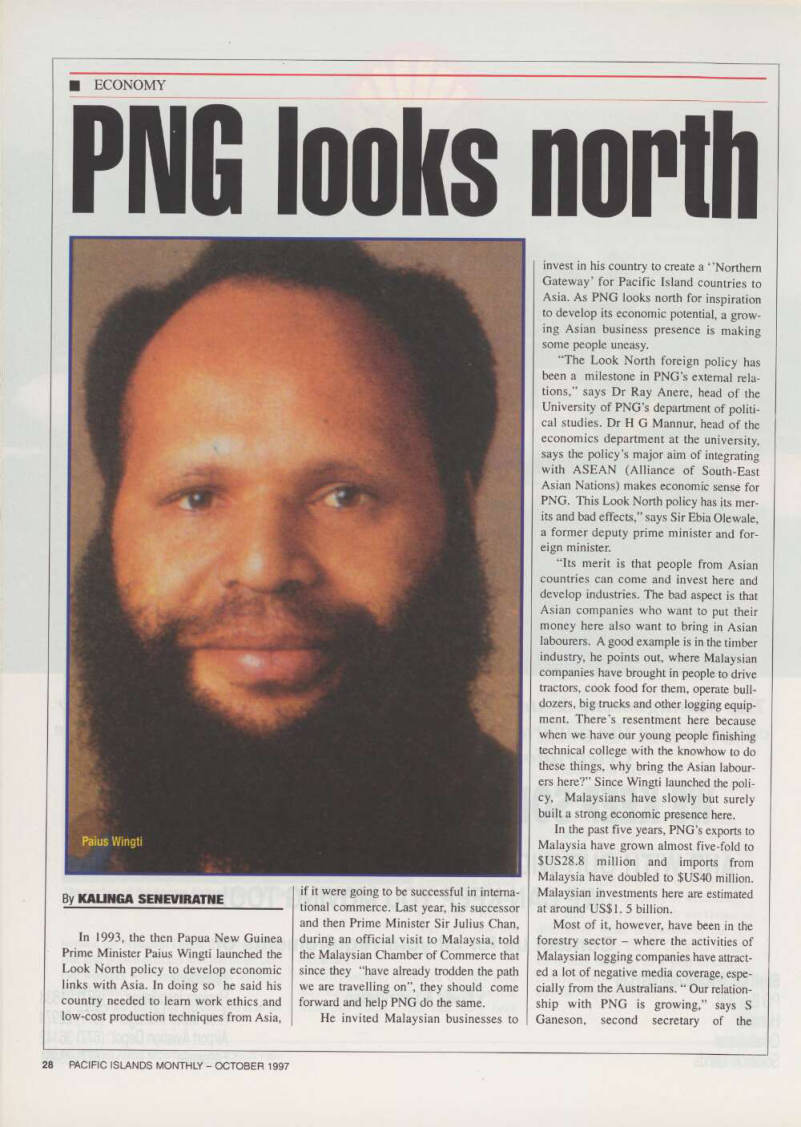
Paius Wingti
Malaysian High Commission here.”
He admits one-sided media coverage of Malaysian logging operations have not helped Malaysian business here but points out that there were a lot of medium-sized Malaysian companies going into other sec tors of the economy now.
“Some companies are looking at using PNG as a gateway to the South Pacific.
That would eventually be the aim of most Malaysian companies because PNG is a strategic location,” he told PIM. Among the major non-forestry investors here is Malaysia’s MBf financial company, which introduced its life and general insurance services to PNG in 1990. It now has a turnover of over SUS 3. 2 million a year.
In 1995 it bought the Australian-owned company W R Carpenters which has exten sive retail and agricultural interests in PNG and Fiji. Carpenters’ turnover in PNG was Kl7O million (SUSI 22 million) last year and it is the third-biggest employer in PNG with a staff of about 4500 - only 75 of whom are expatriates. Malaysia’s biggest bank, Maybank, has already set up two branches in PNG and the Johore Corporation last year bought large palm oil plantations in New Ireland Province.
Another Malaysian company, Damansara Forests, is setting up palm oil plantations in logged forest areas. There is a Malaysian-owned fish cannery in Lae employing 2000 locals.
YTL Corporation of Malaysia will begin constructing a SUS72-million luxury hotel in Port Morseby later this year, as a new joint-venture project with the Investment Corporation of PNG. With the tourism industry in its infancy but with a lot of potential to develop it as a cultural and eco-tourism centre for the Asian mar
ket, PNG is making a hard pitch to get Asian investments into this sector. Jerry Tan, the gener al manager of MBf Assurance Pty Ltd, predicts that if the political situation stabilises, more Malaysian investments should venture here.
“Because of (political) insecuri ty, investments are held back,” he told PIM. The biggest Malaysian investors here is the Sarawak-based timber con glomerate, Rimbuan Hijau group, which dominates the PNG forestry sector with upto
86 per cent share of its log trade. Its prof its from logging has been estimated at between SUS3SO-425 million a year. In recent years, Rimbuan Hijau has been the target of international media accusations of “rapping the forests of PNG”. Thus, in 1994, when it launched PNG’s second daily newspaper, the National, there was a lot of debate in the country and outside about whether this was an attempt to influ ence public opinion in favour of the log ging industry.
But today, there is a widespread view among locals here that the newspaper has, in fact, helped introduce much-needed diversity and competition to the media scene in PNG.
Frank Kolma, the editor-in-chief of the National, a senior PNG journalist who was press secretary to Wingti when he launched the Look North policy told PIM National started as a result of Wingti ask ing Rimbuan Hijau to diversify its invest ments in the country and suggesting com munications as a field where PNG needed help.
Kolma says Wingti engineered the Look North policy because for too long they had been working exclusively with their colonial Triends’, like Australia, New Zealand and Britain. In doing that they
ignored the exciting economic changes”
taking place in Asia.
"There is a big mirror in Canberra that reflects Asian countries and our informa tion comes from that mirror. Even though we have a common border with Indonesia, we were looking at them through Australian eyes,” he explained.
He added that “The pm thought we were strategically placed to deal with Asia on our own. “ We were well placed with
our observer status with ASEAN.”
Kolma points out that durimg the 1993- 1994 economic crisis, Australua abandoned PNG and asked it to go to the World Bank.
This was a time when Malaysians began to invest in a big way heire with MBf
buying up Carpenters, Maybanik moving in
and Rimbuan Hijau setting up ithe newspa per.
“When our friends were not: helping us, Malaysia was helping us at a time when the economy was going downhill,” observed Kolma.
“We saw this change and it affected lib eral people like us. We began to see Malaysia differently, as well as Australia.”
Even among the liberal intelligentsia in PNG there seem to be differences of opin ion on Asian investments in the country.
Powes Parkop, the director of the
Individual and Community Rights
Advocacy Forum says not everyone is in favour of Asians doing business here.
“People feel Look North could be a corpo rate takeover because Malaysian compa nies come and takeover business here.”
He observes that such views have developed because a lot of Chinese are running retail and wholesale businesses in PNG but, unlike many other expatriates, they don’t mix socially with the locals.
Thus, it has created an impression in the community that the Chinese are here only to make money.
Because of that negative perception already there, when Malaysian companies come here and most of them happen to be ethnic Chinese, it adds to these resent ments, says Parkop. This view could change as Asian countries begin to offer technical assistance to PNG. This year, about 15 government officials will be trained in Malaysia in management and technical areas on a govemment-to-gov emment assistance scheme. Also under a memorundum of understanding signed with Indonesia on education and culture in May, PNG will be sending officials to its neighbouring country to study educational reforms there.
After signing the agreement, PNG’s then education minister, John Waiko, said that, traditionally, they had looked to Australia, New Zealand and other Western countries for such training and financial assistance. But now Asian countries like Indonesia are more approriate for their need. ■
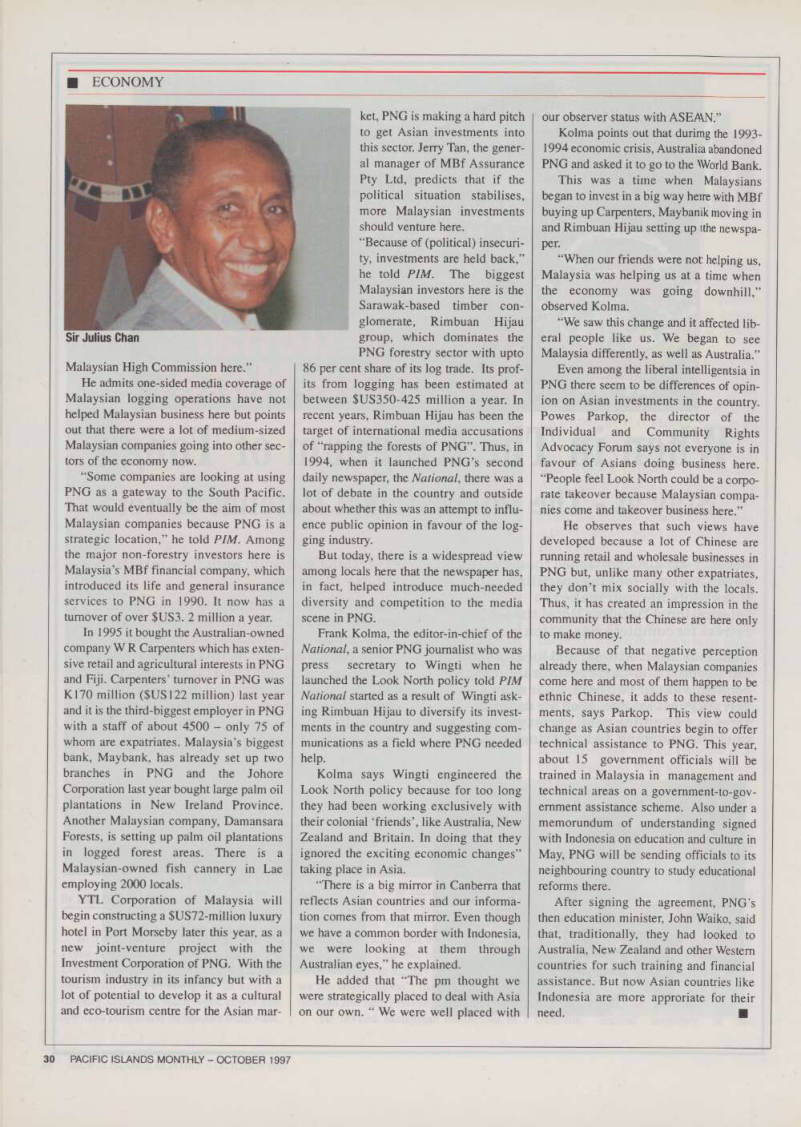
Sir Julius Chan