Burnham declaration approved
pp. 31-32 · Read in the full issue
Bougainville
By Sam Vulum
Long at last, some positive hopes have been raised by the current fresh efforts towards establishing peace on Papua New Guinea’s trou ble-torn Bougainville Island, at least since the Burnham declaration in New Zealand in July.
For the first time in nine years, there is a strong general feeling of consensus among Bougainvilleans, including the Bougainville Revolutionary Army’s supreme commander Francis Ona.
Ona, who has remained in seclusion since the crisis broke out in 1989, expressed his interest for peace though Australian-based BRA spokesman Moses Havini.
Havini said that Ona, who refused to attend the July talks and the subsequent declaration, was briefed in Southern Bougainville by senior rebels who attend ed the talks and now supported the decla ration.
The growing interest by Bougainvilleans for peace is fully support ed and endorsed by the Prime Minister Bill Skate who visited Buka and parts of main land Bougainville in August. The develop
ments are also boosted by com mitments by the Australian and New Zealand gov ernments to sup port the PNG gov ernment in every way possible to bring peace to the island.
Skate gave his gov ernment’s full sup port for the Burnham peace declaration as he outlined the next round of peace talks with the rebels during his visit.
The prime minister
visited Bana, in the island’s south, the first to the Bougainville; mainland by a prime minister since the failed Arawa talks late in 1994.
He also announced cabinet approval for the Burnham declaration which calls for a cease-fire, demilitarisation of the Island, an end to the military blockade and the installation of a United Nation’s peace keeping force.
The talks will be split into two parts.
The first was set for September 8 and the second for this month. Skate has vowed to attend the second meeting.
“I am confident that together we will work out something to dismantle the remaining obstacles to peace on Bougainville,” he told more than 200 offi cials and villagers on Buka.
To facilitate the talks, Australia has pledged to transport the PNG delegation to and from the meeting in New Zealand.
The undertaking was made by the Australian Foreign Minister Alexander Downer during a visit to Port Moresby in August.
Downer also announced that Australia will provide an extra US$l.4 million over the next five years towards reconciliation and rehabilitation on Bougainville.
The money which works out to be $32.4 million in current and proposed aid
covering Buka Hospital, Buka Airport and educational facilities mainly in North Bougainville as well as emergency human itarian activities.
Downer’s PNG counterpart Kilroy Genia also indicated that $3 million would be given to the BTG to help them travel and do their business.
“The basic message I passed on to the PNG Government was that Australia was firmly committed to the strengthening and
re-invigorating the relationship with
PNG,” Downer said.
New Zealand’s Foreign Minister Don McKinnon, who was in PNG days after Downer’s visit, said the NZ government also wanted to ensure that they were tak ing the right approach to facilitate the cur rent peace process following the Burnham declaration.
It was the New Zealand meeting which instigated the current peace process. The meeting followed the successful release of the five PNG security force members from
BRA captivity in early August.
This was achieved also with strong New Zealand involvement.
During the visit, Skate met and mingled around with locals, including rebel fight ers, local chief s and government officials.
Skate said he was told that 500 rebels had recently come “out of the bush” and put down their arms.
Army sources have confirmed that with the exception of Arawa near the rebels stronghold on Bougainville, the island was enjoying a relative calm period.
Bougainville Transitional Government premier Gerard Sinato said his members had embarked on peace missions around the island to “build bridges of trust” based on the New Zealand talks.
“We need to break the barriers of fear and mistrust if we are going to succeed with is building exercise,” Sinato said.
He said the repatriation of thousands of Bougainvillians living in military con trolled cafe centres back to their villages would help the reconciliation process.
The exercise should be extended to the Solomon Islands where 2000 Bougainvillians fled over the years.
In other positive developments, the freed five security forces hostages also planned to go back to Lagual in South Bougainville where they were held for almost 10 months.
But this time they were not going in
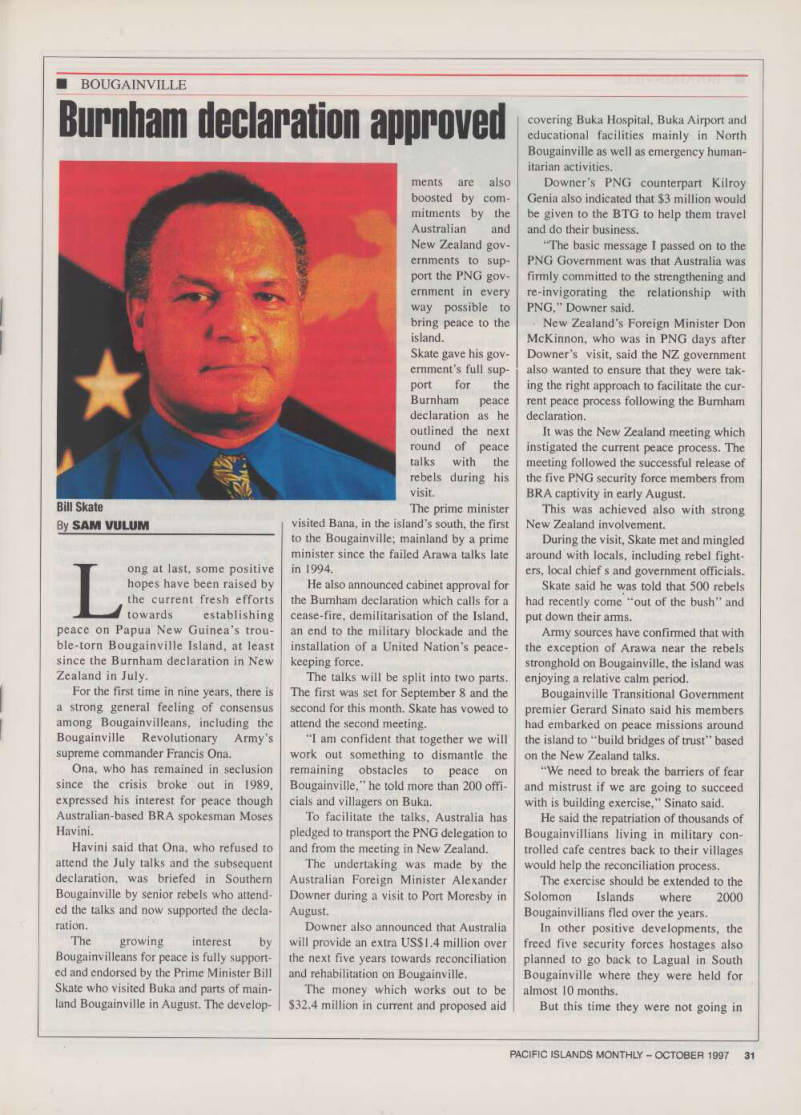
Bill Skate
combat gear but with open hands - to talk peace with the former foes.
One of the hostages, Senior Constable Andrew Ponda said: “The trip is more or less a mercy trip because we will be going there to repay what our brothers and sisters have done for us during the 10 months we were there.”
They were captured at Kangu beach in 1996 following a fierce battle where 11 members of the security forces were killed.
In another encouraging report, rebels stationed at Tinputz, Kunua and Keriaka have demanded the dismantling of the defence force camp at Siara, on the north ern tip of the island.
About 100 rebels, including one of their leaders known only as fox attended a large gathering and announced that they would support the peace building if the camp was removed.
The army camp at Siara junction is the first major presence of security forces on mainland Bougainville, from Buka town.
About 1000 people attended the Tsumpets meeting to listen and air their views.
According to a group of Tinputz men who attended, the meeting was highly charged with chiefs demanding rebels to hand over their guns if they were honest about peace.
According to the men, the chiefs urged the rebels to surrender their firearms and return to their villages and live with their parents.
One of the men, who comes from Tinputz, said there were hardly any rebels left in Tinputz as most of them have sur rendered and returned home to their par ents.
He said chiefs and village counsellors believe strongly that once rebels return to their vil lages and live with their parents, the separatist move ment would wither away.
During the meet ing, the chiefs expressed concern that it was rebels from Buka, Solos and Petspets who were causing all the
problems for the mainland Bougainvilleans.
They claimed that rebels from their own areas had given up and returned to their villages and their families at the urging of the people.
They urged the rebels to return to their own homes, such as to Buka and to leave them alone to try and live a peaceful and normal life.
The progress is looking good on the ground, however, there is danger of it
being destroyed through the continuing
war of words between politicians at the national and provincial levels.
Two key figures, who should be play ing a major part in the peace process, Bougainville regional MP John Momis and South Bougainville MP Michael Laimo were left out of Skate’s delegation during his visit to the island.
The two Opposition MPs, including their leader Bernard Narakobi, expressed grave disappointment over the actions of the pm.
Momis, who has so far been the only politician who has met face to face with the reclusive rebel chief Ona, accused Skate of failing to exercise sensitivity over
the sufferings of Bougainvillians during
the crisis.
While speaking to a gathering in Buka, Skate said: “You Bougainvilleans caused it (crisis), you must solve it...”
Momis said that the crisis was caused by the Waigani government when Skate’s predecessors refused constant pleas from the people of Baugainville, the
Bougainville provincial government, and
elected Bougainville leaders, to review the Bougainville copper agreement.
“The crisis started when the Bougainville people had enough of Waigani’s bullying and victimising tactics, but they were simply playing the cards dealt to them by Waigani.
Obviously the Prime Minister had got a
completely wrong diagnosis, and
inevitably the wrong prescriptions for
Bougainville.
“Of course it is the prerogative of the prime minister to consult whoever he chooses. It is also his prerogative to choose whoever he wants to accompany him on any of his trips. That is all very well, pro vided the prime minister chooses wisely, knowing that is where divisions are first created.
“And when he abandoned his own ini tiative, announced both by the governor general and himself, for a parliamentary bi-partisan committee on Bougainville, he effectively created the divisions on
Bougainville.
“Mr Sinato (BTG premier) and his cohorts confirmed the prime minister’s divisive tactics when they did not advise him to continue on that bi-partisan spirit.
“And all I am saying is that in a democ racy such as ours, the obvious first points of contact on Bougainville are all its elect ed representatives. That is the whole point of having elections. And both Mr Laimo and myself were elected as member for South Bougainville and member for
Bougainville respectively, with over
whelming majorities.
“The member for Central Bougainville (Bougainville Affairs Minister Sam Akotai), who the prime minister has cho sen to listen exclusively to, got just a little over 500 votes.
“The Bougainville premier is not an elected people’s representative.
The BTG was performing like a politi cal party during the last elections, and with the exception of the member for Central Bougainville, all the others were rejected by the people.
John Siau, who is their adviser, was dis missed by the people when he stood for the
Bougainville regional seat.
“I believe the prime minister would be well on the way towards resolving Bougainville if he could ensure that the people’s elected representatives, both national and provincial, are involved in a bi-partisan spirit very early in the peace process,” Momis said. ■
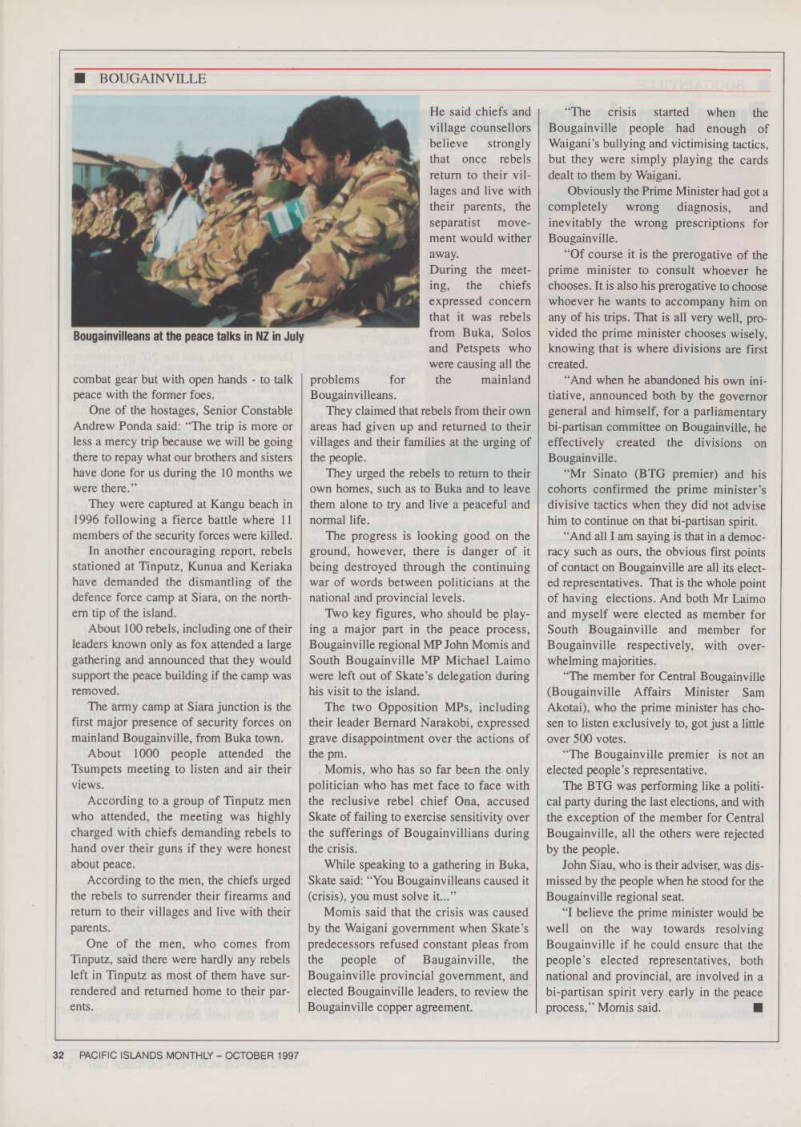
Bougainvilleans at the peace talks in NZ in July