What went wrong with KAL 801
pp. 25-26 · Read in the full issue
Disaster
By Susan Prokop
A tropical storm pounded
Guam’s Won Pat International Airport in the early morning hours of August 6 this year.
In the midst of this, a Korean Airlines flight was preparing to land after a 2000 mile journey from Seoul, South Korea.
Guam is a popular tourist destination for many Japanese and Koreans, draw ing over one million people from those two countries each year.
It is also home to many Koreans who have settled there and established a
thriving business community.
Onboard the Boeing 747 were over 250 people. Many of them were honeymooners and vacation ers either coming to visit Guam or returning from visits to families and friends in Japan and Korea.
Tragically, the airliner’s descent fell short of the airport.
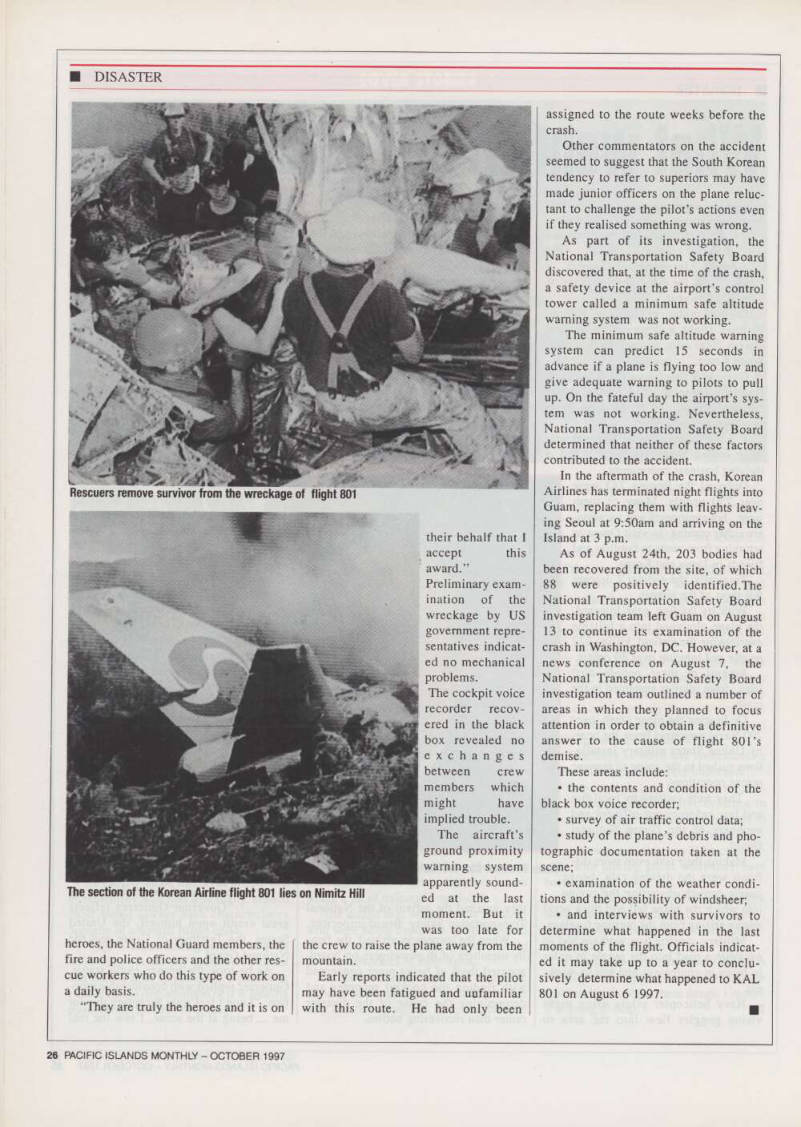
With its landing gear lowered, the plane ploughed into a hillside overlooking the airfield, killing 227 people and injuring over 30 others.
Several of these people died later from injuries sustained in the crash.
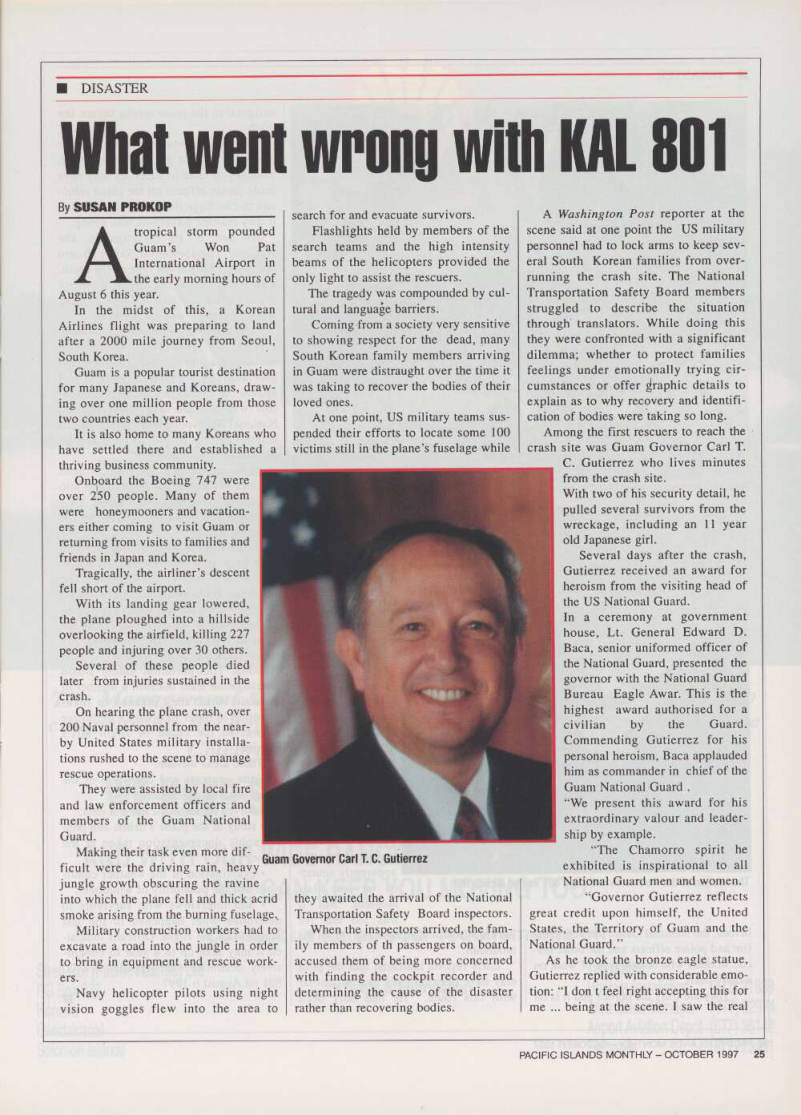
On hearing the plane crash, over 200 Naval personnel from the near by United States military installa tions rushed to the scene to manage rescue operations.
They were assisted by local fire and law enforcement officers and members of the Guam National Guard.
Making their task even more dif ficult were the driving rain, heavy jungle growth obscuring the ravine
into which the plane fell and thick acrid smoke arising from the burning fuselage..
Military construction workers had to excavate a road into the jungle in order to bring in equipment and rescue work ers.
Navy helicopter pilots using night
vision goggles flew into the area to
search for and evacuate survivors.
Flashlights held by members of the search teams and the high intensity beams of the helicopters provided the only light to assist the rescuers.
The tragedy was compounded by cul tural and language barriers.
Coming from a society very sensitive to showing respect for the dead, many South Korean family members arriving in Guam were distraught over the time it was taking to recover the bodies of their loved ones.
At one point, US military teams sus pended their efforts to locate some 100 victims still in the plane’s fuselage while
they awaited the arrival of the National Transportation Safety Board inspectors.
When the inspectors arrived, the fam ily members of th passengers on board, accused them of being more concerned with finding the cockpit recorder and determining the cause of the disaster rather than recovering bodies.
A Washington Post reporter at the scene said at one point the US military personnel had to lock arms to keep sev eral South Korean families from over running the crash site. The National
Transportation Safety Board members
struggled to describe the situation through translators. While doing this they were confronted with a significant dilemma; whether to protect families feelings under emotionally trying cir cumstances or offer graphic details to explain as to why recovery and identifi cation of bodies were taking so long.
Among the first rescuers to reach the crash site was Guam Governor Carl T.
C. Gutierrez who lives minutes from the crash site.
With two of his security detail, he pulled several survivors from the wreckage, including an 11 year old Japanese girl.
Several days after the crash, Gutierrez received an award for heroism from the visiting head of the US National Guard.
In a ceremony at government house, Lt. General Edward D.
Baca, senior uniformed officer of the National Guard, presented the governor with the National Guard Bureau Eagle Awar. This is the highest award authorised for a civilian by the Guard.
Commending Gutierrez for his personal heroism, Baca applauded him as commander in chief of the Guam National Guard .
“We present this award for his extraordinary valour and leader ship by example.
“The Chamorro spirit he exhibited is inspirational to all National Guard men and women.
“Governor Gutierrez reflects
great credit upon himself, the United States, the Territory of Guam and the National Guard.”
As he took the bronze eagle statue, Gutierrez replied with considerable emo tion: “I don t feel right accepting this for me ... being at the scene. I saw the real
Guam Governor Carl T. C. Gutierrez
heroes, the National Guard members, the fire and police officers and the other res cue workers who do this type of work on a daily basis.
“They are truly the heroes and it is on
their behalf that I accept this award.”
Preliminary exam ination of the wreckage by US government repre sentatives indicat ed no mechanical problems.
The cockpit voice recorder recov ered in the black box revealed no exchanges between crew members which
might have
implied trouble.
The aircraft’s ground proximity warning system apparently sound ed at the last moment. But it was too late for
the crew to raise the plane away from the mountain.
Early reports indicated that the pilot may have been fatigued and unfamiliar with this route. He had only been
assigned to the route weeks before the crash.
Other commentators on the accident seemed to suggest that the South Korean tendency to refer to superiors may have made junior officers on the plane reluc tant to challenge the pilot’s actions even if they realised something was wrong.
As part of its investigation, the National Transportation Safety Board discovered that, at the time of the crash, a safety device at the airport’s control tower called a minimum safe altitude warning system was not working.
The minimum safe altitude warning system can predict 15 seconds in advance if a plane is flying too low and give adequate warning to pilots to pull up. On the fateful day the airport’s sys tem was not working. Nevertheless, National Transportation Safety Board determined that neither of these factors contributed to the accident.
In the aftermath of the crash, Korean Airlines has terminated night flights into Guam, replacing them with flights leav ing Seoul at 9:soam and arriving on the Island at 3 p.m.
As of August 24th, 203 bodies had been recovered from the site, of which 88 were positively identified. The National Transportation Safety Board investigation team left Guam on August 13 to continue its examination of the crash in Washington, DC. However, at a news conference on August 7, the National Transportation Safety Board investigation team outlined a number of areas in which they planned to focus attention in order to obtain a definitive answer to the cause of flight 801’s demise.
These areas include: • the contents and condition of the black box voice recorder; • survey of air traffic control data; • study of the plane’s debris and pho tographic documentation taken at the scene; • examination of the weather condi tions and the possibility of windsheer; • and interviews with survivors to determine what happened in the last moments of the flight. Officials indicat ed it may take up to a year to conclu sively determine what happened to KAL 801 on August 6 1997. ■
Rescuers remove survivor from the wreckage of flight 801
The section of the Korean Airline flight 801 lies on Nimitz Hill