The United
pp. 23-24 · Read in the full issue
Tougher laws against child molesters
Nations Children’s Fund (UNICEF) is not sure if paedophilia is
really new or if it is newly recognised.
It is in fact looking at this problem in the context of children’s rights and the con vention of the rights of a child.
Now that all the Pacific Island countries have ratified the Convention on the Rights of the Child, UNICEF is trying to elabo rate it in these countries as they carry clauses and articles which protect the child from any type of abuse.
UNICEF’s social mobilisation officer for the Pacific Islands, Dr Heidi Larson said as they were trying to do this, one of the things that they felt was of great impor tance was parent education.
This meant making parents aware of what was happening and to take steps and
precautions to protect their children.
She said parents and the community in general had to realise that they couldn’t trust children with everybody.
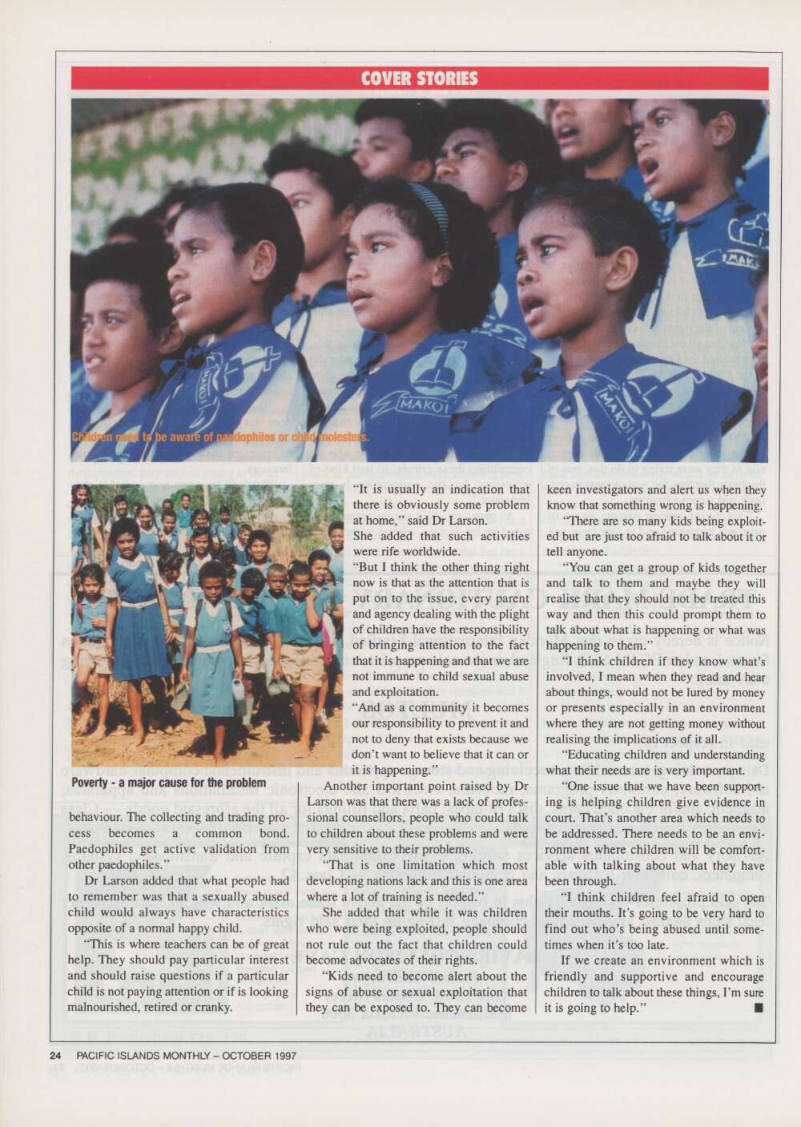
Another cause of this situation was poverty where children were coming from homes in which their basic needs were not being met and sonjeone came along with some cash and ‘goodies’ and off the chil dren went.
Dr Larson said the person doing this, usually came across as someone who did everything in the best interest of the child and family by paying school fees, electric bill, dressed well, was successful, offered nice trips for the family or the child to exotic destinations.
"These are the kinds of people who are committing these crimes, so that kind of education for the community is very
important.”
A paper on child sexual assault pre pared by lan Hopley, adviser to the Royal
Papua New Guinea Constabulary Development project, talked about pae dophiles and their characteristics.
Hopley said these people seduced chil dren with attention, affection and gifts.
“They literally befriend children by talking to them, listening to them, paying attention to them, spending time with them
and buying gifts.”
In his paper he reported that law enforcement investigations in many parts of the world had verified that paedophiles almost always collected child pornography or child erotica.
“The key word here is collection. It does not mean that paedophiles merely view pornography, They save it. It comes to represent their most cherished sexual fantasies.
“Paedophiles swap pornographic pho tographs the same way children swap cards or stamps. As they add to their collections, they get strong reinforcement for their
behaviour. The collecting and trading pro cess becomes a common bond.
Paedophiles get active validation from other paedophiles.”
Dr Larson added that what people had to remember was that a sexually abused child would always have characteristics opposite of a normal happy child.
“This is where teachers can be of great help. They should pay particular interest and should raise questions if a particular child is not paying attention or if is looking malnourished, retired or cranky.
“It is usually an indication that there is obviously some problem at home,” said Dr Larson.
She added that such activities were rife worldwide.
“But I think the other thing right now is that as the attention that is put on to the issue, every parent and agency dealing with the plight of children have the responsibility of bringing attention to the fact that it is happening and that we are not immune to child sexual abuse
and exploitation.
“And as a community it becomes our responsibility to prevent it and not to deny that exists because we don’t want to believe that it can or it is happening.”
Another important point raised by Dr Larson was that there was a lack of profes sional counsellors, people who could talk to children about these problems and were very sensitive to their problems.
“That is one limitation which most developing nations lack and this is one area where a lot of training is needed.”
She added that while it was children
who were being exploited, people should
not rule out the fact that children could become advocates of their rights.
“Kids need to become alert about the signs of abuse or sexual exploitation that they can be exposed to. They can become
keen investigators and alert us when they know that something wrong is happening.
“There are so many kids being exploit ed but are just too afraid to talk about it or tell anyone.
“You can get a group of kids together and talk to them and maybe they will realise that they should not be treated this way and then this could prompt them to talk about what is happening or what was happening to them.”
“I think children if they know what’s involved, I mean when they read and hear about things, would not be lured by money or presents especially in an environment where they are not getting money without realising the implications of it all.
“Educating children and understanding
what their needs are is very important.
“One issue that we have been support ing is helping children give evidence in court. That’s another area which needs to be addressed. There needs to be an envi ronment where children will be comfort able with talking about what they have
been through.
“I think children feel afraid to open their mouths. It’s going to be very hard to find out who’s being abused until some times when it’s too late.
If we create an environment which is friendly and supportive and encourage children to talk about these things, I’m sure it is going to help.” ■
Children need to be aware of paedophiles or child molesters.
Poverty-a major cause for the problem