A worsening crisis
pp. 32-33 · Read in the full issue
Economy
Solomon Islands financial situation shows no signs of improving
By Sam Seke
The Solomon Islands government is in the throes of a finacial crisis. The Solomon Mamaloni government has admitted to this and the nation is feeling the effects. Former Finance Minister Michael Maina has said “the government is in serious debt and unable to meet its commitments”. He said revenue collection had only been sufficient to meet salaries which accounted for 50 per cent of government expenditure.
Maina said the government had been unable to cope with repayment of its staggering debts of SUS2OO million (national budget SUSISO million) and interest arrears on borrowings were
sUS2B million and accumulating. The minister had stated that the government had found itself in this situation because of some “ill informed decisions” on the part of policy makers.
It would be difficult to argue against the AUSTEO secret report on Solomons, which said the “government is preoccupied with averting financial collapse, not reforming”. The permanent secre tary for finance, Gordon Darcy, said the government’s financial crisis was a long way from being resolved.
Darcy said normalising government finances would require a major shake-up in both structure and finacial operations. He said the Mamaloni government’s fiscal measures were not geared towards resolving the financial crisis. He said they were just inter im measures to try and meet the government’s immediate demands.
Central Bank governor Rick Hou said the country’s poor eco nomic performance was reflected in the equally poor economic and social indicators for Solomons which, according to the Asian Development Bank, is one of the lowest in the region at SUSS6O per capita.
Hou said the country needed to disect the situation and find out why things had gone badly and why Solomons had lagged so far behind other countries in the region who have achieved vast improvements with fewer natural resources.
He said Solomons needed to find out why there had been no improvement after 19 years of independence and after having spent SUS 1 billion in government expenditure - and the rapid har vesting of valuable natural resources.
Hou said that whatever economic growth there had been in the past five years (seven per cent, 1995; three per cent, 1996) had been on the basis of unsustainable harvesting of natural resources rather than productive investment.
This is particularly so with logging, which has been the lifeblood of the Solomons economy and which, at SUS9B million, accounts for more than 55 per cent of the country’s total export earnings and 50 per cent of government tax revenue. Warning bells were resounding from all comers and even the government and logging companies seemed to understand the dangers of unsustainable harvesting and were purportedly doing something about it.
Apparently, this turned out to be little more than rhetoric. The unabated destruction of forests continues and, at the current rate, (791,000 cm) environmentalists say it’ll be desolate in less than 10 years.
What then? Mining? The Central Bank governor said money received by the government from the Gold Ridge Mine will be insignificant in terms of its finacial crisis and overall financing needs.
Hou said revenue from income tax payable by the mining com pany, which is expected to start gold production by mid-1998, is not expected for another five years. He cautioned that while the Gold Ridge project and other likely mining activities would indeed bring benefits, the government must make fiscal adjust
ments immediately.
Moving to avert an impending collapse, the Mamaloni govern ment has embarked on structural adjustments it believed had some remedies. State functions and institutions were either being priva tised or corporatised, including forest plantations, shipping, water and postal services and ministries and departments merged to cut
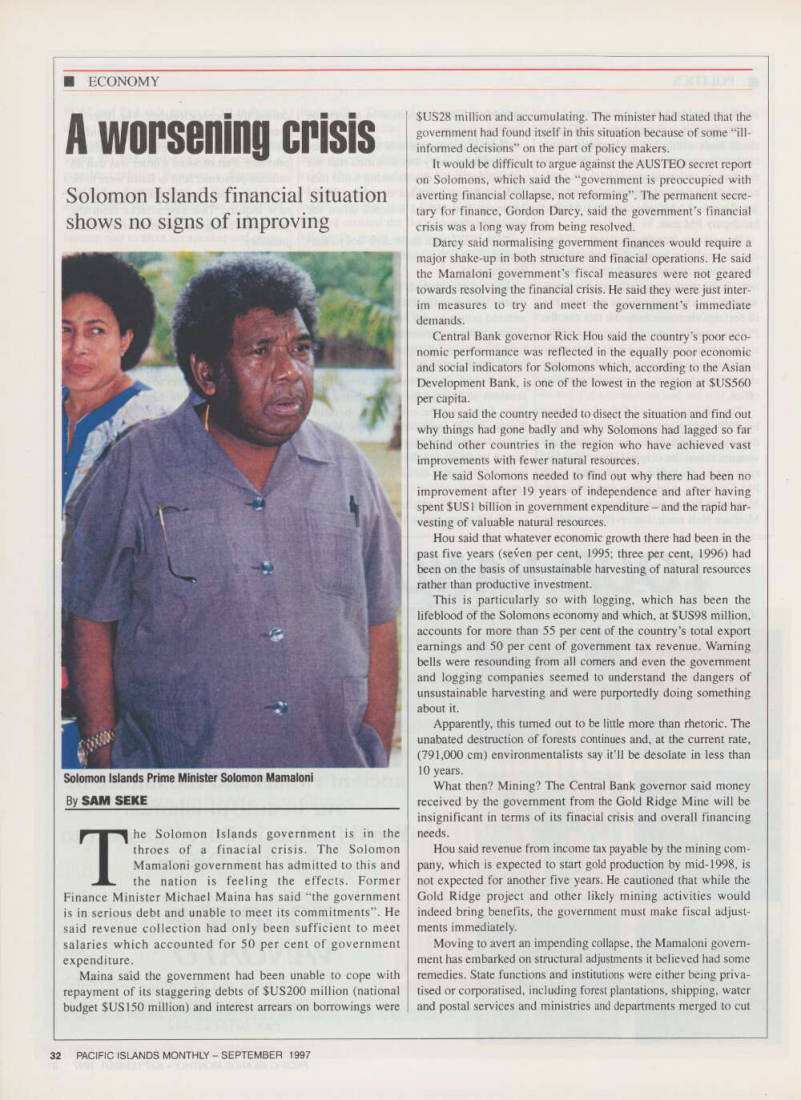
Solomon Islands Prime Minister Solomon Mamaloni
costs. Maina said the fiscal measures undertaken in light of the government’s serious cash-flow problem included restraints on credit, seeing that ministries worked within their monthly budgets, strengthening of revenue-collection departments and review of remissions and exemptions on tax and duty for both local and for eign investors. And after years of implementing control measures, how far has the country come? Debt servicing became slow and neglected while arrears continued to accumulate.
The securities market, which Maina said during an election campaign rally on June 21 would be normalised by the August national elections, has seen no improvement. Darcy said the gov ernment did not have the money to restore the securities market, which collapsed more than two years ago.
The Solomon Islands securities market collapsed when gov ernment borrowing at the Central Bank broke the legal ceiling and did not have the money to restore it.
The National Bank of the Solomon Islands (partly owned by the Bank of Hawaii) has gone as far as taking the government to court over its unpaid principal and interest arrears for treasury bills and bonds with the Central Bank.
But although the NBSI won its case, the SUS 1.4 million is still unsettled. The bank, therefore, closed down the government’s cheque account, saying the account does not have sufficient funds.
However, since the closure of the cheque account at the end of July, the government has opened a new account with the ANZ Bank.
Government telephones had been barred by Solomon Telekom from making outbound calls since April 9 because of non-pay ment of accounts and apart from essential telephones, the govern ment’s phone service for outgoing calls remained barred.
Accountant-general Peter Lokei said government owed Solomon Telekom almost SUSI million and payment of outstand ing accounts had been slow.
Other effects of the cash-flow problem is reflected on delays of up to one day in payment of public servant salaries.
Long queues are a common sight in front of the treasury office each working day, and government cheques are now something one dreads taking to the banks to cash; cheques for as little as SUS3O are known to have bounced.
The country’s bleak financial status is most evident in the state of social and public services.
The government has been having difficulties meeting its finan
cial commitments for the education of its sponsored students at the University of the South Pacific and PNG institutions. In July, SI students at the UPNG were told to pack up and leave because of non-payment of school fees.
And while the government was trying to upgrade the SI College of Higher Education (SICHE) into a university, it was already experiencing serious problems keeping SICHE opera tional. For the 1997 school year, SICHE had requested SUS 4.7 million to enable it to function normally but the government said it could only afford $2.8 million.
Even so, the government has been unable to meet its commit ments for service grants and living and book allowances for stu dents which have accumulated to SUSI. 4 million, and got to a stage where the college closed down in the first week of August.
The same story goes for the government King George VI. Once a prestigious institution, it is now run-down and serves its board ers rice, noodles and canned tuna as the staple.
Morale in the police force has dropped as a result of, among other things, dissatisfaction over shortage and general disrepair of housing.
Health authorities have not been able to implement public health programmes budgeted for and immunisation services have been low with service grants not forthcoming and a shortage of drugs, nurses and doctors. Road conditions in Honiara and other urban centres, as well as in the provinces, are also deteriorating and, in some cases, unpassable.
One could say that the real situation with the treasury is worse than a case of living from hand to mouth, as stated in the AUS TEO report. Mamaloni had correctly said that the government was living beyond its means. But why is the Solomons in this state? To quote Solomons Islands senior statesman Sir Mariano Kelesi, "The problem was not cash flow, but rather proper management of government spending.” He said that with an annual budget of SUSISO million, the government cannot say it has a cash-flow problem.
Could it be that the controversial AUSTEO report was right when it stated: "While the economy has been growing strongly, the [Solomon Island] government has no policies to support sus tainable economic development. Forestry resources have been overexploited, subsistence agriculture and infrastructure largely neglected and government administration corrupted for the per sonal gain of ministers and bureaucrats”? ■