Skate on thin ice
pp. 29-31 · Read in the full issue
Politics
Skate on thin ice New PNG PM faces challenging times
By Sam Vulum
A good proportion of Papua New Guineans, from the little man on the street and the simple villager to the policy maker and money spinner, went to the polls with one genera! goal - to vote in a new
regime.
Thousands were angered and frustrated by the struggling economy, escalating crime problem, deterioration of govern ment services and, most of all, the contin
uing allegations of corruption in high places, particularly in the political arena.
Sacked defence force commander Jerry Singirok’s allegations of corrupt practices by former government ministers in the Sandline International merecenaries fiasco only added fuel to their fire.
The recent election saw the toppling of former Prime Minister and founding lead er of the People’s Progress Party Sir Julius Chan. Sir Julius’ hopes for another crack at the nation’s top job were shattered when he was narrowly defeated in his Namatanai seat by close relative and educationist
Ephraim Apelis, ending his 29-year colourful political career.
Sir Julius blamed his downfall partly on his involvement in the mercenaries deal and other ill-fated government decisions during his term of office.
Another former Prime Minister and People’s Democratic Movement leader Paias Wingti suffered a humiliating defeat by Roman Catholic priest and activist Father robert Lak in his Western Highlands regional seat. Fr Lak had campaigned strongly against the mercenaries deal. His counterpart and a leading figure in the Port Moresby protests, Peti Lafanama, scored a landslide victory in the nearby Eastern Highlands province. The impact of Lafanama’s campaign tactics against the former government partly influenced the unseating of former Defence Minister Mathias Ijape and Mining and Petroleum Minister and deputy Pangu Pary leader for the Highlands region John Giheno in their respective seats in the province. Giheno was acting prime minister when Sir Julius was forced to step aside during the heat of the Sandline crisis.
Two other senior PPP MPs, Lands Minister and deputy PPP leader Sir Albert Kipalan and Agriculture and Livestock Minister David Mai, also lost their seats.
In Port Moresby, National Capital District governor Bill Skate retained his regional seat with a convincing margin.
Skate stood out among the other then opposition MPs who were highly critical of the actions of the former government.
On March 25, Skate had moved a motion in parliament seeking the resignation of then PM Sir Julius, Ijape, and Finance Minister and Deputy PM Chris Haiveta over the mercenaries deal. The motion was defeated but Sir Julius voluntarily stepped aside the same day to defuse tension build ing up among protesters camping outside parliament house. Skate had earlier spoken to the protesters and received their peti tion. He was also reported to have provid ed rations for soldiers on guard at the gates of the Murray Barracks Defence Force headquarters in Port Moresby. His critical stand against the former government led many to believe Skate would join Sir Michael Somare’s National Alliance party, the Melanesian Alliance party and inde pendents to form the new government. The People’s National Congress Party, of which Skate is leader, teamed up with
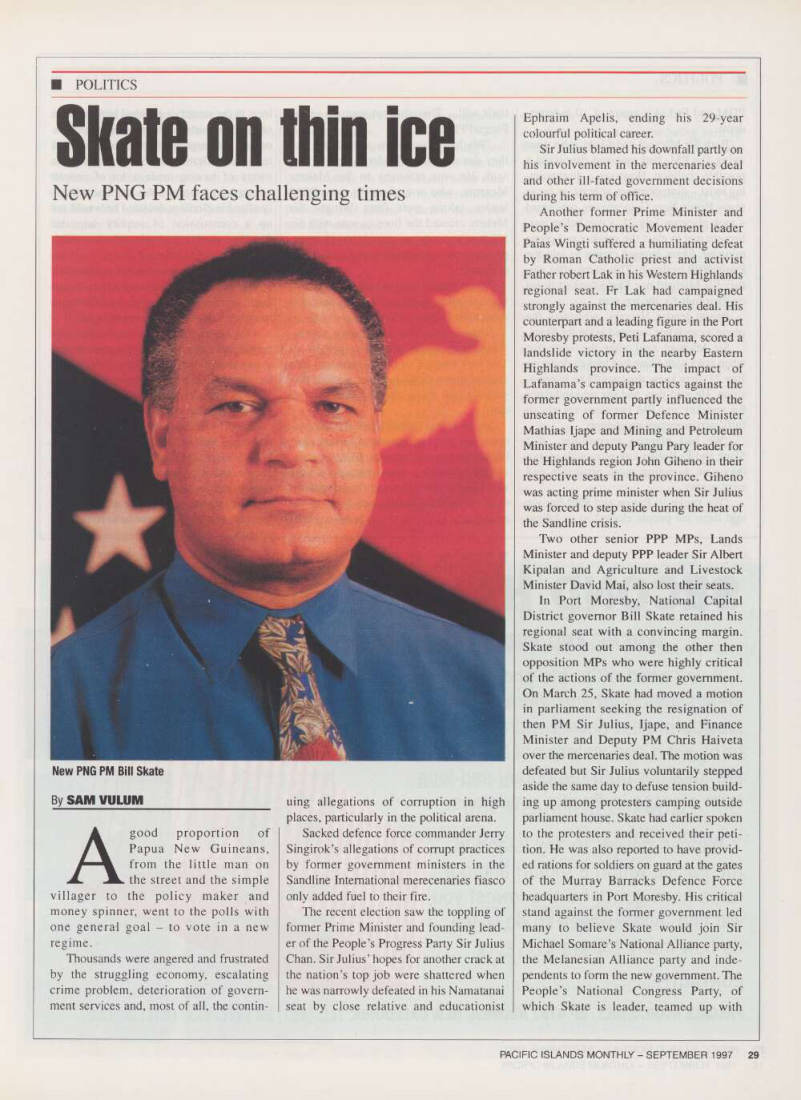
New PNG PM Bill Skate
PDM and Fr Lak’s group of 10 indepen dents.
Both Sir Michael and Skate, who were vying for PM, had met and discussed a possible coalition. However, a disappoint ing twist - disappointing, at least, as far as many Papua New Guineans are concerned - took place on July 21, a day before par liament met to elect the speaker and prime minister. Skate jumped camps to join the Pangu/PPP coalition. This came after nei ther Sir Michael nor Skate backed down on their bids for the top post.
Pangu leader Haiveta, who was the group’s candidate, stepped aside for Skate.
Sir Michael said after the vote that when talks with Skate had broken down on July 21, they knew they would be in oppo sition. He said they had put up candidates for speaker and PM positions merely to fulfil parliamentary procedures.
“We had planned everything... Bill Skate and Fr Robert Lak were with us, but they saw someting more attractive and went across.
“We spoke to Pangu and PPP but we told them the people elected us to follow
their wi11... They did not want to se the
Pangu/PPP regime.
“We had discussions with PDM but they deserted their leader,” Sir Michael said. He was referring to Sir Mekere Morauta, who was then the new PDM leader, taking over from Wingti. Sir Mekere crossed the floor to vote with Sir Michael’s group on principles of trans parency, good government and on fighting corruption.
While commenting on his decision. Sir Mekere told reporters: “I just could not work with Pangu or PPP.
“We seem to have continued a govern ment many people wanted to get rid of.
The very essence of the government that created many problems over the last few years is still there, even by remote con trol.”
Sir Mekere, a former Bank of PNG gov ernor and veteran top public servant, lost his leadership role with the PDM by join ing the opposition. Skate teamed with the very people whom he sought to bring down only two months earlier, and took up the reins of one of the most inexperienced cab
inets in the country’s political history. Nine of the 28 ministries are first-timers and six others, although in their second or third terms, are first-time ministers. Skate is aware of having made a lot of people unhappy by jumping sides and, immediate ly after his election, declared he would set up a commission of inquiry into the Sandline deal - and other deals - with wider terms of reference.
“There have been so many accusations against our leaders. We are going to set up a commission of inquiry to see if there is evidence that they have been at fault.
“We have been been misled by so many people and have been fighting among our selves and destroying leaders. As long as I am prime minister, that nonsense will stop.
We will fight corruption and we will do it
properly.
“I will ensure that foreigners do not come and leak out information to destroy PNG leaders. We have destroyed our own people and why should we become ene mies of our own people?
“This government will be a transparent government. We want it to be seen that we
are doing the right thing,” Skate said.
But Skate is expected to face stiff oppo sition from within his government, espe cially when a good number of ministers in the former government make up his cabi net, including one of the key players in the Sandline deal - Haiveta, who has retained his deputy PM post.
He will also face the challenge of keep ing his coalition intact. A rift has already become apparent among the coalition part ners. Some government MPs are not happy with Haiveta being a cabinet member. The ill-feelings stemmed from the fact that the PM, in making the appointment, side stepped from his previous public assertions that leaders in the initial Sandline inquiry should not be allowed to hold a public office.
The rift has widened following claims by PPP leader Andrew Baing and his deputy, Michael Nali, that Haiveta had watered down the original terms of refers ence set by their former party leader and PM Sir Julius. Agriculture and Livestock Mininster Baing and Trade and Tourism Minister Nali made the revelations while
supporting Skate’s decision to reopen the
Sandline inquiry.
Haiveta accused them of breaching cab inet confidentiality but admitted that the cabinet, under his chairmanship while then PM Sir Julius attended to other official business, had indeed watered down the terms of reference.
“The NEC as a collective body...nar rowed down the terms of reference,”
Haiveta said.
Skate committed his first major blunder when, in an unprecedented move, he ordered police to put on hold all charges against military personnel and members of non-governmental organsations involved in the Sandline crisis.
The order was intended to calm down tensions at Murray Barracks among sol diers following the release of operation Rausin Kwik commander Major Walter Enuma from a Port Moresby police cell by armed loyalists and the subsequent house arrest of Brigadier-General Leo Nuia and a senior officer.
Enuma had been charged with raising an illegal army in the Highlands of PNG
during the recent elections. The other 16 members of the army are being held in Baisu jail in the Western Highlands province. Part of Skate’s order was that all military personnel held in Baisu were to be released on bail pending the findings of the new inquiry. This saw attacks from the public accusing him of interfering in the
judiciary.
Internal Affairs Minister Tom Pelika announced days later that the order did not cover the 16 soldiers. He said the offences allegedly committed by the soldiers were not related to the Sandline saga and would be dealt with under the normal process of law. Only weeks in office, Skate became the subject of more controversy, following revelations of payments towards an exclu sive residence for his family in Cairns, Australia.
The opposition accused the PM of using Papua New Guineans’ money to pay Australians and of “putting his foot in another canoe” and waiting to flee PNG if the country sinks. Skate’s office, has said that the money for the rental fees had come from his own pocket. ■