prospect at last
pp. 26-28 · Read in the full issue
Bougainville
Peace-a real prospect at last
Story and pictures by MICHAEL FIELD
They were in the bright but cold afternoon sun, 17 leaders of a guerrilla army. “My Lord knows the way through the wilderness,” the men and women of the Bougainville Revolutionary Army sang, “and all I have to do is f0110w...” low...”
Few who heard their hymn on the Burnham Military Camp parade ground in New Zealand remained unmoved that July 5, sensing that at last Bougainville was inching toward peace.
After a decade of keeping its distance from Papua New Guinea’s cruel and unforgiving civil war, New Zealand was taking an initiative. Strangely, for a cynical world, the move was altruis tic on the part of Foreign Minister Don McKinnon.
The arrival earlier in the year of the Sandline mercenaries in Bougainville, the military revolt in PNG and the spreading gan grene of war into the Solomon Islands had jolted Wellington.
Former New Zealand High Commissioner to PNG, John Hayes, who was made special envoy to Bougainville, doesn’t strike one as the epitome of the modem diplomat. He smokes and is overweight. A helicopter company hired to fly him into the war zone pointed out he was the weight of three Bougainvilleans.
Still, he is discrete, speaks Pidgin and passionately cares about Bougainville. Respected by all sides, Hayes spent months going through the blockades, talking to the key people, winning confi dences. There were others too working in the background, responding to the increasingly desperate sounds of pain.
Not only is the war exhausting PNG, the Solomon Islands, forced to cope with refugees and hostilities sweeping over their border, suffers badly. On Bougainville an already mean war is spilling into anarchism. Ten years of fighting has created a twist ed, mindless youth who know nothing else but the law of the gun.
The original revolutionaries are losing control of their young.
Bougainville Interim Government vice-president Joseph Kabui said the Sandline saga, coming after last year’s Operation High Speed II which saw a hapless PNG Defence Force defeated on the battlefield, had been a catalyst. Bougainvilleans were seeing the Port Moresby politicians they had fought for years suddenly being tipped out of office by PNG voters - including former Prime Minister Sir Julius Chan.
Among those behind the scenes were Brisbane lawyers Leo White and Mark Plunkett. They had gone to Bougainville, Buka and Port Moresby to run a series of courses using Harvard University-developed conflict resolution techniques. Plunkett, a United Nations prosecutor in Cambodia, said Bougainvilleans had reached “a mutual hurting stalemate”. They were concerned with the process of negotiation, not the substance.
War could never produce a better outcome than a negotiated settlement.
“People are going to have to talk because this war will end one day. The task is to contract the time and bring about the inevitabil ity of peace.”
Selling the idea of negotiation to the Bougainville Revolutionary Army had not been difficult, White said. “In every armed conflict, the soldiers are more keen about peace than their civilian masters.”
June 1997 might be seen as the crucial moment.
First up, then Solomons Prime Minister Solomon Mamaloni brought BIG/BRA to Honiara to meet with their rival Bougainvilleans. It seemed mistimed; PNG was mired in its long general election.
Kabui and his delegation showed up, under false names. But PNG knew they were there and protested. The BIG/BRA men went to Choiseul for a few days. McKinnon and Hayes worked the phones and Port Moresby withdrew their protest.
BIG/BRA returned to Honiara amidst tight Solomons security.
Among those who were in town, though, was the chairman of the Australian Senate’s Defence Committee, Senator David Mac Gibbon.
The rebels see Australia as an ally of the PNG government - it was an Australian mine at Panguna, Australian helicopters flew over Bougainville and the PNGDF trained in Australia. But Mac Gibbon had a different message: Canberra would quietly help any peace efforts.
He secretly met Kabui and came away convinced the rebels
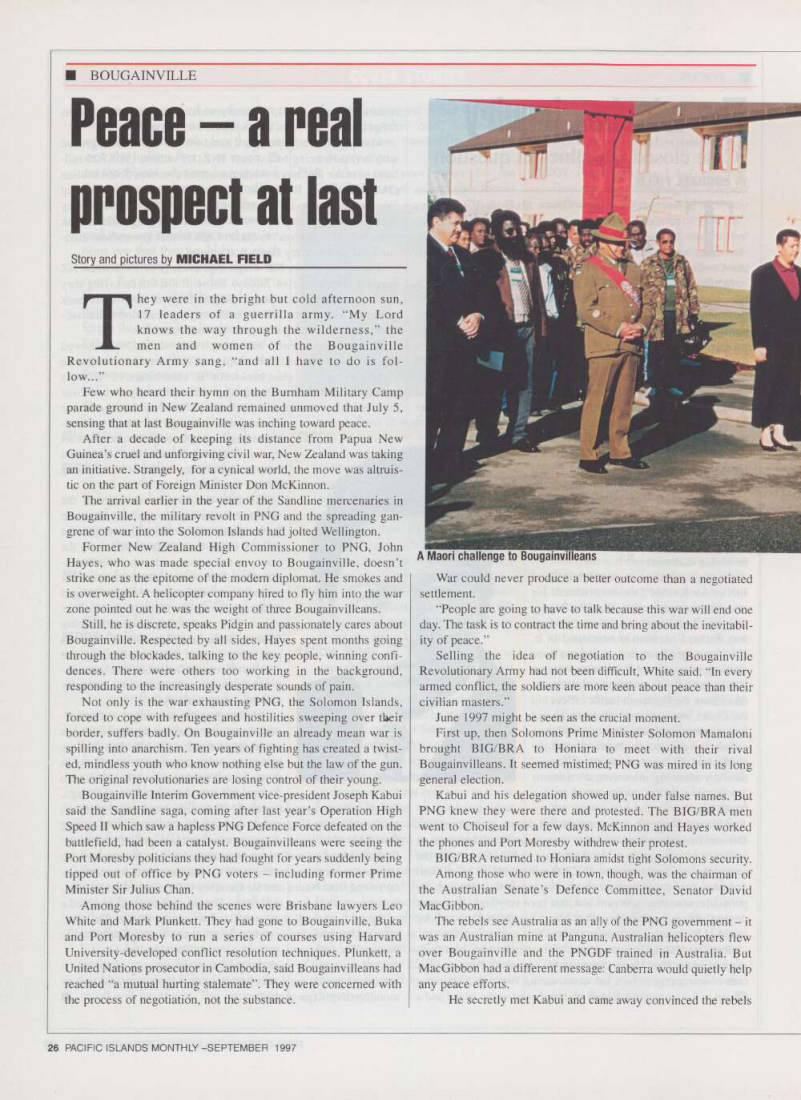
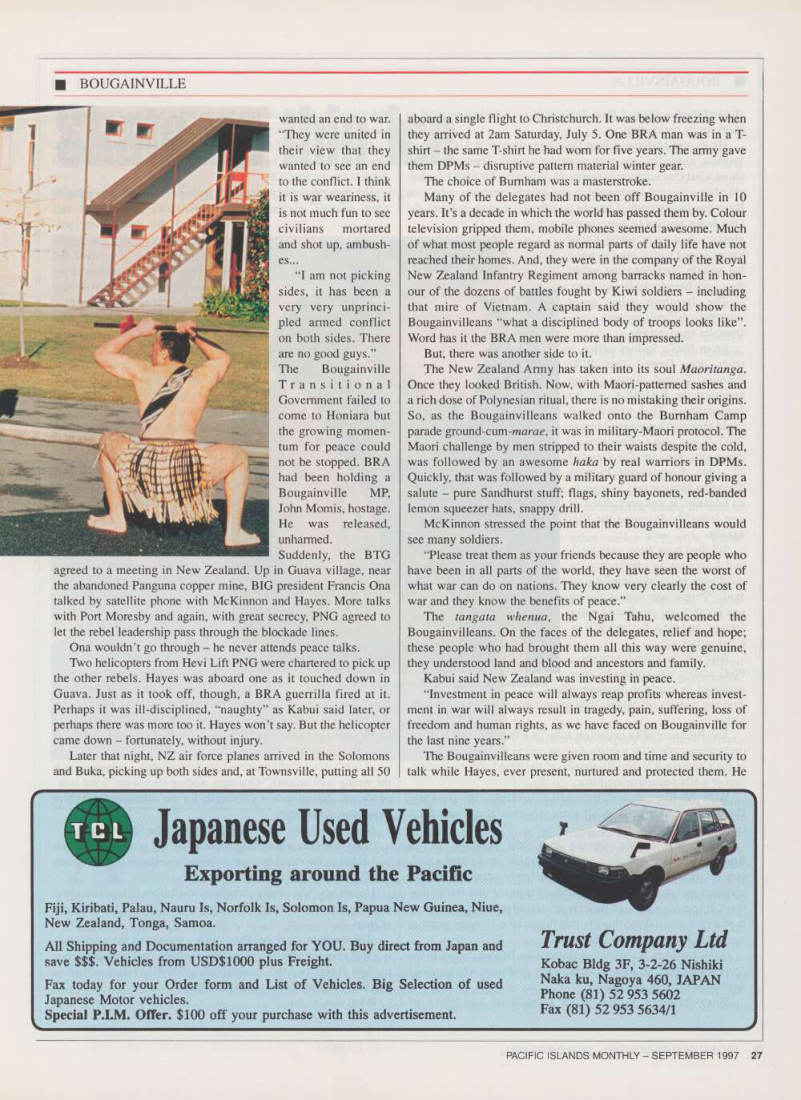
A Maori challenge to Bougainvilleans
wanted an end to war.
“They were united in their view that they wanted to see an end to the conflict. I think it is war weariness, it is not much fun to see civilians mortared and shot up, ambush es...
“I am not picking sides, it has been a very very unprinci pled armed conflict on both sides. There are no good guys.”
The Bougainville
Transitional Government failed to come to Honiara but the growing momen tum for peace could not be stopped. BRA had been holding a
Bougainville MP,
John Momis, hostage.
He was released, unharmed.
Suddenly, the BTG
agreed to a meeting in New Zealand. Up in Guava village, near the abandoned Panguna copper mine, BIG president Francis Ona talked by satellite phone with McKinnon and Hayes. More talks with Port Moresby and again, with great secrecy, PNG agreed to let the rebel leadership pass through the blockade lines.
Ona wouldn’t go through - he never attends peace talks.
Two helicopters from Hevi Lift PNG were chartered to pick up the other rebels. Hayes was aboard one as it touched down in Guava. Just as it took off, though, a BRA guerrilla fired at it.
Perhaps it was ill-disciplined, “naughty” as Kabui said later, or perhaps there was more too it. Hayes won’t say. But the helicopter came down - fortunately, without injury.
Later that night, NZ air force planes arrived in the Solomons and Buka, picking up both sides and, at Townsville, putting all 50
aboard a single flight to Christchurch. It was below freezing when they arrived at 2am Saturday, July 5. One BRA man was in a T shirt - the same T-shirt he had worn for five years. The army gave them DPMs - disruptive pattern material winter gear.
The choice of Burnham was a masterstroke.
Many of the delegates had not been off Bougainville in 10 years. It’s a decade in which the world has passed them by. Colour television gripped them, mobile phones seemed awesome. Much of what most people regard as normal parts of daily life have not reached their homes. And, they were in the company of the Royal New Zealand Infantry Regiment among barracks named in hon our of the dozens of battles fought by Kiwi soldiers - including that mire of Vietnam. A captain said they would show the Bougainvilleans “what a disciplined body of troops looks like”.
Word has it the BRA men were more than impressed.
But, there was another side to it.
The New Zealand Army has taken into its soul Maoritanga.
Once they looked British. Now, with Maori-patterned sashes and a rich dose of Polynesian ritual, there is no mistaking their origins.
So, as the Bougainvilleans walked onto the Burnham Camp parade ground-cum-marae, it was in military-Maori protocol. The Maori challenge by men stripped to their waists despite the cold, was followed by an awesome haka by real warriors in DPMs.
Quickly, that was followed by a military guard of honour giving a salute - pure Sandhurst stuff; flags, shiny bayonets, red-banded lemon squeezer hats, snappy drill.
McKinnon stressed the point that the Bougainvilleans would see many soldiers.
“Please treat them as your friends because they are people who have been in all parts of the world, they have seen the worst of what war can do on nations. They know very clearly the cost of war and they know the benefits of peace.”
The tangata whenua, the Ngai Tahu, welcomed the Bougainvilleans. On the faces of the delegates, relief and hope; these people who had brought them all this way were genuine, they understood land and blood and ancestors and family.
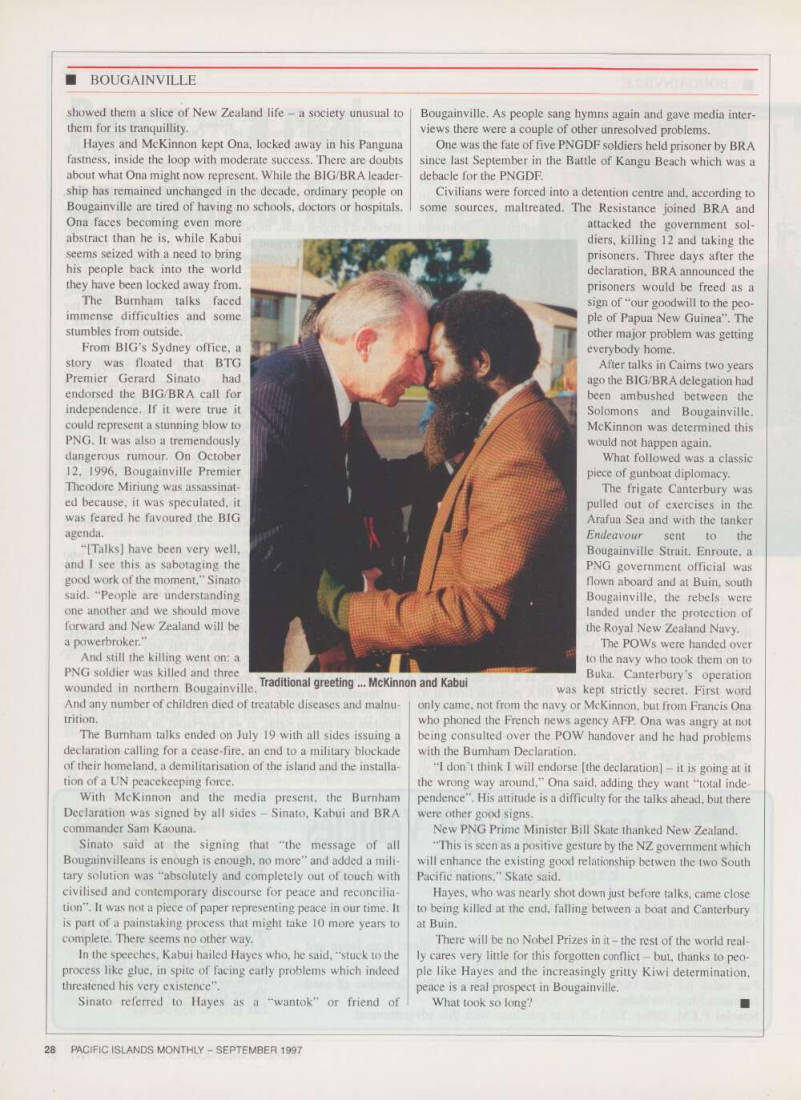
Kabui said New Zealand was investing in peace.
“Investment in peace will always reap profits whereas invest ment in war will always result in tragedy, pain, suffering, loss of freedom and human rights, as we have faced on Bougainville for the last nine years.”
The Bougainvilleans were given room and time and security to talk while Hayes, ever present, nurtured and protected them. He
showed them a slice of New Zealand life - a society unusual to them for its tranquillity.
Hayes and McKinnon kept Ona, locked away in his Panguna fastness, inside the loop with moderate success. There are doubts about what Ona might now represent. While the BIG/BRA leader ship has remained unchanged in the decade, ordinary people on Bougainville are tired of having no schools, doctors or hospitals.
Ona faces becoming even more abstract than he is, while Kabui seems seized with a need to bring his people back into the world they have been locked away from.
The Burnham talks faced ] immense difficulties and some P stumbles from outside.
From BlG’s Sydney office, a 1 story was floated that BTG \ Premier Gerard Sinato had I endorsed the BIG/BRA call for ■ independence. If it were true it r; could represent a stunning blow to I PNG. It was also a tremendously I dangerous rumour. On October 12, 1996, Bougainville Premier |j Theodore Miriung was assassinat- II ed because, it was speculated, it H was feared he favoured the BIG H
agenda. I|
“[Talks] have been very well, I and I see this as sabotaging the I good work of the moment,” Sinato I said. "People are understanding I one another and we should move I forward and New Zealand will be I a powerbroker.” I And still the killing went on; a M PNG soldier was killed and three " wounded in northern Bougainville.
And any number of children died of treatable diseases and malnu trition.
The Burnham talks ended on July 19 with all sides issuing a declaration calling for a cease-fire, an end to a military blockade of their homeland, a demilitarisation of the island and the installa tion of a UN peacekeeping force.
With McKinnon and the media present, the Burnham Declaration was signed by all sides - Sinato, Kabui and BRA commander Sam Kaouna.
Sinato said at the signing that "the message of all Bougainvilleans is enough is enough, no more" and added a mili tary solution was "absolutely and completely out of touch with civilised and contemporary discourse for peace and reconcilia tion”. It was not a piece of paper representing peace in our time. It is part of a painstaking process that might take 10 more years to complete. There seems no other way.
In the speeches, Kabui hailed Hayes who, he said, "stuck to the process like glue, in spite of facing early problems which indeed threatened his very existence".
Sinato referred to Hayes as a “wantok” or friend of
Bougainville. As people sang hymns again and gave media inter views there were a couple of other unresolved problems.
One was the fate of five PNGDF soldiers held prisoner by BRA since last September in the Battle of Kangu Beach which was a debacle for the PNGDF.
Civilians were forced into a detention centre and, according to some sources, maltreated. The Resistance joined BRA and
attacked the government sol diers, killing 12 and taking the prisoners. Three days after the declaration, BRA announced the prisoners would be freed as a sign of “our goodwill to the peo ple of Papua New Guinea”. The other major problem was getting everybody home.
After talks in Cairns two years ago the BIG/BRA delegation had been ambushed between the Solomons and Bougainville.
McKinnon was determined this would not happen again.
What followed was a classic piece of gunboat diplomacy.
The frigate Canterbury was pulled out of exercises in the Arafua Sea and with the tanker Endeavour sent to the Bougainville Strait. Enroute, a PNG government official was flown aboard and at Buin, south Bougainville, the rebels were landed under the protection of the Royal New Zealand Navy.
The POWs were handed over to the navy who took them on to Buka. Canterbury’s operation
i dim i\auui i , was kept strictly secret. First word only came, not from the navy or McKinnon, but from Francis Ona who phoned the French news agency AFP. Ona was angry at not being consulted over the POW handover and he had problems with the Burnham Declaration.
“I don't think I will endorse [the declaration] - it is going at it the wrong way around,” Ona said, adding they want “total inde pendence”. His attitude is a difficulty for the talks ahead, but there were other good signs.
New PNG Prime Minister Bill Skate thanked New Zealand.
"This is seen as a positive gesture by the NZ government which will enhance the existing good relationship betwen the two South Pacific nations,” Skate said.
Hayes, who was nearly shot down just before talks, came close to being killed at the end, falling between a boat and Canterbury at Buin.
There will be no Nobel Prizes in it - the rest of the world real ly cares very little for this forgotten conflict - but, thanks to peo ple like Hayes and the increasingly gritty Kiwi determination, peace is a real prospect in Bougainville.
What took so long? ■
Traditional greeting...McKinnon and Kabui