The winebox inquiry
p. 25 · Read in the full issue
Focus
The winebox inquiry Case closed but ethics in question
By Michael Field
These days, widow Grace McDonald struggles to make a living as the forgotten, saddest vic tim of the strange Cook Islands tax haven saga.
It is a weird story which nobody, least of all the Cooks, comes out of with any credit.
While some of the world’s biggest corporates and their CEOs have escaped charges that they have defrauded the governments of Australia, New Zealand and Japan, Grace makes a living selling coconuts in Rarotonga. She is the widow of Richard McDonald, the one-time Cooks auditor. The Cooks’ tax haven operation is surrounded by a bodyguard of secrecy laws but McDonald risked imprisonment by flying to NZ to give evidence to a NZ commis sion of inquiry investigating the tax haven. He told the inquiry the Cooks government had written false tax withholding certificates
which, in essence, allowed Japanese banks to claim SUSI. 2 billion in credit for taxes they did not actually pay in the Cooks.
Exiled from the Cooks, McDonald moved to Queensland where in March last year he died in yet to be explained circumstances.
Some say it was suicide, others say a third person was involved because McDonald had received death threats and others say he died of diabetes.
In August this year, retired NZ Chief Justice Sir Ronald Davison produced his two-volume report on the Winebox Inquiry into the Cook Islands tax haven. Nowhere was Richard McDonald mentioned in it.
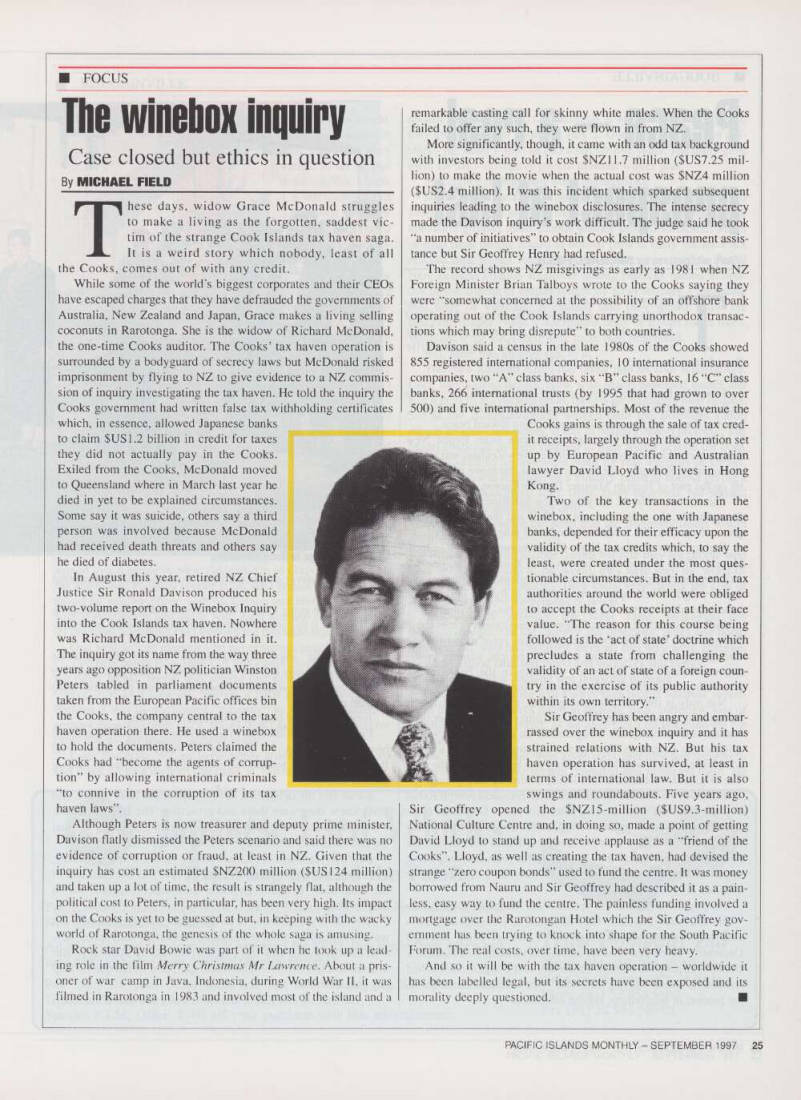
The inquiry got its name from the way three years ago opposition NZ politician Winston Peters tabled in parliament documents taken from the European Pacific offices bin the Cooks, the company central to the tax haven operation there. He used a winebox to hold the documents. Peters claimed the Cooks had "become the agents of corrup tion” by allowing international criminals “to connive in the corruption of its tax haven laws”.
Although Peters is now treasurer and deputy prime minister, Davison flatly dismissed the Peters scenario and said there was no evidence of corruption or fraud, at least in NZ. Given that the inquiry has cost an estimated SNZ2OO million (SUSI 24 million) and taken up a lot of time, the result is strangely flat, although the political cost to Peters, in particular, has been very high. Its impact on the Cooks is yet to be guessed at but, in keeping with the wacky world of Rarotonga, the genesis of the whole saga is amusing.
Rock star David Bowie was part of it when he took up a lead ing role in the film Merry Christmas Mr Lawrence. About a pris oner of war camp in Java, Indonesia, during World War 11, it was filmed in Rarotonga in 1983 and involved most of the island and a
remarkable casting call for skinny white males. When the Cooks failed to offer any such, they were flown in from NZ.
More significantly, though, it came with an odd tax background with investors being told it cost SNZII.7 million ($U57.25 mil lion) to make the movie when the actual cost was SNZ4 million (SUS 2.4 million). It was this incident which sparked subsequent inquiries leading to the winebox disclosures. The intense secrecy made the Davison inquiry’s work difficult. The judge said he took “a number of initiatives” to obtain Cook Islands government assis tance but Sir Geoffrey Henry had refused.
The record shows NZ misgivings as early as 1981 when NZ Foreign Minister Brian Talboys wrote to the Cooks saying they were “somewhat concerned at the possibility of an offshore bank operating out of the Cook Islands carrying unorthodox transac tions which may bring disrepute” to both countries.
Davison said a census in the late 1980 s of the Cooks showed 855 registered international companies, 10 international insurance companies, two “A” class banks, six “B” class banks, 16 “C” class banks, 266 international trusts (by 1995 that had grown to over 500) and five international partnerships. Most of the revenue the
Cooks gains is through the sale of tax cred it receipts, largely through the operation set up by European Pacific and Australian lawyer David Lloyd who lives in Hong Kong.
Two of the key transactions in the winebox, including the one with Japanese banks, depended for their efficacy upon the validity of the tax credits which, to say the least, were created under the most ques tionable circumstances. But in the end, tax authorities around the world were obliged to accept the Cooks receipts at their face value. "The reason for this course being followed is the 'act of state’ doctrine which precludes a state from challenging the validity of an act of state of a foreign coun try in the exercise of its public authority within its own territory.”
Sir Geoffrey has been angry and embar rassed over the winebox inquiry and it has strained relations with NZ. But his tax haven operation has survived, at least in terms of international law. But it is also swings and roundabouts. Five years ago,
Sir Geoffrey opened the SNZIS-million (SUS9.3-million) National Culture Centre and, in doing so, made a point of getting David Lloyd to stand up and receive applause as a "friend of the Cooks”. Lloyd, as well as creating the tax haven, had devised the strange "zero coupon bonds” used to fund the centre. It was money borrowed from Nauru and Sir Geoffrey had described it as a pain less, easy way to fund the centre. The painless funding involved a mortgage over the Rarotongan Hotel which the Sir Geoffrey gov ernment has been trying to knock into shape for the South Pacific Forum. The real costs, over time, have been very heavy.
And so it will be with the tax haven operation - worldwide it has been labelled legal, but its secrets have been exposed and its morality deeply questioned. ■